Originally published: December 2024 | Updated: September 2026 | Reviewed by Dr. Michael Berglass, DDS
West Palm Beach Family Dental — Dr. Michael Berglass, DDS, 1840 Forest Hill Blvd — provides fellowship-trained dental implant treatment at $2,400 all-inclusive, covering the implant post, abutment, and crown.
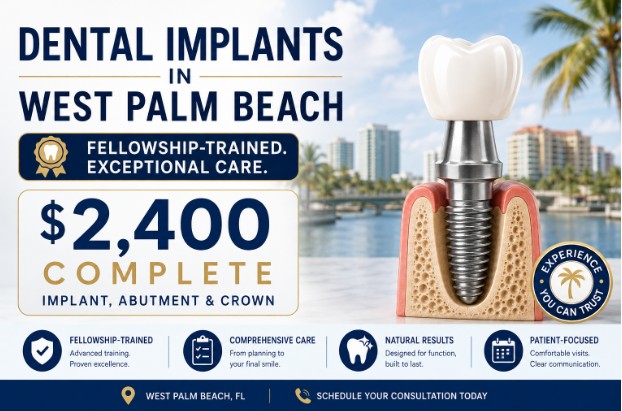
Placement and restoration happen under one roof, with no referral to an outside oral surgeon. Final candidacy is confirmed at a free consultation with X-rays included.
A quote naming one number rarely covers one tooth. Dr. Berglass itemizes every component at a free consultation with West Palm Beach Family Dental.
A dental implant is a titanium post surgically placed into the jawbone to serve as an artificial tooth root, topped with an abutment and a custom crown that restore full chewing function.
The post integrates with surrounding bone through osseointegration, the biological process that fuses titanium to living bone tissue over several months. Healing typically follows this pattern:
Once integration is confirmed, the abutment connects the post to a porcelain crown shade-matched to the adjacent teeth. Cleveland Clinic documents that implants placed under sound clinical conditions commonly last 25 years or longer.
The titanium post is the most durable component; the crown on top typically needs replacement after 10 to 15 years of normal wear, though it can last longer depending on material and bite habits.
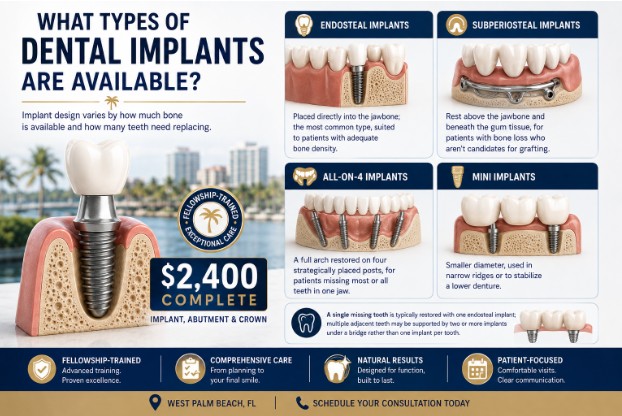
Implant design varies by how much bone is available and how many teeth need replacing.
A single missing tooth is typically restored with one endosteal implant; multiple adjacent teeth may be supported by two or more implants under a bridge rather than one implant per tooth.
Dr. Michael Berglass, DDS, and Dr. Ivan Cedeno, DMD, perform every stage of implant treatment in-house, from consultation through final crown delivery.
Berglass earned his Doctor of Dental Surgery from Stony Brook School of Dental Medicine in 1996, completed a general practice residency and a dental implant fellowship at North Shore–Long Island Jewish Hospital, and received his Fellowship in Dental Implantology in 1998.
Case volume matters alongside credentials: published volume-outcome research records 98% success among high-volume implant practices in the patient population that the study evaluated, compared with 90% among low-volume providers.
Treatment planning uses cone-beam CT imaging and computer-guided placement to map the implant’s angle and position before surgery, rather than adjusting it afterward.
This planning approach, combined with a minimally invasive surgical technique, is intended to reduce trauma at the placement site and support a more comfortable initial recovery.
Cedeno trained at the University of Puerto Rico and holds a DMD, with earlier clinical experience in Cuba before relicensing to practice in the United States.
Patients are treated by the same clinician at every stage, eliminating the coordination gap common in practices that split surgery and restoration between separate providers.
A complete single-tooth implant costs $2,400 at West Palm Beach Family Dental. Other practices across Palm Beach County commonly charge $3,000 to $5,000 for the same procedure when they bill components separately.
| Included in $2,400 | May Require Additional Treatment |
| Implant post, abutment, and crown | Bone grafting, when imaging shows insufficient volume |
| Surgical placement | Extraction, when a failing tooth remains at the site |
| Free consultation and X-rays | Gum disease treatment, when inflammation is active |
A full breakdown by component and by case type appears under implant costs, including what a low quote typically leaves out.
Financing at $79 per month with no credit check is available, subject to approval, and insurance and financing options cover the remaining balance for patients without full coverage.
Most adults missing one or more teeth qualify, provided bone volume is adequate, gum tissue is free of active infection, and any chronic medical condition is well managed.
Cone-beam CT imaging at the free consultation confirms bone volume and candidacy on an individual basis before any treatment is scheduled.
Bone at an untreated extraction site can recede over time, and in some cases this leads to the need for grafting before an implant can be placed. Dr. Berglass evaluates each case individually at West Palm Beach Family Dental.
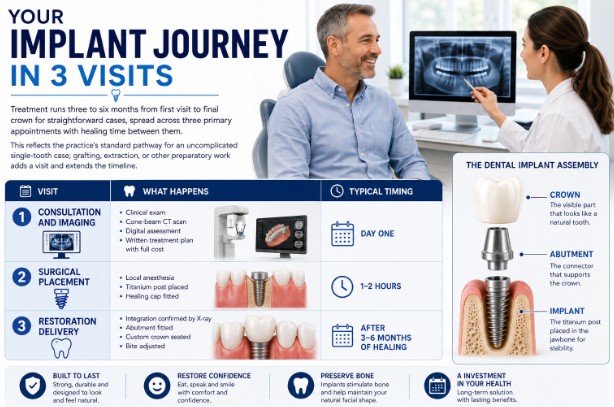
Treatment runs three to six months from first visit to final crown for straightforward cases, spread across three primary appointments with healing time between them.
This reflects the practice’s standard pathway for an uncomplicated single-tooth case; grafting, extraction, or other preparatory work adds a visit and extends the timeline.
| Visit | What Happens | Typical Timing |
| 1. Consultation and imaging | Clinical exam, cone-beam CT scan, written treatment plan with full cost | Day one |
| 2. Surgical placement | Local anesthesia, titanium post placed, healing cap fitted | 1–2 hours |
| 3. Restoration delivery | Abutment fitted, custom crown seated, bite adjusted | After 3–6 months of healing |
Cases requiring bone grafting or extraction beforehand add a preparatory visit and extend the total timeline to six to twelve months.
Swelling and mild soreness are common through the first week after placement, and many patients return to their usual routine within a couple of days.
The single-tooth implant page covers the full recovery timeline, including what to expect week by week.
West Palm Beach Family Dental treats patients from West Palm Beach and the surrounding Palm Beach County communities.
Additional location pages for neighboring communities are planned and will be linked here once published.
How much does a dental implant cost in West Palm Beach?
A complete single-tooth implant costs $2,400 at West Palm Beach Family Dental, covering post, abutment, and crown in one flat fee. Other Palm Beach County practices commonly charge $3,000 to $5,000 for the same procedure when they bill components separately across several invoices.
Who places the implants at West Palm Beach Family Dental?
Dr. Michael Berglass and Dr. Ivan Cedeno perform every implant in-house, from consultation through final crown. Berglass holds a Fellowship in Dental Implantology earned in 1998 and has more than 25 years of clinical experience placing and restoring implants personally.
Am I too old for a dental implant?
Age alone rarely disqualifies a candidate for implant treatment. Many patients in their eighties and nineties receive implants successfully when overall health permits minor oral surgery. Bone volume, gum health, and controlled medical conditions matter more than chronological age.
How long does the implant process take?
Straightforward cases run three to six months from consultation to final crown, allowing time for osseointegration. Cases requiring bone grafting or prior extraction take six to twelve months. A written timeline follows the initial cone-beam CT imaging review.
Does insurance cover dental implants?
Coverage varies significantly by plan and by component. Many Florida dental plans limit or exclude coverage for the implant post, while crowns, extractions, and imaging more often receive partial coverage. A full insurance and financing breakdown covers typical scenarios in detail.
How do implants compare to bridges and dentures?
The implant post can last 25 years or more, well beyond the replacement cycles bridges and dentures typically require, though the crown on top generally needs replacement after 10 to 15 years of wear. A full side-by-side comparison of durability, cost, and daily care covers each option in detail.
A complete single-tooth dental implant costs $2,400 at West Palm Beach Family Dental.
Dr. Michael Berglass and Dr. Ivan Cedeno perform every implant in-house, from consultation through final crown, across three primary visits.
Candidacy turns on bone volume, gum health, and well-managed medical conditions rather than age.
Bone at an untreated extraction site can recede over time, and in some cases this leads to the need for grafting. Dr. Berglass evaluates each case individually at a free implant consultation, X-rays included.
About Dr. Berglass

Dr. Michael Berglass, a dedicated dentist with over 25 years of experience, specializes in dental implants, cosmetic, and general dentistry in West Palm Beach, Florida. A proud alumnus of Stony Brook School of Dental Medicine (DDS, 1996), Dr. Berglass further honed his expertise with residencies in general practice and dental implants at North Shore-Long Island Jewish Hospital. His journey in dentistry has taken him from New York to North Carolina, and now to Florida, where he continues to offer top-notch dental care. Known for his wit and intellect, Dr. Berglass makes every patient's visit comfortable. Formerly a member of the American Dental Association and the Florida Dental Association, Dr. Berglass remains committed to staying informed about advancements in dentistry and providing exceptional care to his patients. He looks forward to welcoming you to his practice.
About Dr. Cedeno

Dr. Ivan Cedeno is originally from Cuba where he did his dental studies. Having graduated with a DDS diploma gave Ivan and his family great satisfaction, considering he comes from a family of dedicated dental care professionals. After years of practicing Dentistry in Cuba for a few years, Ivan decided to continue his growth journey as a professional in the United States. Early on, Ivan worked as a laboratory technician, which gave him some unique insights that dental school does not teach. Having graduated from the University of Puerto Rico as a DMD, Ivan is allowed to practice in the USA.


