Dental Implant Cost in West Palm Beach: Complete Pricing Guide
Originally published: September 2025 | Updated: September 2026 | Reviewed by Dr. Michael Berglass, DDS
A complete single-tooth dental implant at West Palm Beach Family Dental costs $2,400. That price covers the implant post, abutment, and crown in one flat fee, with no separate add-on charges for restoration components.
Final candidacy and treatment cost are confirmed at the free consultation, which includes a clinical exam and necessary X-rays.
Dental implants offer a permanent solution for missing teeth, and knowing the cost upfront makes planning easier. Across Palm Beach County, most practices charge $3,000 to $5,000 for the same complete single-tooth procedure, and quotes in the wider South Florida metro often run $4,000 to $6,000.
The dental implant procedure has several stages, so a quoted price only means something when it states which stages it includes. This guide sets out what West Palm Beach Family Dental charges, what the surrounding market charges, and which factors change a final treatment plan.
A complete implant at West Palm Beach Family Dental is a single flat price; market ranges elsewhere reflect components billed separately.
A complete single-tooth implant costs $2,400 at West Palm Beach Family Dental and $3,000 to $5,000 at most other practices in Palm Beach County.

The gap between those figures isn’t a difference in component quality. It reflects how each practice structures its billing. West Palm Beach Family Dental quotes one number for the finished tooth.
Many practices quote the implant post first and bill the abutment, crown, imaging, and placement fee separately, so the final total arrives in stages.
The flat fee includes every component required to complete a straightforward single-tooth restoration.
Patients comparing written quotes from several providers can use the guide to compare dental implant quotes to check that each estimate covers the same line items.
Practices that bill by component typically price each element within the ranges below. These are market figures for the West Palm Beach area, not West Palm Beach Family Dental’s prices.
Added together, those components explain why a complete restoration reaches $3,000 to $5,000 at a practice that itemizes them separately.
Cost per tooth falls as the number of implants rises, because several teeth can be supported by fewer posts.
Patients weighing a full-arch plan against replacing individual teeth can review single tooth replacement alongside the full-arch options.
Ready to get started? Call the practice now.
The table below compares the complete single-tooth implant price at West Palm Beach Family Dental against prevailing rates in Palm Beach County and the wider South Florida metro.
| Provider | Complete Single-Tooth Implant | What the Price Includes |
|---|---|---|
| West Palm Beach Family Dental | $2,400 | Implant post, abutment, and crown in one flat fee; free consultation with X-rays included |
| Palm Beach County average | $3,000–$5,000 | Components frequently billed separately; imaging and placement fees may be additional |
| South Florida metro (Boca Raton, Fort Lauderdale, Miami) | $4,000–$6,000 | Higher overhead markets; itemized billing is common |
Final candidacy and treatment cost are confirmed at the free consultation, which includes a clinical exam and necessary X-rays.
Case complexity, bone volume, and material selection drive cost differences far more than practice address does.
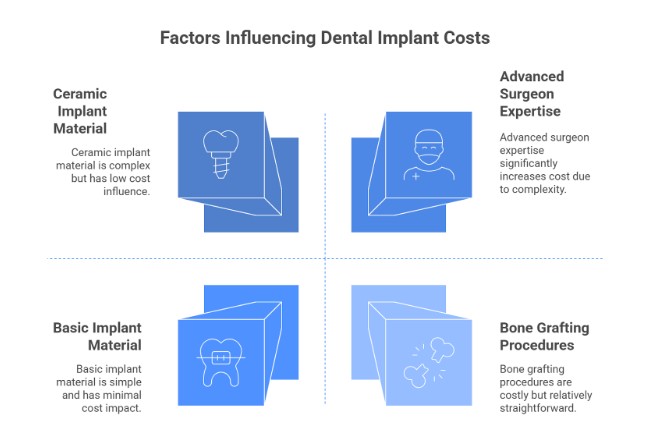
Several variables influence the cost of implant treatment, including materials, the surgeon’s experience, and whether preparatory work is required before placement.
Most implant posts are titanium, which fuses reliably with bone. Implant systems carrying peer-reviewed outcome data show documented failure rates under 2 percent, while unbranded generic components report failure rates of 5 to 10 percent.
Patients can ask which system a provider uses and why during a consultation. The dental implant specialist page sets out the credentials worth verifying before treatment begins.
Insufficient bone volume at the implant site requires preparatory grafting, which adds both cost and time to the treatment plan.
Bone loss begins at an extraction site within weeks, so patients who lost a tooth months or years earlier are more likely to need grafting. Cone-beam CT imaging at the consultation identifies this before any commitment is made.
Providers who both place and restore implants avoid the coordination gap created when surgery and restoration are split between two offices.
At West Palm Beach Family Dental, Dr. Berglass performs consultation, imaging, surgical placement, restoration, and follow-up in-house, with no referrals at any stage.
Crown material affects both appearance and longevity, and we choose it during treatment planning.
Most Florida dental plans cover parts of implant treatment — typically extractions, imaging, and sometimes the crown — but rarely the implant post itself.
Most dental insurance plans classify implant crowns as major restorative work and pay roughly half the cost after deductibles. Coverage varies widely between insurers, so a written pre-treatment estimate is the only reliable way to know what a specific plan will pay.
Coverage percentages differ by plan, but the pattern below is common across Florida insurers.
A pre-treatment estimate in writing prevents surprise denials after treatment has started.
Verification usually takes one to three business days, so patients know their out-of-pocket cost before scheduling.
West Palm Beach Family Dental offers financing at $79 per month with no credit check, subject to approval.
Because most insurance plans cover only part of implant treatment, financing options fill the gap for many patients. In-house plans, third-party lenders, and pre-tax health accounts can each reduce the amount due at the time of treatment.
West Palm Beach Family Dental offers in-house financing from $79 per month with no credit check, subject to approval.
CareCredit and similar healthcare lenders offer promotional terms for dental treatment, subject to approval.
Flexible spending accounts and health savings accounts both cover dental implant treatment with pre-tax dollars, which lowers the effective cost depending on the account holder’s tax bracket.
Patients weighing total cost against monthly outlay can review the affordable implant options for Palm Beach County for a breakdown of savings-plan pricing.
Ready to get started? Call the practice now.
Implants cost more upfront than bridges or dentures but require no replacement cycle, which reverses the comparison over a ten-year horizon.
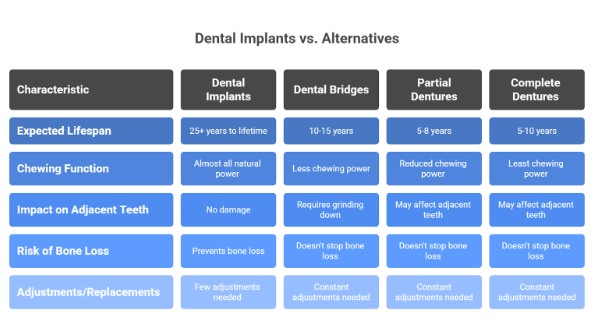
A traditional bridge requires grinding down the healthy teeth on either side of the gap so they can serve as anchors.
Implants leave adjacent teeth untouched. Patients considering a fixed multi-tooth option can compare an implant-supported bridge against individual implants.
Removable dentures rely on adhesives, require periodic relines, and do not prevent the bone loss that follows tooth loss.
Replacement cycles, not initial price, determine which option costs less across a decade.
| Option | Initial Cost | Average Lifespan | Ten-Year Outlook |
|---|---|---|---|
| Single dental implant (West Palm Beach Family Dental) | $2,400 | 20+ years | Routine hygiene only; no replacement cycle within ten years |
| Traditional bridge | $2,500–$4,500 | 7–10 years | One replacement likely within the decade; healthy teeth reduced |
| Removable partial denture | $1,000–$2,500 | 5–7 years | Adjustments plus at least one replacement; may accelerate bone loss |
| Full dentures (per arch) | $2,000–$3,500 | 5–8 years | Relines, adhesives, and at least one replacement |
| All-on-4 implants (full arch) | $20,000–$25,000 | 20+ years | Occasional prosthetic adjustment; no replacement cycle |
Implants deliver the lowest lifetime cost per tooth of any replacement option because they are not on a replacement cycle.
With appropriate care, dental implants can last 25 years or longer, and many are never replaced. The titanium post bonds with the jawbone through osseointegration, creating a foundation that withstands normal chewing forces.
A fixed implant restores close to natural chewing power and is cleaned the same way as a natural tooth.
The single-crown design permits normal cleaning between teeth, which lowers the risk of gum disease around the restoration. Long-term care guidance is set out under caring for dental implants.
An implant transmits chewing force into the jaw the way a natural tooth root does, which slows the bone loss that follows tooth loss.
Bridges and dentures do not stimulate the bone, which is why facial profile changes are common after years of denture wear. Older patients weighing their options often prioritize this difference.
Flat all-inclusive pricing, in-house treatment from consultation to crown, and a fellowship-trained implant dentist distinguish the practice in the local market.
The complete single-tooth implant price is $2,400, quoted as one figure before treatment begins.
Dr. Michael Berglass earned his Fellowship in Dental Implantology in 1998 and has more than 25 years of clinical experience. The same dentist places and restores every implant, so patients are not passed between a surgeon and a separate restorative provider.
Diagnostic imaging and guided placement reduce surgical time and improve accuracy.
A complete single-tooth implant costs $2,400 at West Palm Beach Family Dental, compared to $3,000 to $5,000 at most Palm Beach County practices.
The difference between quotes usually comes down to what each one includes rather than the quality of the components.
A written, itemized estimate makes that comparison possible. Patients weighing implant treatment in West Palm Beach against bridges or dentures should factor in replacement cycles, not just the figure due on the day of treatment.
A free consultation at West Palm Beach Family Dental includes a clinical exam, necessary X-rays, and a written treatment plan setting out the full cost before anything is scheduled.
You can schedule an appointment by calling (561) 968-6022 or through the contact page. Patients holding a quote from another provider are welcome to bring it in for a free second opinion.
How much does a dental implant cost in West Palm Beach?
A complete single-tooth dental implant at West Palm Beach Family Dental costs $2,400, covering the implant post, abutment, and crown in one flat fee. Most other practices in Palm Beach County charge $3,000 to $5,000 for the same complete procedure. We confirm final candidacy and treatment cost at the free consultation, which includes a clinical exam and necessary X-rays.
Why do dental implant prices vary so much between practices?
The largest source of variation is what each quote includes. Some practices advertise the implant post alone, sometimes as low as $999, then bill the abutment, crown, imaging, and placement fee separately, bringing the total to $4,000 or more. Case complexity, bone volume, implant system, and whether preparatory grafting is required also affect the final plan.
Does the $2,400 price include the crown?
Yes. The $2,400 price covers the titanium implant post, the custom abutment, and the porcelain crown. Surgical placement and the free consultation with necessary X-rays are also included. Preparatory procedures such as bone grafting, if imaging shows they are required, are quoted separately in the written treatment plan before treatment begins.
Does insurance cover dental implants in Florida?
Most Florida dental plans do not fully cover implants. Many cover related steps such as extractions, imaging, and sometimes the crown, with the implant post itself covered at between zero and fifty percent. A written pre-treatment estimate from the carrier is the only reliable way to confirm what a specific plan will pay.
What financing is available for dental implants in West Palm Beach?
West Palm Beach Family Dental offers in-house financing from $79 per month with no credit check, subject to approval. Third-party lenders, including CareCredit, offer promotional terms of 6 to 24 months at 0 percent interest for qualifying applicants, subject to approval. Flexible spending and health savings accounts can also be used.
How do dental implants compare to dentures and bridges in cost?
Implants cost more at the outset but don’t follow a replacement cycle. Bridges typically need replacing every 10 to 15 years and partial dentures every 5 to 7, so over a decade the cumulative cost of the alternatives often exceeds the cost of a single implant.
Is a free second opinion available before committing to treatment?
West Palm Beach Family Dental offers free consultations and free second opinions, both including necessary X-rays and a written treatment plan. Patients holding a quote from another West Palm Beach provider can bring it in, and Dr. Berglass reviews it line by line at no charge.
How long does implant treatment take from consultation to final crown?
Straightforward cases typically run 3 to 6 months from surgical placement to final crown, allowing time for the post to fuse with the jawbone. Cases requiring bone grafting or extraction beforehand can run 6 to 12 months in total.

About Dr. Berglass
Dr. Michael Berglass, a dedicated dentist with over 25 years of experience, specializes in dental implants, cosmetic, and general dentistry in West Palm Beach, Florida. A proud alumnus of Stony Brook School of Dental Medicine (DDS, 1996), Dr. Berglass further honed his expertise with residencies in general practice and dental implants at North Shore-Long Island Jewish Hospital. His journey in dentistry has taken him from New York to North Carolina, and now to Florida, where he continues to offer top-notch dental care. Known for his wit and intellect, Dr. Berglass makes every patient's visit comfortable. Formerly a member of the American Dental Association and the Florida Dental Association, Dr. Berglass remains committed to staying informed about advancements in dentistry and providing exceptional care to his patients. He looks forward to welcoming you to his practice.
About Dr. Cedeno

Dr. Ivan Cedeno is originally from Cuba where he did his dental studies. Having graduated with a DDS diploma gave Ivan and his family great satisfaction, considering he comes from a family of dedicated dental care professionals. After years of practicing Dentistry in Cuba for a few years, Ivan decided to continue his growth journey as a professional in the United States. Early on, Ivan worked as a laboratory technician, which gave him some unique insights that dental school does not teach. Having graduated from the University of Puerto Rico as a DMD, Ivan is allowed to practice in the USA.


