The Ultimate Guide to Dental Implants in West Palm Beach | Costs, Care & Candidacy Explained
Originally published: August 2025 | Updated: January 2026 | Reviewed by Dr. Michael Berglass, DDS
Missing teeth can significantly impact your ability to eat, speak, and smile with confidence.
Dental implants in West Palm Beach offer a permanent, natural-looking solution that replaces both the tooth root and crown, providing superior stability compared to dentures or bridges.
Dental implants are titanium posts surgically placed into the jawbone to replace missing tooth roots, topped with crowns that look and function like natural teeth.
In West Palm Beach, dental implants have a 95-98% success rate and typically cost $3,000 to $5,000 per tooth, with a lifespan of 25 years or more with proper care.
Dr. Michael Berglass, with over 25 years of experience in implant dentistry and specialized fellowship training, has successfully placed thousands of dental implants for families in West Palm Beach.
Unlike corporate dental chains, our practice provides personalized, honest care with transparent pricing and comprehensive treatment planning.
This complete guide covers everything you need to know about dental implants, from candidacy and costs to the procedure and recovery.

Let’s start with the basics. If you’re new to dental implants or just want a clearer picture of how they work, here’s a simple breakdown.
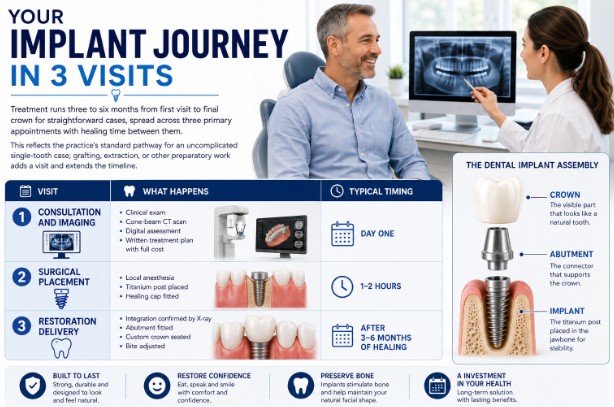
A dental implant consists of three main parts: a titanium post surgically inserted into your jawbone, an abutment that connects the post to the final restoration, and a custom-made crown that replaces your visible tooth.
The implant fuses with the jawbone through a process called osseointegration, providing a stable, long-lasting foundation that looks, feels, and functions like a natural tooth.
Now that you understand what dental implants are, let’s look at the individual parts that make them work so seamlessly.
Dental implants consist of three main parts that work together as a complete tooth replacement system.
The implant post serves as the artificial tooth root. Made from medical-grade titanium, this screw-shaped component gets placed directly into the jawbone during surgery.
The abutment connects the implant post to the visible crown. This small connector piece attaches to the top of the implant after healing is complete.
The custom-made crown replaces the visible tooth portion. Made from porcelain or ceramic, it matches the patient’s natural teeth in color, shape, and size.
| Component | Material | Function |
| Implant Post | Titanium | Artificial root |
| Abutment | Titanium/Ceramic | Connector piece |
| Crown | Porcelain/Ceramic | Visible tooth |
Each piece plays a critical role in creating a stable, functional tooth replacement that looks and feels natural.
Osseointegration is the biological process where bone tissue grows around and bonds with the titanium implant post. This fusion creates the strong foundation needed for successful tooth replacement.
After implant placement, bone cells begin growing onto the titanium surface within days. The healing process typically takes 3-6 months for complete integration.
The osseointegration timeline:
Titanium’s biocompatible properties enable osseointegration. The body accepts titanium as natural tissue rather than rejecting it as a foreign material.
Successful osseointegration depends on adequate bone density, good oral hygiene, and following post-surgical care instructions. Smoking and certain medical conditions can interfere with this healing process.
While the osseointegration process is consistent, not all implants are the same. Depending on your needs, several types of implants are available.
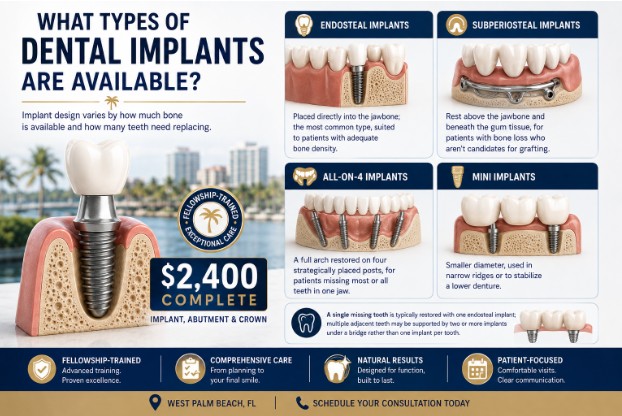
Endosteal Implants (Most Common)
These are placed directly into the jawbone and are ideal for patients with good bone density.
Subperiosteal Implants
Placed under the gum but above the jawbone—used for patients with bone loss who can’t undergo bone grafting.
All-on-4 / All-on-6 Implants
Full-arch restorations using only four or six implants per arch. Ideal for individuals missing most or all of their teeth and seeking a fixed, non-removable solution.
Mini Dental Implants
Smaller in diameter, these are used in tight spaces or for stabilizing lower dentures in patients with narrow bone ridges.
Missing teeth don’t have to define your smile. Schedule a free implant consultation with Dr. Michael Berglass in West Palm Beach and discover your personalized treatment plan today.
If you’re ready to get started, call us now!

Dental implants provide superior stability, aesthetics, and function compared to dentures and bridges. They offer better long-term health outcomes and cost savings over time.
Dental implants offer significant advantages over dentures and bridges, including superior durability (25+ years vs 5-15 years), bone preservation, and natural function without affecting adjacent teeth.”
| Feature | Dental Implants | Dentures | Bridges |
|---|---|---|---|
| Lifespan | 25+ years | 5-7 years | 10-15 years |
| Bone Preservation | ✓ Prevents bone loss | ✗ Bone continues to shrink | ✗ No bone stimulation |
| Adjacent Teeth | ✓ No impact | ✓ No impact | ✗ Requires grinding healthy teeth |
| Eating Ability | ✓ 100% chewing power | ✗ 25% chewing power | ✓ 80% chewing power |
| Maintenance | ✓ Brush and floss normally | ✗ Special cleaning required | ✓ Normal care + floss threader |
| Comfort | ✓ Feels like natural teeth | ✗ May slip or cause sores | ✓ Generally comfortable |
| Speech | ✓ Natural speech | ✗ May affect pronunciation | ✓ Minimal impact |
| Initial Cost | Higher | Lower | Moderate |
| Long-term Cost | Most economical | Ongoing replacements | Moderate |
Now let’s break that table down even further, because the benefits of dental implants go far beyond just numbers.
Implants restore nearly 100% of the full chewing power of a natural tooth. Dentures typically provide only 25-30% of normal bite force.
Patients can eat tough foods like steaks, corn on the cob, and apples without difficulty. Speech remains clear and natural since implants don’t shift during talking.
Functional Improvements:
Traditional dentures can slip while eating or speaking. This creates embarrassing situations and significantly limits food choices.
Beyond offering better chewing and comfort, dental implants provide significant health benefits that can protect your smile for the long term.
Dental implants are made of high-quality, biocompatible materials that can last for decades. The titanium post stimulates jawbone growth and prevents deterioration.
When teeth are missing, the jawbone begins shrinking within months. This process changes facial structure and creates a sunken appearance.
Implants maintain bone density by providing the stimulation that natural tooth roots once gave. This preserves facial height and prevents premature aging.
Health Advantages:
Partial dentures can trap food particles and bacteria, potentially leading to dental issues. This increases the risk of decay in remaining natural teeth and gum infections.
Thinking long-term? Let’s talk dollars and sense—because implants aren’t just better functionally, they’re often more cost-effective over time.
Dental implants provide excellent durability, a natural look, and a comfortable feel. Patients regain confidence in social and professional situations.
The natural look and feel allow people to smile freely without self-consciousness. There are no dietary restrictions or special cleaning routines to follow.
Lifestyle Improvements:
Social activities become more enjoyable when patients don’t worry about denture problems. They can participate fully in conversations and meals without anxiety.
Professional situations also improve significantly. Clear speech and confident smiling enhance career prospects and personal relationships.
If you’re ready to get started, call us now!
However, the lifetime cost often proves to be lower than that of alternatives.
Dentures typically require replacement every 5-7 years due to wear and changes in the jaw. Bridges usually last 10-15 years before needing replacement.
Cost Comparison Over 20 Years:

| Treatment | Initial Cost | Replacement Costs | Total Cost |
| Implants | $3,000-5,000 | Minimal maintenance | $3,500-6,000 |
| Dentures | $1,500-3,000 | 2-3 replacements | $4,500-9,000 |
| Bridges | $2,000-4,000 | 1-2 replacements | $4,000-8,000 |
Implants rarely need replacement when properly maintained. This makes them the most economical choice for younger patients, especially.
Additional savings come from avoiding complications. Bridge failures can damage supporting teeth and require expensive treatments to restore your smile.
Q: Are dental implants better than dentures?
A: Yes, dental implants provide superior function, comfort, and durability compared to dentures, with 100% chewing power vs 25% for dentures.
Q: Do dental implants look natural?
A: Dental implants look completely natural because they’re custom-made to match your existing teeth in color, shape, and size.

Most adults with missing teeth are candidates for dental implants, but success depends on factors such as bone density, overall health, and oral hygiene habits.
Specific criteria determine dental implant candidacy, including jawbone structure, gum health, and lifestyle factors.
Most adults with missing teeth are candidates for dental implants if they have sufficient bone density, healthy gums, and overall good health. Age is rarely a limiting factor – we’ve successfully placed implants in patients from 18 to 90+ years old.
Not sure if you qualify for implants? Most adults do—and this quick checklist can help you find out.
| Requirement | Details |
| Adequate Bone Density | Sufficient jawbone to securely anchor the implant; may need grafting if lost |
| Healthy Gums | No active gum disease; inflammation must be treated before surgery |
| Good Overall Health | Medically fit for minor surgery; chronic conditions must be well-managed |
| Non-Smoker or Willing to Quit | Smoking impairs healing; quitting reduces the risk of implant failure |
| Oral Hygiene Commitment | Must be able to maintain excellent at-home and professional dental care |
| Realistic Expectations | Understands timeframes, procedures, and success rates |
| Age Consideration | Typically 18+ with a fully developed jawbone |
Good oral health forms the foundation for implant success. Healthy gums without active periodontal disease allow proper healing around implants.
Adequate bone density and volume support the implant structure. The jawbone must be thick enough and tall enough to hold the titanium post securely.
Excellent oral hygiene habits prevent infection during healing. Patients must brush their teeth twice daily and floss regularly to maintain the long-term health of their implants.
Non-smokers heal faster and experience fewer complications. Smoking restricts blood flow and increases infection risk around healing implants.
Commitment to regular dental visits ensures early detection of potential problems. Professional cleanings every 3-6 months help maintain the health of your implants.
Financial stability or insurance coverage helps patients complete the full treatment plan without interruption.
Diabetes affects healing, but doesn’t eliminate candidacy. Well-controlled blood sugar levels allow successful implant integration in most diabetic patients.
Heart disease requires medical clearance before surgery. Patients taking blood thinners need coordinated care between their dentist and physician.
Cancer treatments can delay implant placement. Radiation therapy to the head and neck area requires special timing considerations for optimal results.
Autoimmune disorders may slow healing processes. Conditions such as rheumatoid arthritis or lupus require careful evaluation before proceeding.
Osteoporosis medications called bisphosphonates can interfere with jaw healing. Patients taking these drugs require modified treatment protocols.
Age alone doesn’t disqualify candidates. Many patients in their 70s and 80s successfully receive implants with proper medical management.
Bone grafting expands treatment options for patients with insufficient jawbone. Common grafting materials include the patient’s bone, donor bone, or synthetic materials.
CT scans reveal the exact dimensions and quality of the bones. This 3D imaging helps determine if additional procedures are needed before implant placement.
Bone graft procedures typically require 3-6 months of healing before implant surgery. Some minor grafting can be done simultaneously with implant placement.
Sinus lifts address bone loss in the upper jaw. This procedure adds bone material above the back teeth where sinuses have expanded.
Ridge preservation after tooth extraction maintains bone volume. Grafting material placed immediately after extraction prevents bone shrinkage.
Dense, healthy bone provides the strongest implant foundation. Softer bone types may require longer healing periods or modified implant designs.
Young adults must have completed jaw development before implant placement. Placing implants too early can result in misaligned teeth as growth continues.
Elderly patients face no upper age limit for implants. Overall health matters more than chronological age in determining candidacy.
Pregnancy requires postponing elective implant surgery. Hormonal changes and medication restrictions make timing important for safety.
Growing children with missing teeth need temporary solutions until implant placement becomes appropriate. Removable partial dentures or space maintainers preserve alignment.
Active lifestyles benefit greatly from implant stability. Athletes and active individuals appreciate the secure fit compared to removable options.
Medication management becomes crucial for older patients taking multiple prescriptions that might affect healing.
Smoking significantly reduces implant success rates. Nicotine restricts blood flow to healing tissues and substantially increases the risk of infection.
Heavy alcohol consumption impairs immune function and healing. Moderate drinking doesn’t typically affect implant outcomes negatively.
Teeth grinding (bruxism) can damage implants over time. Night guards protect both implants and natural teeth from excessive forces.
Professional athletes may need modified treatment timing. Contact sports require a period of healing before returning to full activity.
Stress management supports better healing outcomes. High stress levels can slow recovery and increase the risk of complications.
Regular exercise promotes good circulation and faster healing. Physical activity benefits overall health and implant success rates.
Gum disease must be treated before implant placement. Active infections prevent proper healing and integration of the titanium post.
Adjacent tooth positions affect implant placement angles. Crowded or tilted neighboring teeth may require orthodontic correction first.
Bite alignment influences long-term implant success. Proper force distribution prevents overloading and potential implant failure.
Jaw muscle tension associated with TMJ disorders requires evaluation. Excessive jaw clenching can stress implants beyond their designed limits.
Previous dental work, like root canals or crowns, doesn’t prevent implant placement. Failed treatments often create ideal situations for implant replacement.
Local anatomy variations require customized treatment approaches. West Palm Beach dental specialists evaluate each patient’s unique jaw structure and oral health status.
Think you might not qualify for implants? Dr. Berglass offers advanced treatment solutions, even for the most complex cases. Find out if you’re a candidate with a free exam in West Palm Beach.
If you’re ready to get started, call us now!

The dental implant process involves multiple phases spanning several months to ensure proper healing and long-term success.
Getting dental implants requires multiple appointments and procedures that allow the implant to integrate with the jawbone.
The dental implant process typically takes 3-6 months and involves four main phases: consultation and planning (1-2 weeks), implant placement surgery (1-2 hours), healing and osseointegration (3-6 months), and final restoration placement (2-3 weeks).
Initial Consultation Process:
Pre-Surgical Preparation:
Surgical Procedure Steps:
Healing Timeline and Milestones:
Week 1-2: Initial Healing
Month 1: Early Integration
Month 2-3: Active Osseointegration
Months 4-6: Complete Integration
Restoration Process Steps:
Curious about the dental implant process? Let Dr. Berglass guide you step-by-step. Schedule a no-pressure consultation in West Palm Beach and receive expert answers tailored to your needs.
If you’re ready to get started, call us now!
Dental implants aren’t cheap, but they’re built to last a lifetime. Below, you’ll find a full breakdown of what you can expect to pay and why the long-term value often outweighs the upfront cost.
Dental implant costs in West Palm Beach typically range from $3,000 to $5,000 for a single implant and crown, with multiple implants costing $2,500 to $4,000 each.
All-on-4 full arch replacements range from $15,000 to $25,000, making them cost-effective in the long term compared to alternatives.
| Component | Cost Range | Description |
|---|---|---|
| Implant Post | $1,200 – $2,000 | Titanium implant placement |
| Abutment | $300 – $500 | Connector piece |
| Crown | $1,000 – $2,000 | Custom porcelain crown |
| Total Single Implant | $3,000 – $5,000 | Complete tooth replacement |
| Treatment | Cost Range | Best For |
|---|---|---|
| 2-3 Individual Implants | $6,000 – $15,000 | Non-adjacent missing teeth |
| Implant-Supported Bridge | $8,000 – $16,000 | 3-4 adjacent missing teeth |
| All-on-4 (per arch) | $15,000 – $25,000 | Full upper or lower arch |
| Full Mouth (both arches) | $30,000 – $50,000 | Complete smile restoration |
| Procedure | Cost Range | When Required |
|---|---|---|
| Tooth Extraction | $150 – $400 | Damaged tooth removal |
| Bone Grafting | $500 – $2,000 | Insufficient bone volume |
| Sinus Lift | $1,500 – $3,000 | Upper jaw posterior implants |
| Gum Grafting | $600 – $1,200 | Inadequate gum tissue |
| Temporary Restoration | $200 – $500 | Immediate tooth replacement |
It’s not just about the number on the invoice—many personal and treatment-related factors affect implant pricing.
Dental implant pricing isn’t cookie-cutter—it varies significantly depending on your unique needs and treatment plan.
Here’s a closer look at the key factors that influence how much you might pay for dental implants in West Palm Beach:
Q: How much do dental implants cost in West Palm Beach?
A: Single dental implants cost $3,000-$5,000 in West Palm Beach, while full mouth restoration ranges from $30,000-$50,000.
Q: Does insurance cover dental implants?
A: Many dental insurance plans now cover 50% of implant costs, and medical insurance may cover implants needed due to trauma or disease.
Q: Are dental implants worth the cost?
A: Yes, implants cost $150-200 per year over their 25+ year lifespan, making them more economical than dentures or bridges long-term.
Worried about affordability? Dr. Berglass offers transparent pricing and flexible financing to make dental implants in West Palm Beach accessible—book your free cost consultation now.
If you’re ready to get started, call us now!
Dental insurance is starting to catch up with modern dentistry. While coverage used to be rare, many plans now offer partial implant benefits.
We know cost is a significant concern. That’s why we work closely with insurance providers and offer 0% interest plans through trusted partners, so you never have to delay care because of finances.
Here’s what to know:
Not covered by insurance? No problem. Many West Palm Beach patients use affordable monthly financing to move forward confidently.
Even if implants cost more upfront, the long-term math tells a different story. Here’s why they often save you money over time.
When you break it down by lifespan, implants are often the most cost-effective solution over time:
| Solution | Avg. Annual Cost | Lifespan |
| Dental Implants | $150–$200/year | 25+ years (often lifetime) |
| Dentures | $300–$500/year | 5–7 years |
| Dental Bridges | $200–$300/year | 10–15 years |
| Doing Nothing | $500+/year | Leads to further tooth loss, bone loss, and complications |
Choosing a lower-cost option like dentures or bridges may seem wise at first, but the hidden maintenance costs add up fast:
Dental implant recovery typically takes 7-10 days for initial healing, with complete osseointegration occurring over 3-6 months. Most patients experience minimal discomfort and return to normal activities within 2-3 days following proper post-operative care.
The first two days are crucial for setting the stage for a successful implant.
As swelling subsides, your mouth begins to stabilize. Keeping the site clean is essential.
Daily Care
Warning Signs – Call Your Dentist If You Notice:
By this point, most soft tissue healing is complete, and your implant begins to bond with the jawbone.
Activity Guidelines
Dental implants can last 25 years or more—but only with proper care.
Dr. Michael Berglass brings over 25 years of dental implant experience and specialized fellowship training to West Palm Beach, having successfully placed thousands of implants with a 98% success rate.
Unlike corporate dental chains, our practice provides personalized, honest care with transparent pricing and comprehensive treatment planning.
Dr. Berglass uses cutting-edge technology to ensure precision, comfort, and predictable outcomes:
Our focus is on people, not profits. That’s why so many West Palm Beach families trust us with their care.
Dr. Berglass is known for helping patients smile again—even in complex or failed cases.
Our all-in-one implant center saves you time, stress, and unnecessary referrals.
| Pillar | What It Means for You |
| Experience | A quarter-century of implant dentistry mastery |
| Education | Cutting-edge care through continuous learning |
| Ethics | Honest, pressure-free treatment recommendations |
| Excellence | High-quality outcomes with every procedure |
| Empathy | Respect for your fears, goals, and comfort |
Take the first step toward a complete, confident smile by scheduling your complimentary dental implant consultation with Dr. Berglass.
During this comprehensive evaluation, you’ll receive a personalized treatment plan, cost estimate, and all your questions answered in a comfortable, pressure-free environment.
How long do dental implants last?
Dental implants can last 25 years or more, and in some cases, even a lifetime, with proper care and maintenance.
The titanium implant post integrates permanently with your jawbone, while the crown may need replacement after 15-20 years due to normal wear. Dr. Berglass has patients with implants that have been functioning perfectly for over 20 years.
Q: Are dental implants painful?
A: Most patients report minimal discomfort during and after implant surgery. Local anesthesia ensures you feel no pain during the procedure, and post-operative discomfort is typically manageable with over-the-counter pain medication like ibuprofen. Many patients say it’s less painful than a tooth extraction.
Q: How much do dental implants cost in West Palm Beach?
A: Single dental implants typically cost $3,000-$5,00,0, including the implant, abutment, and crown.
Multiple implants cost $2,500 to $4,000 each, and All-on-4 full arch replacements range from $15,000 to $25,000. Dr. Berglass provides detailed cost estimates during consultation and offers financing options.
Q: What is the success rate of dental implants?
A: Dental implants have a 95-98% success rate when placed by experienced practitioners like Dr. Berglass.
Success depends on several factors, including patient health, oral hygiene, adherence to post-operative instructions, and selecting an experienced implant dentist with proper training.
Q: Can I get dental implants if I have gum disease?
A: Gum disease must be treated and controlled before implant placement to ensure success. Dr. Berglass will evaluate your periodontal health and recommend appropriate treatment to create optimal conditions for implant integration and long-term success.
Q: How do I know if I have enough bone for dental implants?
A: Dr. Berglass uses advanced 3D CBCT imaging to assess bone density and volume precisely. If insufficient bone is present, bone grafting procedures can create the necessary foundation for successful implant placement, which we perform in-office.
Q: Can I eat normally with dental implants?
A: Yes, dental implants restore full chewing function, allowing you to eat all your favorite foods without restrictions. Unlike dentures, which provide only 25% of natural chewing power, implants restore 100% of your bite force, allowing for complete dietary freedom.
Q: How soon can I return to work after implant surgery?
A: Most patients return to work within 1-2 days after implant placement. The minimally invasive techniques used by Dr. Berglass typically result in faster healing and less downtime compared to traditional surgical approaches.
Q: Do dental implants require special care?
A: Dental implants are cared for just like natural teeth with regular brushing, flossing, and professional cleanings every 6 months. No special products or procedures are required for daily maintenance, making them convenient and easy to maintain.
Q: Can dental implants be done in one day?
A: In appropriate cases, Dr. Berglass can place implants and temporary restorations in a single appointment using immediate loading protocols. However, the final restoration typically requires 3-6 months for complete osseointegration and optimal long-term success.
Q: What happens if a dental implant fails?
A: While implant failure is rare (2-5% of cases), Dr. Berglass has extensive experience in implant rescue and revision procedures. Failed implants can often be replaced successfully after addressing the underlying cause of failure.
Q: Am I too old for dental implants?
A: Age alone doesn’t disqualify you from dental implants. Dr. Berglass has successfully placed implants in patients over 90 years old. Good overall health and adequate bone density are more critical factors than chronological age.
Q: Can people with diabetes get dental implants?
A: Yes, patients with well-controlled diabetes can receive dental implants successfully. While healing may take slightly longer, studies show similar success rates for diabetic patients when blood sugar is managed correctly.
Q: How do dental implants compare to All-on-4?
A: All-on-4 is a specific type of implant treatment using four strategically placed implants to support a full arch of teeth. It’s ideal for patients missing most or all teeth in an arch, while individual implants are better for single or a few missing teeth.
Q: What is osseointegration?
A: Osseointegration is the process where the titanium implant fuses with your natural bone tissue, typically taking 3-6 months. This biological process creates the strong foundation that makes dental implants so stable and long-lasting.
Q: Can I get implants if I smoke?
A: Smoking significantly reduces implant success rates and healing ability. While not an absolute contraindication, Dr. Berglass strongly recommends smoking cessation before and after implant treatment for optimal outcomes.