Single Tooth Implant in West Palm Beach: Cost, Process & Long-Term Value
Originally published: November 2025 | Updated: September 2026 | Reviewed by Dr. Michael Berglass, DDS

A complete single-tooth implant costs $2,400 at West Palm Beach Family Dental, including the implant post, abutment, and crown in one flat fee.
A single-tooth implant replaces one missing tooth with a permanent restoration that looks and functions like a natural tooth.
Most other practices across Palm Beach County charge $3,000 to $5,000 for the same complete procedure. Final candidacy and treatment cost are confirmed at the free consultation, which includes a clinical exam and necessary X-rays.
The process starts with a titanium post placed in the jawbone. Over time, that post fuses with the bone through osseointegration, giving the replacement tooth a stable foundation.
Unlike dentures or bridges, which often need tweaks or replacements, implants report high success rates and can last a lifetime with routine care.
Implant dentistry has become the standard solution for restoring a complete bite and preserving jawbone volume at the site of a missing tooth.
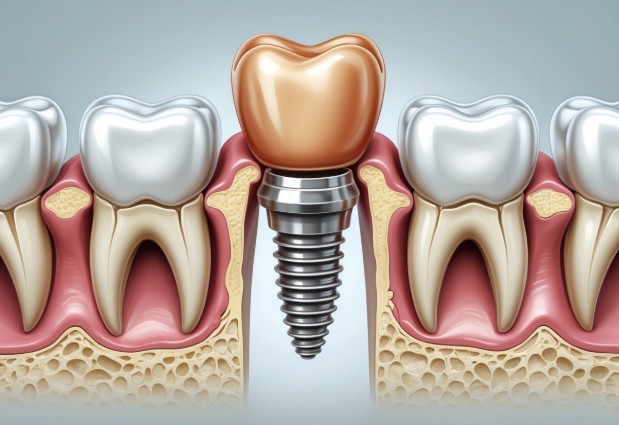
A single-tooth implant fills the gap left by a missing tooth using three parts that work together. Unlike bridges or dentures, dental implants leave the adjacent healthy teeth untouched and stay fixed in place permanently.
A single tooth implant consists of three main components: the implant post, the abutment, and the crown. Each piece performs a specific function in the finished restoration.
The implant post acts as an artificial tooth root. Dentists use medical-grade titanium for this component and place it surgically into the jawbone. The post bonds with surrounding bone through osseointegration, the biological process by which bone tissue grows onto the titanium surface.
The abutment is the connector. Once the surgical site heals, the dentist screws this piece into the post, and the abutment holds the crown in position without movement.
The dental crown is the visible chewing surface. The crown is custom-made to match the surrounding teeth in shade and shape, then attached to the abutment to complete the restoration.
A dental implant offers three advantages over other tooth-replacement options: preservation of adjacent teeth, a fixed rather than removable restoration, and continued stimulation of the jawbone.
Dental Bridge Impact on Nearby Teeth:
Dental Implants vs Bridges:
Partial dentures come out for cleaning every day and can slip during eating or speaking. Single-tooth implants stay fixed in place and function just like a real tooth.
For patients missing several adjacent teeth, implant-supported bridges use two or more implants to support a bridge, leaving the healthy neighboring teeth untouched.
Ready to get started? Call the practice now.
A complete single-tooth implant costs $2,400 at West Palm Beach Family Dental as of August 2026, covering every component of the complete procedure.
Preparatory procedures such as bone grafting appear as separate line items in the written treatment plan, and material selection affects the final figure in cases requiring premium restorations.
West Palm Beach Family Dental charges $2,400 for all components combined. The ranges below show what practices billing each component separately charge across the Palm Beach County market.
| Component | Cost Range | Description |
| Implant Post | $1,000 – $1,500 | Titanium screw placed in jawbone |
| Abutment | $300 – $700 | Connector piece between post and crown |
| Crown | $1,000 – $2,000 | Visible tooth replacement |
| Surgery Fee | $500 – $1,200 | Placement procedure cost |
| Initial Consultation | Included – no charge | Examination and treatment planning |
The implant post forms the foundation for the replacement tooth. The dentist places it surgically and allows several months for the post to bond with the jawbone.
The crown is typically the most expensive component at practices that itemize. Premium materials such as zirconia or high-grade porcelain raise the price and deliver better appearance and durability.
Four factors can increase an implant’s base cost. Dr. Berglass reviews each one during the consultation, before scheduling any treatment.
Bone grafting adds $300 to $3,000 when the jawbone lacks sufficient volume. Grafting gives the implant a solid anchor and extends the healing timeline before placement can proceed.
Sedation options go from $200 for basic nitrous oxide up to $800 for IV sedation. A lot of people pick sedation for a more comfortable experience during surgery.
Premium implant brands like Straumann or Nobel Biocare cost 20-30% more than standard brands. These companies have extensive research behind them and offer high-tech perks.
Laboratory materials affect the final figure. Zirconia crowns cost $200 to $500 more than standard porcelain, and they hold their appearance and strength longer.
Most Florida dental plans cover 0 to 50% of implant costs, since insurers classify implants as major restorative work. A written pre-treatment estimate confirms plan limits and the remaining annual maximum before treatment begins.
CareCredit offers six to twenty-four months at zero percent interest for qualifying applicants, subject to approval, which spreads the balance across manageable monthly payments.
West Palm Beach Family Dental offers in-house financing from $79 per month with no credit check, subject to approval, which avoids third-party underwriting entirely.
Health Savings Accounts (HSAs) and Flexible Spending Accounts (FSAs) cover implant treatment with pre-tax dollars, which lowers the effective cost depending on the account holder’s tax bracket.
A written, itemized treatment estimate is the only reliable basis for comparing providers. Implant costs vary widely between practices because quotes rarely cover the same line items, so comparing itemized estimates matters more than comparing headline figures.
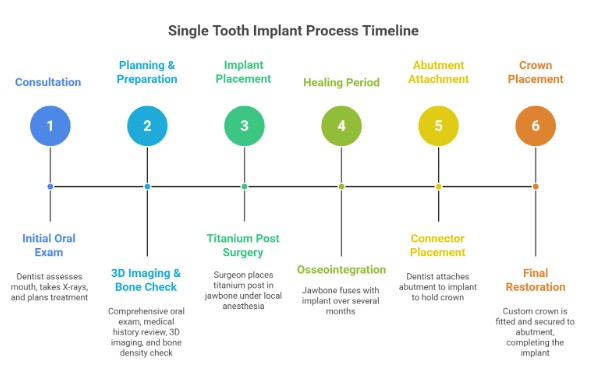
The single-tooth implant process runs three to six months across four phases, with healing intervals between each stage.
These days, 3D imaging and guided surgery are standard to ensure the implant lands exactly where it should.
The single-tooth implant process begins with a free consultation. Dr. Berglass examines the site, takes digital X-rays, and confirms whether the patient is a candidate for placement.
The surgeon places a titanium post in the jawbone during a minor procedure that typically takes one to two hours.
Local anesthesia numbs the area, and a small incision in the gum tissue exposes the bone beneath.
Once the site has healed, the dentist fits an abutment to the implant and seats a custom crown on top, completing the restoration.
Osseointegration is the fusion of jawbone tissue with the titanium post. Healing typically takes three to four months in the lower jaw and four to six months in the upper jaw.
Swelling and mild soreness are common through the first week after surgery. Most patients return to their usual routine within two days of placement.
Guided surgery has some real perks:
Computer planning fixes the exact angle and position of the implant before surgery begins, so the finished crown seats in correct bite alignment rather than requiring later adjustment.
During healing, patients follow specific care instructions, including avoiding hard foods, stopping tobacco use, and gently cleaning the surgical area.
Immediate loading lets patients walk out the same day with a temporary crown. This approach works best when the implant sits tightly in dense bone from the start.
Immediate Loading Benefits:
Immediate loading does not suit every case. The implant must seat with strong insertion torque, and bone quality at the site must be sound.
Delayed loading takes the more traditional route. Patients wait for the implant to fully fuse with the bone before getting their crown. The whole process, including healing, usually takes about 3-6 months.
Most implant cases use delayed loading since it gives the best results. The waiting period allows the implant to bond with the bone before chewing pressure is applied.
CBCT (Cone Beam Computed Tomography) 3D imaging gives dentists a detailed view of the jaw, showing bone density, nerve pathways, and sinus position in three dimensions.
The 3D scan builds a virtual model of the jaw, and surgeons plan the exact implant position before the procedure begins.
Guided Surgery Process:
The surgical guide fits over the teeth or gums like a template and directs the drill to the exact position and angle set during planning.
Guided placement reduces surgery time and improves accuracy, so patients experience less surgical trauma and heal faster.
Bone at an untreated extraction site recedes every month until grafting becomes necessary. Dr. Berglass maps what remains at West Palm Beach Family Dental. Schedule a free implant evaluation.
Ready to get started? Call the practice now.
Most adults missing one tooth qualify for an implant, subject to bone density, gum health, and certain lifestyle habits. Some patients need preparatory steps such as bone grafting or a sinus lift first.
Healthy gums and adequate bone density determine implant success. The jawbone must be thick and dense enough to hold the titanium post steady under chewing load.
Bone Density Requirements:
Gum disease must be treated before implant surgery, because infected or inflamed tissue raises the risk of failure. Healthy gum tissue that does not bleed during brushing or flossing is a prerequisite.
Smoking really hurts implant success rates. Tobacco restricts blood flow to gum tissue and slows healing. Many dentists require cessation for at least two weeks before surgery.
Uncontrolled diabetes and certain medications also affect healing. Dr. Berglass reviews the complete medical history during the consultation before scheduling any procedure.
Bone grafting applies when the jawbone is too thin or too short to hold an implant. Bone recedes after tooth loss, and the deficit widens across months and years.
Common grafting situations:
Sinus lifts are needed for upper back teeth when the sinus sits too close to the jawbone. The procedure raises the sinus floor and adds bone underneath.
A sinus lift adds four to six months to the treatment timeline, since the grafted bone must heal before placement. Recovery is generally mild, with soreness the most common complaint.
Bone grafting uses the patient’s own bone, donor bone, or synthetic graft material. The graft gives the implant a solid base to anchor into.
Single-tooth implants outlast bridges and dentures by a wide margin. With proper care, implants can last a lifetime, while bridges and dentures require replacement every five to ten years. Maintenance is straightforward, which makes implants the lowest lifetime cost per tooth.
| Treatment | Lifespan | Cost Over 20 Years | Adjacent Teeth Impact | Replacement Frequency |
| Single Implant | 25+ years to lifetime | $2,400 initial | No impact – preserves neighboring teeth | Rarely needed |
| Bridge | 10-15 years | $6,000-12,000 | Requires grinding healthy teeth | Replace 1-2 times |
| Partial Denture | 5-10 years | $3,000-9,000 | Can damage adjacent teeth over time | Replace 2-4 times |
Studies show single-tooth implants hold up well over decades, so the higher upfront cost becomes a lower annual cost over the restoration’s lifespan.
Bridges require grinding down healthy teeth. Partial dentures place stress on the remaining natural teeth and can cause problems over time.
Implant maintenance means stopping inflammation and bone loss around the implant. Daily brushing and interdental cleaning apply, exactly as with natural teeth.
Professional cleanings every six months let the hygienist keep an eye on the implant, with particular attention to the gum line around the crown.
Long-term checkups matter most for younger patients with decades of wear ahead. Dentists monitor for peri-implantitis, an inflammatory condition that threatens the tissue supporting an implant.
Implants require simpler daily care than bridges, and they need no soaking solutions or adhesives like dentures do.
West Palm Beach Family Dental combines continuity of care, current diagnostic technology, and flat all-inclusive pricing.
Patients see the same dentist at every stage of treatment, receive care on current diagnostic equipment, and know the full cost before placement begins.
One dentist handles the case from consultation through final crown. Continuity means the clinician who plans the placement is the clinician who restores it.
Dr. Berglass handles each step, from bone density assessment through post placement and crown design. Nothing is lost in handoff between separate providers.
Key Benefits:
Appointments are unhurried. The dentist explains each stage and answers questions before treatment moves forward.
The practice uses digital imaging for precise implant placement. 3D scans map bone structure and establish optimal post position before surgery begins.
Computer-guided surgery speeds up treatment and improves accuracy. The system makes custom guides so the implant goes exactly where it should.
Technology Features:
Modern sterilization keeps things safe. All tools get hospital-grade cleaning between patients.
The practice issues a detailed cost breakdown before treatment starts. The quote covers implant placement, abutment, crown, and all follow-up visits, with no hidden fees.
Payment Options:
The practice works directly with insurance carriers to maximize available coverage. Staff reviews the plan line by line, so the covered portion and the out-of-pocket balance are both clear before scheduling.
Financing spreads the balance across 12 to 24 months. Zero percent interest is available for qualified applicants, subject to approval, which brings implant treatment within reach for patients paying without insurance.
Treatment estimates stay valid for 90 days, giving you time to compare options and arrange financing without pressure.
A missing tooth shifts the surrounding bite and reduces chewing force with each month it goes unaddressed. Dr. Berglass confirms candidacy at West Palm Beach Family Dental. Book a free consultation.
How much does a single tooth implant cost in West Palm Beach?
A complete single-tooth implant costs $2,400 at West Palm Beach Family Dental and includes the implant post, abutment, and crown. Most Palm Beach County practices charge $3,000 to $5,000 for the same procedure and bill each component separately. We confirm final candidacy at the free consultation.
How long does the single tooth implant process take from start to finish?
From consultation to final crown, the process takes three to six months on average. Healing time depends on bone integration and whether you need grafting or a temporary restoration. Cases needing a bone graft beforehand can run six to twelve months.
Is getting a single dental implant painful?
Implant placement occurs under local anesthesia, so most patients feel pressure rather than pain. Mild soreness for a few days is common and managed with over-the-counter pain relief. Sedation options are available for patients whose anxiety would otherwise delay treatment.
How long does a single tooth implant last?
With proper care, a single implant lasts 20 years or more, often a lifetime. The titanium post integrates permanently with the jawbone. Regular hygiene and professional cleanings every six months remain the decisive factors in long-term success at the restoration site.
Who is a good candidate for a single tooth implant?
Healthy adults with adequate bone density and healthy gums make strong candidates for a single-tooth implant. Smokers and patients with uncontrolled diabetes may need additional preparation before treatment. Cone-beam CT imaging confirms available bone volume before scheduling surgery.
Does insurance cover single tooth implants?
Most Florida dental plans cover part of the cost, usually the crown or diagnostic steps, rather than the full implant surgery. Coverage commonly runs from zero to fifty percent of the post. Financing and HSA or FSA funds cover the remaining balance.
Why choose West Palm Beach Family Dental for a single tooth implant?
At West Palm Beach Family Dental, patients work with the same implant dentist at every stage, receive transparent pricing, and benefit from cone-beam CT imaging. Dr. Berglass places and restores each implant in-house, with no referral to an outside oral surgeon.
What financing is available for a single tooth implant?
West Palm Beach Family Dental offers in-house financing from $79 monthly with no credit check, subject to approval. CareCredit provides six to twenty-four months at zero percent interest for qualifying applicants, subject to approval. Treatment estimates stay valid for 90 days.

About Dr. Berglass
Dr. Michael Berglass, a dedicated dentist with over 25 years of experience, specializes in dental implants, cosmetic, and general dentistry in West Palm Beach, Florida. A proud alumnus of Stony Brook School of Dental Medicine (DDS, 1996), Dr. Berglass further honed his expertise with residencies in general practice and dental implants at North Shore-Long Island Jewish Hospital. His journey in dentistry has taken him from New York to North Carolina, and now to Florida, where he continues to offer top-notch dental care. Known for his wit and intellect, Dr. Berglass makes every patient's visit comfortable. Formerly a member of the American Dental Association and the Florida Dental Association, Dr. Berglass remains committed to staying informed about advancements in dentistry and providing exceptional care to his patients. He looks forward to welcoming you to his practice.
About Dr. Cedeno

Dr. Ivan Cedeno is originally from Cuba where he did his dental studies. Having graduated with a DDS diploma gave Ivan and his family great satisfaction, considering he comes from a family of dedicated dental care professionals. After years of practicing Dentistry in Cuba for a few years, Ivan decided to continue his growth journey as a professional in the United States. Early on, Ivan worked as a laboratory technician, which gave him some unique insights that dental school does not teach. Having graduated from the University of Puerto Rico as a DMD, Ivan is allowed to practice in the USA.


