Dental Implants vs Dentures vs Bridges: The 20-Year Lifetime Value Matrix
Originally published: March 2026 | Updated: October 2026 | Reviewed by Dr. Michael Berglass, DDS
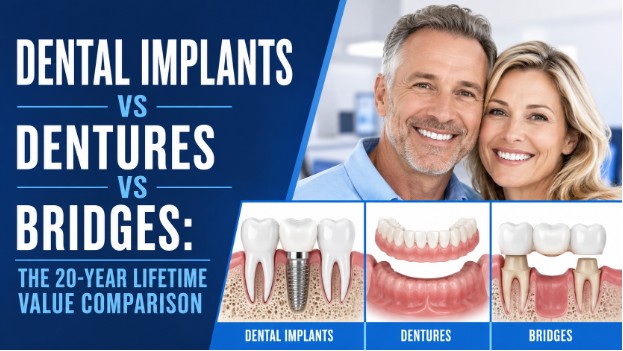
For a single missing tooth, a dental implant costs more on the day of treatment, carries no replacement cycle, and is the only option that keeps the jawbone loaded at the site.
An implant replaces the tooth root with a titanium post and a porcelain crown; a three-unit bridge spans the gap using the two adjacent teeth as anchors; a removable partial denture clasps to neighboring teeth and lifts out.
At West Palm Beach Family Dental, Dr. Michael Berglass, DDS, places single dental implants for $2,400 all-inclusive (2026 pricing).
Over 20 years, that figure lands below a three-unit bridge and well below a complete denture. A removable partial denture stays cheaper in cash — what it costs instead is chewing function and bone.
Missing teeth get more expensive to treat the longer they go unreplaced, because bone loss raises surgical complexity. Schedule a free consultation with Dr. Berglass at West Palm Beach Family Dental for a written 20-year comparison built on CBCT imaging rather than an estimate.

For one missing tooth, a dental implant totals roughly $3,600–$4,200 over 20 years at West Palm Beach Family Dental; a three-unit bridge costs $4,000–$8,000; and a removable partial denture costs $2,500–$8,500.
The comparison below prices all three for the same job—replacing a single tooth—across the eleven factors that determine real lifetime value.
| Factor | Dental Implant (single tooth) | Three-Unit Bridge | Removable Partial Denture |
| Upfront cost, West Palm Beach | $2,400 all-inclusive at WPBFD (2026); $3,000–$5,000 county average | $2,000–$4,000 | $500–$1,500 |
| Lifespan | 25–30 years (post); 15–20 years (crown) | 10–15 years | 5–10 years |
| Replacement within 20 years | One crown, typically year 15–20: $1,200–$1,800 | One full bridge: $2,000–$4,000 | 2–3 remakes plus relines: $2,000–$7,000 |
| Estimated 20-year total | $3,600–$4,200 at WPBFD | $4,000–$8,000 | $2,500–$8,500 |
| Break-even against an implant | — (baseline) | Implant costs less from roughly year 10–12 | Implant does not overtake on cash within 20 years in most cases |
| Bone preservation at the site | Yes — osseointegration keeps the jaw under functional load | No — no root replacement; bone resorbs beneath the pontic | No — clasps rest on gum tissue; resorption continues |
| Chewing force restored | 80–90% of natural bite strength | 60–70%, limited by the anchor teeth | 20–25% of natural bite strength |
| Effect on adjacent teeth | None — self-supporting | Two healthy teeth ground down and permanently crowned | Clasps can wear abutment enamel; drifting over time |
| Maintenance | Brushing, flossing, cleanings every 6 months | Threaders to clean beneath; decay risk at crown margins | Nightly removal and soaking; relines every 2–3 years |
| Time to completion | 3–6 months staged; same-day in selected cases | 2–4 weeks | 3–6 weeks |
| Documented failure risk | ~95% survival at 5 years, 86.7% at 10 years; peri-implantitis is the leading late cause | Abutment-tooth failure escalates cost to $4,000–$8,000+ | Highest discontinuation rate; many wearers stop using them |
Full-arch cases run on different math and are covered in the next section. The American College of Prosthodontists reports that roughly 178 million Americans are missing at least one tooth, and 40 million are missing all of them. The method chosen at first tooth loss sets the cost trajectory for the next two decades, which is why a quote deserves a line-by-line read before anything is scheduled—comparing dental implant quotes across offices reveals which costs surface later and which are genuinely included.
Ready to get started? Call the practice now.

Complete dentures run $4,700–$12,500 per arch across 20 years because resorption keeps reshaping the ridge the appliance rests on, forcing relines, adjustments, and full remakes that were never part of the original quote.
The ridge shrinks, the denture loosens, adhesive goes on, a reline follows, and eventually a new set is made. Over two decades, the components stack:
Complete dentures also restore only 20–25% of natural chewing force, which pushes diet toward softer food and narrows variety. That matters most after 65, an age at which the National Institute on Aging identifies reduced dietary variety as a nutrition risk. Implants end the replacement cycle because the titanium post fuses with bone, so the restoration sits on a fixed foundation instead of shifting tissue — the structural line that separates root-replacement from surface-supported options.
A three-unit bridge fails at its anchors rather than its middle. When an abutment tooth decays, fractures, or needs root canal treatment, a one-tooth problem becomes a three-tooth problem costing $4,000–$8,000+ to resolve.
Preparing a bridge means grinding two healthy teeth down to seat crowns. Those teeth are permanently altered:
An implant sidesteps the sequence entirely by standing on its own, with no adjacent tooth modified. Dr. Berglass weighs bridge against implant at every free consultation using CBCT imaging, bone density, and the condition of the neighboring teeth. Some gaps do suit a bridge — particularly where both neighbors already carry large restorations, a situation covered under crowns and bridges in West Palm Beach.
Paying for a bridge that fails at year 10 costs more than paying once for an implant that lasts 25 years or longer. Schedule a free consultation with Dr. Berglass to see which option fits the bone, the budget, and the timeline.
Bone preservation is the one clinical variable that reprices every future option: a resorbed ridge makes any later treatment more complex and more expensive than it would have been earlier.
An implant is the only replacement that keeps functional load on the bone through osseointegration, in which titanium fuses directly with living tissue. Bridges and dentures leave the socket unloaded.
A systematic review of post-extraction dimensional change published in Clinical Oral Implants Research found the alveolar ridge loses 29–63% of its width within 6–7 months and 11–22% of its height within 6 months, with most of that change occurring in the first three to six months.
Two financial consequences follow. Denture fit degrades on a moving foundation, which triggers the reline cycle.
Delayed implant placement often requires bone grafting at $400–$1,500 per site before a post can be seated — a cost earlier treatment would have avoided.
Dr. Berglass uses in-house CBCT 3D imaging to measure current bone volume and determine whether grafting is needed or whether existing bone supports immediate placement.
Where resorption has already altered facial height and volume, an implant halts further loss at the site of placement, which no removable or tooth-borne option does at any price — part of why implant dentistry is credentialed separately by bodies such as the American Academy of Implant Dentistry.
Patients seeing early facial changes from tooth loss have the narrowest window to act before grafting enters the plan.
Ready to get started? Call the practice now.
A single implant overtakes a three-unit bridge in roughly 10–12 years and a complete denture in roughly 6–10 years per arch, once replacements, relines, adjustments, and complications are counted.
Against a removable partial denture, an implant generally does not break even on cash within 20 years—that decision trades money for function and bone rather than savings.
Financing changes the cash-flow picture without changing the 20-year arithmetic.
The practice offers CareCredit promotional financing on No Interest if Paid in Full terms over 6 to 24 months, subject to approval, an In-Office Savings Plan at $375 per year including 20% off all dental work, and in-house plans from $79 per month with no credit check, subject to approval.
Patients weighing same-day against staged implant timelines should also budget $500–$1,000 for a temporary crown or flipper during osseointegration.
An implant is not the right answer in every case. A bridge or a denture is the better clinical or financial choice in several defined situations:
Implants are durable rather than permanent, and the real survival figures make better decision input than a lifetime guarantee. Pooled data on implant-supported fixed prostheses shows about 95% survival at 5 years and 86.7% at 10 years — strong, and not 100%.
Four failure modes are worth understanding before treatment:
Ongoing care decides which of these a patient meets. Implant maintenance is unglamorous and decisive: brushing, flossing, and cleanings every six months with monitoring of the tissue around the post. Risk assessment before placement identifies who needs a modified protocol rather than discovering it afterward.
Denture wearers with sufficient remaining bone can transition, though anyone who has worn a denture five years or longer needs CBCT imaging to confirm candidacy, since unloaded bone has been receding the whole time.
Two pathways cover most cases. Implant-retained dentures place 2–4 implants per arch to snap-lock an existing or modified denture, which sharply improves stability and bite force for less than individual implants throughout.
All-on-4 full-arch restoration uses four angled implants to carry a fixed, non-removable bridge replacing an entire arch.
In-house CBCT imaging routinely finds usable bone that a 2D panoramic film cannot resolve, so patients told they are “not candidates” on a panoramic alone are worth re-evaluating; a free second opinion with 3D imaging changes the answer often enough to justify the appointment.
The choice between full-arch implant pathways turns on remaining bone volume, bite forces, and whether the restoration needs to come out for cleaning.
Implants restore 80–90% of natural bite strength with no dietary restrictions after healing and no routine beyond brushing, flossing, and regular cleanings.
Complete dentures restore 20–25% of bite force, require nightly soaking, and often cause sore spots, slippage during speech, and quiet food avoidance.
Bridges restore 60–70% but need threaders to clean beneath and carry a risk of decay at the anchors. The measurable differences land in three places:
Recovery runs shorter than the timeline suggests: the first one to two weeks call for a soft-food period before unrestricted eating resumes, after which daily routines return to normal.
A tooth replacement decision sets diet, speech, and spending for two decades, not just the amount due at checkout.
Call (561) 968-6022 or schedule online for a free, itemized 20-year comparison from Dr. Berglass at West Palm Beach Family Dental.
Are dental implants worth the higher upfront cost compared to dentures?
A single implant at West Palm Beach Family Dental is $2,400 all-inclusive and totals roughly $3,600–$4,200 across 20 years, including one crown replacement. A complete denture runs $4,700–$12,500 per arch over the same period once relines, remakes, adhesive, and adjustments are counted, so implants break even within 6–10 years for most patients.
What lasts longer — dental implants, bridges, or dentures?
The implant post lasts 25–30 years and its crown 15–20 years, a bridge 10–15 years, and a denture 5–10 years before ridge change requires a new set. The implant is the only one with no whole-restoration replacement cycle.
Do dental implants prevent bone loss in the jaw?
An implant preserves bone at the site through osseointegration, in which titanium fuses with living jawbone and carries functional load. Bridges and dentures leave the socket unloaded; peer-reviewed data on post-extraction changes record 29–63% loss of ridge width within 6–7 months and 11–22% of height within 6 months.
How often do dental implants fail?
Pooled survival for implant-supported fixed restorations is about 95% at 5 years and 86.7% at 10 years. Peri-implantitis is the leading late cause, with smoking, uncontrolled diabetes, and poor maintenance the strongest risk factors. Screw and crown complications are more common than implant loss and are repairs rather than failures.
Is a partial denture cheaper than an implant over 20 years?
In cash terms, usually yes: about $2,500–$8,500 against $3,600–$4,200 for a single implant at West Palm Beach Family Dental. The trade is function and bone — a partial restores 20–25% of chewing force against 80–90% for an implant, and it does nothing to slow resorption.
Can dental implants replace an existing denture?
Denture wearers with sufficient remaining bone can move to implants or implant-retained dentures once a CBCT scan confirms adequate density. Patients told they lack bone based on a 2D X-ray are worth re-evaluating with 3D imaging, which often identifies usable bone a panoramic film cannot resolve.
Does dental insurance cover implants, and how much does it pay?
Coverage varies by plan, and the binding constraint is usually the annual maximum rather than the exclusion list — most plans cap benefits at $1,000–$2,000 per year, so multi-tooth cases are often staged across benefit years. Original Medicare does not cover implants, dentures, or bridges; Medicare.gov sets out current limitations.
How long does each option take from start to finish?
A staged implant takes 3–6 months because osseointegration cannot be rushed, with same-day placement available in selected cases. A three-unit bridge seats in 2–4 weeks and a partial denture in 3–6 weeks. Where a deadline is fixed, treatment time can outweigh 20-year cost.
What is the cheapest way to replace a missing tooth?
A removable partial denture has the lowest upfront cost at $500–$1,500 per tooth and often the lowest 20-year outlay, while restoring the least function and permitting continued bone loss. Among options that fully restore function, the implant carries the lowest 20-year total.
Is a dental bridge a good option for a single missing tooth?
A bridge replaces a single tooth effectively where both adjacent teeth are healthy and the 10–15-year replacement timeline is understood, and it becomes the stronger choice where those neighbors already need crowns. The trade-off is that both anchor teeth are permanently ground down, raising their long-term risk of fracture and decay.

About Dr. Berglass
Dr. Michael Berglass, a dedicated dentist with over 25 years of experience, specializes in dental implants, cosmetic, and general dentistry in West Palm Beach, Florida. A proud alumnus of Stony Brook School of Dental Medicine (DDS, 1996), Dr. Berglass further honed his expertise with residencies in general practice and dental implants at North Shore-Long Island Jewish Hospital. His journey in dentistry has taken him from New York to North Carolina, and now to Florida, where he continues to offer top-notch dental care. Known for his wit and intellect, Dr. Berglass makes every patient's visit comfortable. Formerly a member of the American Dental Association and the Florida Dental Association, Dr. Berglass remains committed to staying informed about advancements in dentistry and providing exceptional care to his patients. He looks forward to welcoming you to his practice.
About Dr. Cedeno

Dr. Ivan Cedeno is originally from Cuba where he did his dental studies. Having graduated with a DDS diploma gave Ivan and his family great satisfaction, considering he comes from a family of dedicated dental care professionals. After years of practicing Dentistry in Cuba for a few years, Ivan decided to continue his growth journey as a professional in the United States. Early on, Ivan worked as a laboratory technician, which gave him some unique insights that dental school does not teach. Having graduated from the University of Puerto Rico as a DMD, Ivan is allowed to practice in the USA.


