Bone Graft for Dental Implant Cost in West Palm Beach: Implants With Bone Loss
Originally published: October 2026 | Reviewed by Dr. Michael Berglass, DDS

Bone grafting rebuilds jawbone volume so a dental implant can anchor in sufficient bone.
At West Palm Beach Family Dental, grafting adds $400–$1,500 to dental implant treatment, quoted separately from the $2,400 all-inclusive implant fee, and a staged graft adds four to six months of healing.
Cone-beam CT measurements of ridge height, width, and density determine whether a site needs augmentation.
Guesswork about bone volume produces guesswork quotes. West Palm Beach Family Dental measures the site on cone-beam CT and issues a written treatment plan beforehand.
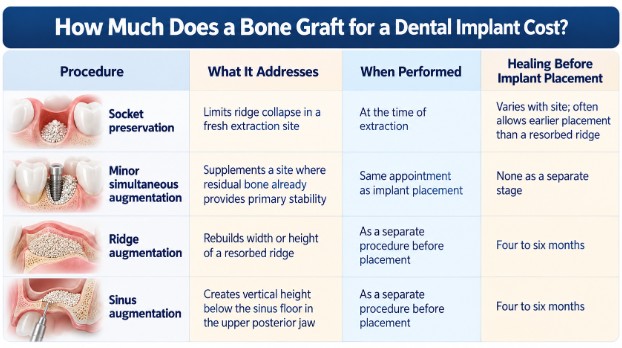
Bone grafting at West Palm Beach Family Dental ranges from $400 to $1,500, depending on graft type, defect size, and material, and is quoted separately from the $2,400 all-inclusive implant fee.
Four distinct procedures fall within that range.
| Procedure | What It Addresses | When Performed | Healing Before Implant Placement |
| Socket preservation | Limits ridge collapse in a fresh extraction site | At the time of extraction | Varies with site; often allows earlier placement than a resorbed ridge |
| Minor simultaneous augmentation | Supplements a site where residual bone already provides primary stability | Same appointment as implant placement | None as a separate stage |
| Ridge augmentation | Rebuilds width or height of a resorbed ridge | As a separate procedure before placement | Four to six months |
| Sinus augmentation | Creates vertical height below the sinus floor in the upper posterior jaw | As a separate procedure before placement | Four to six months |
The procedure depends on a measurement outcome rather than preference, and the fee is quoted after imaging rather than estimated from a description of symptoms.
A component-level bone graft cost comparison across practices shows whether a quote itemizes grafting or omits it, since a headline implant price that excludes augmentation is not comparable to one that includes it.
Ready to get started? Call the practice now.
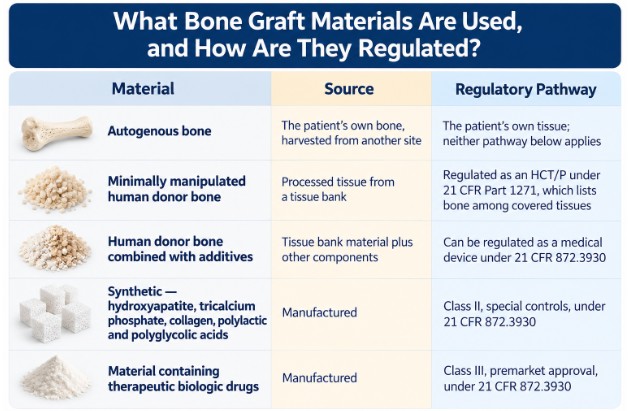
Graft materials fall into autogenous bone, human donor bone, and synthetic substitutes, and they follow two separate federal regulatory pathways rather than one.
| Material | Source | Regulatory Pathway |
| Autogenous bone | The patient’s own bone, harvested from another site | The patient’s own tissue; neither pathway below applies |
| Minimally manipulated human donor bone | Processed tissue from a tissue bank | Regulated as an HCT/P under 21 CFR Part 1271, which lists bone among covered tissues |
| Human donor bone combined with additives | Tissue bank material plus other components | Can be regulated as a medical device under 21 CFR 872.3930 |
| Synthetic — hydroxyapatite, tricalcium phosphate, collagen, polylactic and polyglycolic acids | Manufactured | Class II, special controls, under 21 CFR 872.3930 |
| Material containing therapeutic biologic drugs | Manufactured | Class III, premarket approval, under 21 CFR 872.3930 |
Part 1271 governs human cells, tissues, and cellular and tissue-based products intended for implantation, explicitly naming bone, and sets donor-eligibility and good tissue practice requirements to prevent communicable disease transmission.
Section 872.3930 separately defines bone grafting material as a substance “intended to fill, augment, or reconstruct periodontal or bony defects of the oral and maxillofacial region,” assigning Class III status only where therapeutic biologic drugs are present.
Alveolar resorption begins after extraction and proceeds fastest during the first three to six months, with the horizontal dimension reducing more than the vertical.
A systematic review of post-extraction dimensional change published in Clinical Oral Implants Research found the ridge loses 29–63% of its width within six to seven months and 11–22% of its height within six months. Width is the dimension an implant needs most and the dimension that reduces the most.
That pattern shapes planning without dictating an outcome for any individual. Ridge morphology, extraction characteristics, the presence of the buccal plate, and planned implant dimensions all bear on whether a given site can receive an implant directly. Planning a tooth extraction and its restoration together keeps socket preservation an option, which is not available once a ridge has fully remodeled.
Patients noticing facial changes after tooth loss are seeing the vertical component of the same process.
Measured bone volume determines grafting, assessed against the dimensions required to seat the planned implant with primary stability. Dr. Berglass evaluates three measurements at every implant site.
Several circumstances reduce those measurements, and Dr. Berglass finds the following recur most often in patients who arrive needing augmentation: extraction sites left unrestored long enough for the ridge to remodel substantially, long-term removable denture wear that transmits no root-level load to the bone beneath, periodontal bone destruction, traumatic loss involving fracture of the buccal plate, and upper posterior sites where the sinus floor sits close to the ridge.
Periodontal disease is a common route into that group, and NIDCR data show that moderate and severe periodontal disease prevalence in adults and seniors has decreased since the early 1970s, making timely gum disease treatment a bone-preservation measure as much as a periodontal one.
Not every resorbed ridge calls for the same response. Ridge expansion displaces existing bone laterally and can permit placement in one appointment, shorter implant systems clear limited height without augmentation, and tilted placement avoids deficient regions altogether.
Whether a recommended graft is clinically necessary in a particular case is treated separately under grafting candidacy.
Patients carrying an outside grafting quote sometimes have adequate bone on cross-section. Dr. Berglass reviews the measurements at a free bone evaluation.
Sequence affects the calendar more than the fee. At West Palm Beach Family Dental, the graft is quoted within the same $400–$1,500 range whether it is placed alongside the implant or as a separate earlier procedure.
| Pathway | Sequence | Typical Time to Final Crown | Graft Fee at This Practice |
| Adequate measured bone | Placement, osseointegration, crown | 3–6 months | None |
| Simultaneous graft and placement | Graft and implant in one appointment, healing, crown | 3–6 months | $400–$1,500 |
| Staged graft, then implant | Graft, four to six months healing, placement, osseointegration, crown | 8–12 months | $400–$1,500 |
Simultaneous treatment requires enough residual bone for the implant to achieve primary stability at placement, so the pathway follows from measurement rather than from patient choice.
Individual healing durations vary with procedure type, graft size, and medical history, and smoking and uncontrolled diabetes both extend them.
Implant financing covers either pathway over months, and an itemized cost breakdown separates the implant fee from the graft fee for budgeting.
Ready to get started? Call the practice now.
Cone-beam CT produces cross-sectional images that show ridge width, height, density, nerve position, and sinus floor location at the planned implant site. A panoramic radiograph cannot provide width measurements.
The American Academy of Oral and Maxillofacial Radiology position statement on imaging in dental implantology, published by Tyndall, Price, Tetradis, and colleagues in Oral Surgery, Oral Medicine, Oral Pathology, Oral Radiology in 2012, recommends “cross-sectional imaging be used for the assessment of all dental implant sites and that CBCT is the imaging method of choice.”
The same statement identifies the limitation directly: “a major limitation of panoramic radiography is that buccolingual assessments cannot be made,” and it considers panoramic radiography unsuitable as a single imaging source for implant site assessment.
Width is one of several planning measurements rather than the sole determinant, and it is the one a two-dimensional film omits.
A site that appears adequate on a panoramic can prove narrow on cross-section, and a site that appears deficient can prove workable once measured.
CBCT implant planning therefore precedes any grafting recommendation at this practice, and patients holding an outside recommendation made without cross-sectional imaging are entitled to a free second opinion before consenting.
Adults aged 20 to 64 retain an average of 26 teeth out of 32 according to NIDCR figures drawn from NHANES 2017–March 2020, so most cases involve partial loss where measurement, not assumption, governs the plan.
How much does a bone graft for a dental implant cost in West Palm Beach?
Bone grafting at West Palm Beach Family Dental ranges from $400 to $1,500 depending on graft type, defect size, and material used, quoted separately from the $2,400 all-inclusive single implant fee. The figure is confirmed in writing after imaging, before treatment begins.
Can dental implants be placed with bone loss?
Yes, in many cases. Implants require adequate measured ridge width, height, and density rather than untouched bone. When measurements show insufficient volume, grafting rebuilds it; ridge expansion, shorter implant systems, or tilted placement may allow placement without augmentation.
How long does bone graft healing take before an implant?
A staged bone graft generally requires four to six months before the site reaches sufficient density for implant placement, though individual healing varies with procedure type, graft size, and medical history. Grafting performed alongside placement adds no separate healing stage.
How much bone loss happens after a tooth is extracted?
Peer-reviewed data on post-extraction change records 29–63% loss of alveolar ridge width within six to seven months and 11–22% of height within six months, with the fastest change during the first three to six months. Width reduces further than height.
What determines whether a bone graft is needed?
Measured bone determines it. Dr. Berglass assesses height above the nerve or below the sinus, ridge width at the insertion point, and bone density. Roughly 10 mm of height and 5–6 mm of width generally permit direct placement without augmentation.
Can a bone graft and implant be done at the same appointment?
Yes, when augmentation is minor and the implant achieves primary stability in the remaining bone. West Palm Beach Family Dental quotes the graft within the same $400–$1,500 range either way, so the practical difference is treatment duration rather than fee.
What is the difference between a bone graft and a sinus lift?
Ridge augmentation rebuilds width or height at the implant site itself. Sinus augmentation raises the sinus floor membrane to create vertical height in the upper posterior jaw. Both procedures fall within the same $400–$1,500 range at this practice.
What bone graft materials are used for dental implants?
Three categories exist: autogenous bone from the patient, human donor bone from a tissue bank, and synthetic substitutes such as hydroxyapatite, tricalcium phosphate, and collagen. Minimally manipulated donor bone is regulated as an HCT/P rather than as a device.
Does a panoramic X-ray show whether a bone graft is needed?
No. The American Academy of Oral and Maxillofacial Radiology states that buccolingual assessments cannot be made from panoramic radiography and considers it unsuitable as a single imaging source for implant site assessment, recommending cross-sectional imaging for all implant sites.
Does the graft evaluation cost anything at West Palm Beach Family Dental?
No. The free consultation includes a clinical examination, X-rays, and cone-beam CT where indicated, along with a written treatment plan issued before any financial commitment. Free second opinions carry the same terms for patients holding an outside recommendation.

About Dr. Berglass
Dr. Michael Berglass, a dedicated dentist with over 25 years of experience, specializes in dental implants, cosmetic, and general dentistry in West Palm Beach, Florida. A proud alumnus of Stony Brook School of Dental Medicine (DDS, 1996), Dr. Berglass further honed his expertise with residencies in general practice and dental implants at North Shore-Long Island Jewish Hospital. His journey in dentistry has taken him from New York to North Carolina, and now to Florida, where he continues to offer top-notch dental care. Known for his wit and intellect, Dr. Berglass makes every patient's visit comfortable. Formerly a member of the American Dental Association and the Florida Dental Association, Dr. Berglass remains committed to staying informed about advancements in dentistry and providing exceptional care to his patients. He looks forward to welcoming you to his practice.
About Dr. Cedeno

Dr. Ivan Cedeno is originally from Cuba where he did his dental studies. Having graduated with a DDS diploma gave Ivan and his family great satisfaction, considering he comes from a family of dedicated dental care professionals. After years of practicing Dentistry in Cuba for a few years, Ivan decided to continue his growth journey as a professional in the United States. Early on, Ivan worked as a laboratory technician, which gave him some unique insights that dental school does not teach. Having graduated from the University of Puerto Rico as a DMD, Ivan is allowed to practice in the USA.


