Full Arch Implants in West Palm Beach: All-on-4, All-on-6, and Denture Alternatives
Originally published: February 2025 | Updated: October 2026 | Reviewed by Dr. Michael Berglass, DDS

Full-arch implants replace every tooth in an upper or lower jaw with a bridge anchored to implants rather than a removable appliance resting on gum tissue.
Four paths exist: a traditional complete denture, an implant-retained denture, All-on-4, and All-on-6.
At West Palm Beach Family Dental, full-arch implant treatment runs $15,000 to $38,000 per arch, depending on implant count and prosthetic material, and takes four to six months.
Four replacement paths exist for a full arch at very different prices. West Palm Beach Family Dental measures bone before quoting a written treatment plan.
Four options replace a complete arch, depending on whether the restoration is fixed or removable and how many implants it uses. Cost scales with implant count and prosthetic material.
| Option | Implants Per Arch | Fixed or Removable | Cost Per Arch | Bone Loading |
| Traditional complete denture | None | Removable | $1,000–$3,000 | None — rests on gum tissue, replaced every 5–10 years |
| Implant-retained denture | Two to four | Removable, snap-locked onto implants | Quoted after imaging; below fixed full-arch treatment | At the implant positions |
| All-on-4 | Four | Fixed, non-removable | $15,000–$20,000 acrylic; $20,000–$30,000 zirconia | At the implant positions |
| All-on-6 | Six | Fixed, non-removable | $18,000–$28,000 acrylic; $23,000–$38,000 zirconia | At the implant positions |
Treating both arches with fixed restorations runs $30,000 to $60,000. Extractions at $200 to $600 per tooth, sedation at $500 to $1,500, and same-day provisional teeth at $2,000 to $4,000 are quoted separately from the arch fee.
These ranges are West Palm Beach Family Dental’s own pricing, and a patient’s final figure depends on clinical findings and the components their plan includes, which is why the written quote follows examination and imaging.
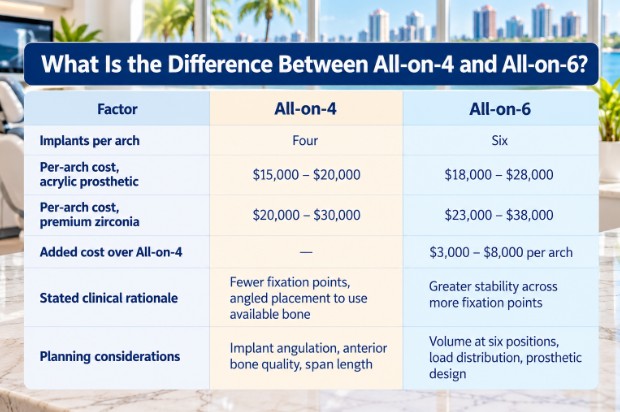
All-on-4 secures a fixed full-arch bridge on four implants per arch, while All-on-6 uses six. The six-implant configuration adds $3,000 to $8,000 per arch.
| Factor | All-on-4 | All-on-6 |
| Implants per arch | Four | Six |
| Per-arch cost, acrylic prosthetic | $15,000–$20,000 | $18,000–$28,000 |
| Per-arch cost, premium zirconia | $20,000–$30,000 | $23,000–$38,000 |
| Added cost over All-on-4 | — | $3,000–$8,000 per arch |
| Stated clinical rationale | Fewer fixation points, angled placement to use available bone | Greater stability across more fixation points |
| Planning considerations | Implant angulation, anterior bone quality, span length | Volume at six positions, load distribution, prosthetic design |
Implant count follows more than bone availability. Additional positions distribute bite force across more fixation points, which can matter when the opposing arch carries natural teeth or a fixed restoration that generates higher loads.
Fewer implants placed at an angle can reach denser anterior bone and avoid the sinus or nerve canal, which sometimes makes a four-implant design the better-supported plan even where six positions are technically available.
Prosthetic design also constrains the choice, since span length and material affect how load reaches each implant.
Prosthetic material often matters more than implant count. Stepping from acrylic to premium zirconia adds $5,000 to $10,000 per arch on either configuration, which exceeds the difference between four implants and six.
Dr. Berglass weighs these factors together during treatment planning, supported by CBCT imaging.
A component-level breakdown of All-on-4 pricing separates the arch fee from the add-ons that appear on a final quote.
Ready to get started? Call the practice now.
An implant-retained denture snap-locks onto two to four implants and lifts out for cleaning. It costs less than a fixed restoration and suits several situations better.
The trade-off is stability and bite force. A snap-locked denture is markedly more stable than a conventional one but still removable, and patients who want teeth that never come out generally choose a fixed design.
A fuller comparison of implant-retained dentures against fixed alternatives covers the functional differences.
Full-arch quotes vary by implant count and prosthetic material, so the figure follows the plan. Dr. Berglass sets out both at a free full-arch consultation.
Candidacy rests on bone volume at the planned implant positions, supported by stable general health and treated gum tissue. Four factors govern the assessment.
Age alone does not disqualify anyone. Patients in their seventies and eighties receive full-arch implants routinely when bone volume and general health support treatment, and NIDCR figures from NHANES 2017–March 2020 show that about 2% of adults aged 20 to 64 have no remaining natural teeth.
Periodontal disease is one route to arch-wide tooth loss, and NIDCR data show that moderate and severe periodontal disease prevalence in adults and seniors has declined since the early 1970s, making timely gum disease treatment worthwhile on its own terms.
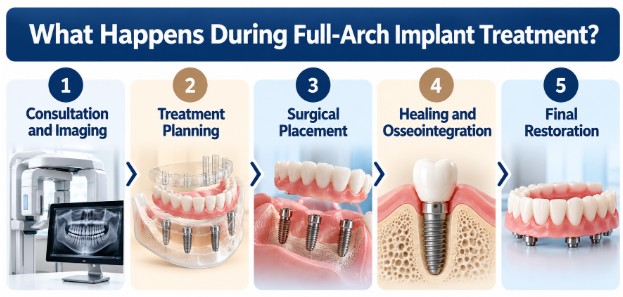
Full-arch treatment runs four to six months from surgery to final restoration, across five stages. Most of that span is healing rather than chair time.
A free consultation includes a clinical examination, X-rays, and cone-beam CT where indicated. The scan measures bone at each planned position and maps nerve canals and sinus floors.
Implant positions, angulation, prosthetic material, and sedation are settled before surgery, and the written figure follows those decisions. Any required tooth extraction is scheduled into the same surgical appointment, where possible.
Surgery takes two to four hours per arch under sedation. Remaining teeth are extracted, implants are placed, and provisional teeth are often fitted the same day.
Osseointegration accounts for three to four months, during which the implant surface fuses with surrounding bone. Provisional teeth remain in place throughout, and smoking or uncontrolled blood sugar extends this stage.
Fitting the definitive prosthesis takes two to three hours once integration is confirmed. It is fabricated to the healed tissue contours, so it cannot be made in advance.
Ready to get started? Call the practice now.
Bone volume influences which configurations remain available, and resorption after tooth loss proceeds fastest in the first months rather than gradually across years.
A systematic review of post-extraction dimensional change published in Clinical Oral Implants Research found the alveolar ridge loses 29–63% of its width within six to seven months of extraction and 11–22% of its height within six months, with most change occurring during the first three to six months. Width reduces the most, and width is the dimension an implant needs.
That pattern describes populations rather than predicting any individual outcome. Long-term denture wear transmits no load to the bone beneath, so arches edentulous for years often show reduced posterior volume, which can favor angled four-implant designs or call for augmentation first.
Where volume falls short, bone grafting can bring a site into range at $400 to $1,500, adding a separate healing period.
The AAOMR position statement on imaging in dental implantology, published by Tyndall, Price, Tetradis and colleagues in 2012, recommends “cross-sectional imaging be used for the assessment of all dental implant sites and that CBCT is the imaging method of choice,” noting that “a major limitation of panoramic radiography is that buccolingual assessments cannot be made.”
Patients told elsewhere that they lack bone for any implant are entitled to a free second opinion with cross-sectional measurement.
A fixed full-arch restoration is cleaned daily and reviewed professionally, with a maintenance burden between natural teeth and a removable denture.
Routine implant maintenance separates restorations that last decades from those that fail early. Implant financing can spread treatment costs across months.
What is the difference between All-on-4 and All-on-6 dental implants?
All-on-4 anchors a full-arch bridge on four implants per arch, while All-on-6 uses six. At West Palm Beach Family Dental, the six-implant option adds $3,000 to $8,000 per arch. Dr. Berglass selects the count during treatment planning after examination and imaging.
How much does All-on-6 cost per arch in West Palm Beach?
All-on-6 runs $18,000 to $28,000 per arch with an acrylic prosthetic and $23,000 to $38,000 with premium zirconia at West Palm Beach Family Dental, reflecting the $3,000 to $8,000 added over comparable All-on-4 treatment. Extractions, grafting, and sedation are quoted separately.
How many implants are used for a full arch?
Fixed full-arch bridges at West Palm Beach Family Dental use four to eight implants per arch, with four being the fewest used for a fixed design here. Removable implant-retained dentures are carried on two to four. The count follows each patient’s treatment plan.
Can both the upper and lower arches be replaced with implants?
Yes. Treating both arches with fixed restorations runs $30,000 to $60,000 at West Palm Beach Family Dental, priced per arch and then combined. Some patients treat one arch first and the second later, which spreads both cost and recovery.
How long does full-arch implant treatment take?
Four to six months from surgery to final restoration. Surgery takes two to four hours per arch, osseointegration takes three to four months, and fitting the definitive prosthesis takes two to three hours. Provisional teeth are often placed on the day of surgery.
What is the most cost-efficient alternative to full-arch implants?
A traditional complete denture at $1,000 to $3,000 per arch carries the lowest upfront cost, though it requires replacement every five to ten years and transmits no load to the bone. An implant-retained denture sits between that and fixed treatment.
Are full-arch implants suitable for elderly patients?
Age alone is not a disqualifier. Patients in their seventies and eighties receive full-arch implants where bone volume and general health support treatment. Controlled systemic conditions matter considerably more than chronological age in determining candidacy and healing.
What financing is available for full-arch implants?
West Palm Beach Family Dental offers in-house payment plans from $79 monthly with no credit check, subject to approval, plus CareCredit promotional financing and an In-Office Savings Plan at $375 yearly that takes 20% off all dental services, subject to its own terms.
Will bone grafting be needed before full-arch implants?
Only where measured volume falls below what the planned implant positions require. Grafting costs $400 to $1,500 at West Palm Beach Family Dental and adds four to six months of healing when performed as a separate stage rather than alongside implant placement.
Do full-arch implants protect the jawbone?
Implants transmit chewing load into bone at the positions where they sit, which supports bone locally. That doesn’t guarantee support for the whole ridge, and peri-implant bone change can still occur. A denture resting on gum tissue transmits no such load.
Full-arch treatment is a five-figure decision deserving a measured quote, not an estimate. West Palm Beach Family Dental provides one at a free consultation.

About Dr. Berglass
Dr. Michael Berglass, a dedicated dentist with over 25 years of experience, specializes in dental implants, cosmetic, and general dentistry in West Palm Beach, Florida. A proud alumnus of Stony Brook School of Dental Medicine (DDS, 1996), Dr. Berglass further honed his expertise with residencies in general practice and dental implants at North Shore-Long Island Jewish Hospital. His journey in dentistry has taken him from New York to North Carolina, and now to Florida, where he continues to offer top-notch dental care. Known for his wit and intellect, Dr. Berglass makes every patient's visit comfortable. Formerly a member of the American Dental Association and the Florida Dental Association, Dr. Berglass remains committed to staying informed about advancements in dentistry and providing exceptional care to his patients. He looks forward to welcoming you to his practice.
About Dr. Cedeno

Dr. Ivan Cedeno is originally from Cuba where he did his dental studies. Having graduated with a DDS diploma gave Ivan and his family great satisfaction, considering he comes from a family of dedicated dental care professionals. After years of practicing Dentistry in Cuba for a few years, Ivan decided to continue his growth journey as a professional in the United States. Early on, Ivan worked as a laboratory technician, which gave him some unique insights that dental school does not teach. Having graduated from the University of Puerto Rico as a DMD, Ivan is allowed to practice in the USA.


