AI-Guided Dental Implant Surgery in West Palm Beach: The Precision Protocol
Originally published: March 2026 | Updated: August 2026 | Reviewed by Dr. Michael Berglass, DDS
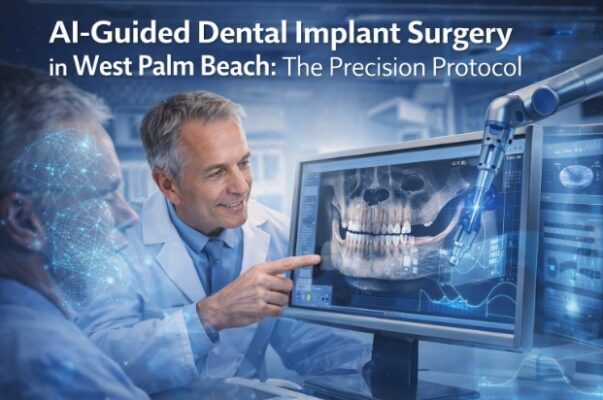
AI-guided dental implant surgery uses 3D CBCT imaging and machine learning to plan implant placement before any incision is made.
Dental implant surgery has a precision problem. Traditional freehand placement relies on the surgeon’s line of sight, two-dimensional X-rays, and manual estimation of bone depth and nerve location.
Even experienced surgeons operate within a 5–10° margin of angular error — a range wide enough to cause nerve impingement, sinus perforation, or implant failure.
West Palm Beach Family Dental eliminates that margin for patients seeking dental implants in West Palm Beach through an AI-Guided Precision Protocol — a fully integrated digital workflow that plans, simulates, and guides every implant procedure before a single incision is made.
For patients over 50 in West Palm Beach and Palm Beach County, this technology closes the gap between surgical intent and surgical outcome.
The American Academy of Oral and Maxillofacial Radiology recognizes CBCT imaging as the diagnostic standard for implant planning in anatomically complex cases — the category that includes most senior patients.
Choosing a qualified implant specialist who uses this technology is the first and most consequential decision a patient makes.
AI-guided implant surgery combines CBCT scanning and machine learning to produce a virtual surgical plan.
A 3D-printed surgical guide locks that plan into physical reality during the implant procedure, removing manual estimation from the most critical placement decisions.
| Clinical Feature | Traditional Freehand Surgery | AI-Guided Precision Protocol |
| Imaging used | 2D panoramic X-ray | 3D CBCT volumetric scan |
| Placement accuracy | Visual estimation | Sub-millimeter (<0.5mm deviation) |
| Angular deviation | 5°–10° average | <2.1° (precision-controlled) |
| Nerve/sinus safety | Manual estimation | 3D safety zone mapping |
| Incision type | Tissue flap + sutures | Minimally invasive/flapless |
| Surgical planning time | 45+ minutes manual | 8 minutes (AI-automated) |
| Recovery time | 5–10 days typical | 24–48 hours for most patients |
Patients who want to understand whether same-day implants or a staged approach is appropriate for their case should know that AI planning directly determines which pathway is clinically viable — the bone quality data gathered during the CBCT scan drives that decision.
Many patients assume “digital dentistry” means a robot performs the surgery. The AI functions as a high-resolution navigation system.
The surgeon controls all movement; the AI provides real-time boundaries and bone-quality data to prevent deviation from the pre-planned trajectory.
If you’re ready to get started, call us now!
Patients over 65 benefit most from AI-guided surgery because age-related alveolar bone resorption reduces jawbone volume and increases proximity to critical anatomical structures. The AI identifies and works within those constraints rather than against them.
Seniors exploring senior implant options typically experience 25–40% bone volume loss within five years of tooth loss.
AI-guided surgery navigates reduced bone architecture with precision that freehand methods cannot replicate, often eliminating the need for bone grafts.
| Patient Characteristic | Impact on Implant Planning | AI Protocol Advantage |
| Alveolar bone resorption | Thinner bone walls, closer nerve proximity | Voxel density mapping identifies usable anchor zones |
| Osteoporosis (controlled) | Reduced bone density | Tapered implant thread selection optimized by AI |
| Type 2 Diabetes (HbA1c <7.5%) | Slower tissue healing | The flapless technique minimizes the wound surface area |
| Sinus pneumatization | Sinus floor descends as bone resorbs | 3D sinus floor mapping prevents perforation |
| Multiple missing teeth | Complex occlusal loading patterns | Virtual stress-test simulation pre-validates bite force |
The National Institute on Aging reports that approximately 27% of adults aged 65 and older have lost all their natural teeth.
Many of these patients have worn dentures long enough that significant bone loss has already occurred, which makes the benefits of implants for seniors extend well beyond aesthetics into structural bone preservation.
Patients with bone loss are frequently told they are “not candidates” for implants without being evaluated using 3D imaging. A 2D panoramic X-ray cannot assess bone width — only height.
CBCT scanning routinely reveals usable bone that 2D imaging misses entirely. Patients who receive this determination should review implants vs. traditional options before accepting a denture as the only alternative.
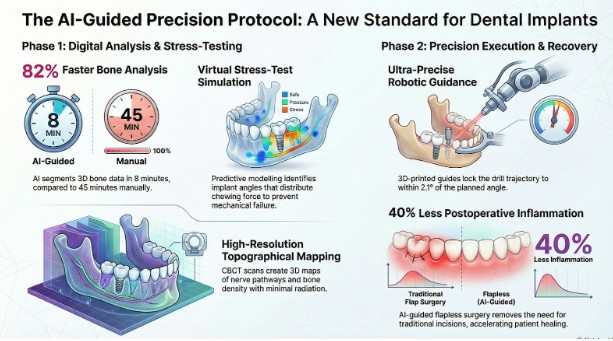
The AI-Guided Precision Protocol compresses four distinct clinical phases into a single pre-surgical session. By the time the patient sits in the surgical chair, the entire procedure has been executed virtually.
West Palm Beach Family Dental’s 4-step workflow — Scan, Analyze, Simulate, Execute — transforms CBCT bone data into a 3D-printed surgical guide that locks drill trajectory to within 2.1° of the planned angle.
The clinician captures a high-resolution Cone Beam Computed Tomography (CBCT) scan. This scan produces a 3D topographical map of the patient’s mandibular and maxillary bone structures, revealing nerve pathways, sinus floors, cortical bone thickness, and trabecular density.
CBCT scanning exposes patients to significantly less radiation than a medical CT scan — approximately 11–674 microsieverts depending on the field of view, per guidelines from the American Dental Association.
Patients who are anxious about the scanning process or the procedure itself should ask about available sedation options before their appointment.
Proprietary machine-learning software segments CBCT data and analyzes voxel density at each potential implant site. Voxel density — measured in Hounsfield Units — determines bone quality.
The AI selects the densest anchor zones to maximize bone-to-implant contact (BIC) and long-term osseointegration stability. This analysis takes approximately 8 minutes. Manual analysis of equivalent data requires 45 minutes or more and introduces human interpretation error at each measurement point.
The AI simulates the patient’s specific occlusal loading patterns — bite force and direction — before any incision is made.
This predictive modeling identifies implant angles that distribute chewing force evenly across the prosthetic and surrounding bone.
Implants placed without this simulation are statistically more likely to experience late-stage mechanical failure under repeated off-axis loading.
A custom 3D-printed surgical guide — fabricated to match the patient’s exact anatomy based on the AI’s planned trajectory — physically constrains the drill to the approved path.
This execution method enables flapless surgery in most single-tooth implant cases, meaning the surgeon does not need to cut or peel back the gum tissue.
Patients undergoing flapless placement experience approximately 40% less postoperative inflammation than those undergoing traditional flap procedures, according to published outcomes data from theJournal of Oral Implantology.
If you’re ready to get started, call us now!
Published clinical data from 2024–2026 show AI-guided implant protocols achieve 96–98.4% success rates at five years.
Traditional freehand methods in complex cases produce success rates closer to 80%, primarily due to angular deviation errors that compromise osseointegration.
| Case Type | Traditional Freehand Success Rate | AI-Guided Protocol Success Rate |
| Single-tooth, healthy bone | ~95% | ~98.4% |
| Multiple implants, moderate bone loss | ~85% | ~96% |
| Full arch (All-on-4 rehabilitation), senior patient | ~78–82% | ~95–97% |
| Patient with Type 2 Diabetes | ~75–80% | ~90–94% |
| Smoker with cessation protocol | ~70–75% | ~88–92% |
Data drawn from aggregate outcomes published in the International Journal of Oral and Maxillofacial Implants and the European Journal of Oral Implantology.
Patients researching implant costs in West Palm Beach should factor in long-term success rates when comparing prices — a lower-cost procedure with a higher failure rate results in a higher total expense over a 10-year period.
West Palm Beach Family Dental serves Florida dental implant patients across Palm Beach County, including Boca Raton, Lake Worth, Boynton Beach, and Jupiter.
Florida’s senior population — the largest proportionally of any U.S. state, according to U.S. Census Bureau data — makes AI-guided implant technology particularly relevant to this region.
Patients concerned about cost can review available financing options before their consultation; West Palm Beach Family Dental offers payment plans designed for patients on fixed retirement incomes.
CBCT scanning and AI planning are performed in-office at the same appointment, with no external referral required.
If you’re ready to get started, call us now!
AI-guided dental implant surgery is a pre-surgical planning process that uses CBCT 3D imaging and machine-learning software to calculate the optimal implant position, depth, and angulation. A 3D-printed surgical guide then transfers the digital plan into the physical procedure with sub-millimeter accuracy.
AI-guided protocols achieve angular deviations of less than 2.1° and positional deviations of less than 0.5mm at the implant tip. Traditional freehand surgery produces average angular deviations of 5–10°, which increases the risk of nerve impingement, sinus perforation, and osseointegration failure.
Yes. AI-guided surgery is particularly advantageous for patients with bone loss because CBCT scans identify usable bone volume that 2D imaging may miss. The AI selects anchor zones with sufficient density to support osseointegration, often eliminating the need for bone grafts.
No. The AI functions as a high-precision planning and navigation system. The surgeon retains full physical control. The AI provides boundary data and a 3D-printed surgical guide that prevents deviation from the planned trajectory.
Yes, provided HbA1c levels are managed below 7.5%. West Palm Beach Family Dental implements a specialized post-operative protocol for diabetic patients, including coordinated healing intervals and antimicrobial therapy to support osseointegration despite impaired microvascular circulation.
Most patients return to normal activity within 24–48 hours following flapless implant placement. Flapless surgery reduces post-operative inflammation by approximately 40% compared to traditional flap procedures because no gum tissue is incised or sutured.
CBCT scanning generates a 3D volumetric map of the jawbone that shows exact locations of nerve pathways and sinus floor depth. The AI uses this data to set digital safety zones — minimum clearance distances that the surgical guide physically prevents the drill from crossing.
AI-guided implant protocols achieve 5-year success rates of 96–98.4% across published clinical studies. Traditional freehand methods in complex cases — including patients with bone loss, diabetes, or full-arch rehabilitation — produce success rates of approximately 78–85%.
Ideal candidates include adults over 50 with single or multiple missing teeth, patients transitioning from dentures, individuals with a history of bone loss or systemic conditions like diabetes, and anyone who requires full-mouth rehabilitation. Patients unsure whether standard or mini vs. standard implants are appropriate for their case receive a definitive recommendation based on CBCT bone data.
Yes. West Palm Beach Family Dental fabricates a custom 3D-printed surgical guide for each patient based on the AI treatment plan. The guide physically constrains drill movement to the approved trajectory — the mechanism that transfers digital precision into the surgical result.
AI-guided implants fail less often because angular precision directly affects bone-to-implant contact (BIC) during osseointegration. An implant placed even 5° off-axis experiences uneven occlusal loading over time, which creates micro-movement at the bone-implant interface and eventual failure. The AI eliminates this source of mechanical error.
Bring any existing dental records, recent X-rays, a full medication list (including supplements), documentation of systemic health conditions, and your insurance card. If you have a prior CBCT scan from another provider, request the DICOM digital file — not a printed film — so the data can be imported directly into the AI planning software.

About Dr. Berglass
Dr. Michael Berglass, a dedicated dentist with over 25 years of experience, specializes in dental implants, cosmetic, and general dentistry in West Palm Beach, Florida. A proud alumnus of Stony Brook School of Dental Medicine (DDS, 1996), Dr. Berglass further honed his expertise with residencies in general practice and dental implants at North Shore-Long Island Jewish Hospital. His journey in dentistry has taken him from New York to North Carolina, and now to Florida, where he continues to offer top-notch dental care. Known for his wit and intellect, Dr. Berglass makes every patient's visit comfortable. Formerly a member of the American Dental Association and the Florida Dental Association, Dr. Berglass remains committed to staying informed about advancements in dentistry and providing exceptional care to his patients. He looks forward to welcoming you to his practice.
About Dr. Cedenos

Dr. Ivan Cedeno is originally from Cuba where he did his dental studies. Having graduated with a DDS diploma gave Ivan and his family great satisfaction, considering he comes from a family of dedicated dental care professionals. After years of practicing Dentistry in Cuba for a few years, Ivan decided to continue his growth journey as a professional in the United States. Early on, Ivan worked as a laboratory technician, which gave him some unique insights that dental school does not teach. Having graduated from the University of Puerto Rico as a DMD, Ivan is allowed to practice in the USA.


