Mini Dental Implants vs Standard Implants in West Palm Beach: Pros, Cons & Best Uses
Originally published: January 2026 | Updated: March 2026 | Reviewed by Dr. Michael Berglass, DDS
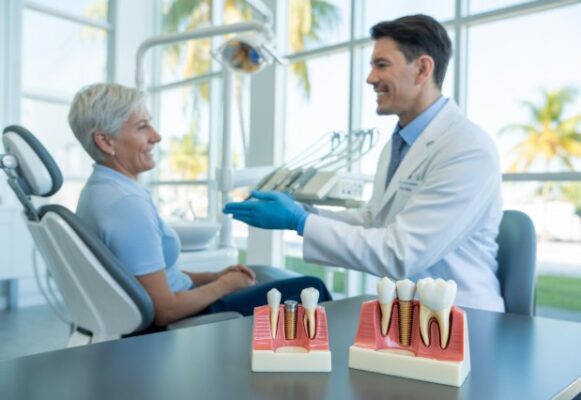
When you’re looking to replace missing teeth in West Palm Beach, deciding between mini and standard dental implants can get confusing fast.
Both choices have strengths and weaknesses, particularly in size, strength, cost, and their use in implant dentistry.
Mini dental implants are smaller and less invasive, making them ideal for stabilizing dentures or replacing front teeth.
Standard implants, on the other hand, offer greater strength and durability, making them a better fit for molars and long-term single-tooth replacement.
Your implant dentist will look at your bone density, the location of your missing tooth, and your oral health goals before recommending an option.
The choice between mini and standard dental implants depends on your jawbone structure and your desired smile.
Some people need the quick healing and lower cost of mini implants. Others just want the stability that standard implants offer for chewing and long-term health.

Standard implants usually measure 4-6mm in diameter and deliver the most stability for long-term tooth replacement. Mini implants are 2-3mm in diameter, allowing dentists to place them with less invasive procedures and promote faster healing.
Choosing between them depends on your bone density, which teeth you’re replacing, and whether you need single teeth or full dentures secured.
Standard dental implants are titanium posts, 4 to 6mm in diameter, that act as permanent anchors for crowns, bridges, or dentures. Dentists need sufficient bone density to place them, and the procedure is slightly more complex.
Mini dental implants are smaller—just 2 to 3mm across—making them about half as wide as standard implants. They’re a good fit when you have limited bone or want a quicker, less invasive option.
Key Size Comparison:
The size difference changes how your dentist places them—and how much bone you need for a stable result.
If you’re missing one or more teeth and want to know which implant type fits your situation, this guide’s for you. It’ll help you prep for a real conversation with your West Palm Beach dentist about your options.
Single-tooth replacement typically works best with standard implants, which offer greater stability and durability. If your bone is healthy and you want a strong foundation for a crown, most dentists will recommend standard implants.
Denture stabilization is where mini implants really shine. Dentists can use 4-6 mini implants to secure a full denture, and the cost is often lower than that of standard implants. If you’re tired of dentures that slip, this route can be a game-changer.
Full arch restoration depends on your bone structure and budget. Standard implants provide the most secure foundation for full-arch bridges. However, if you don’t want bone grafting, mini implants may work for some full-arch cases. Your own anatomy will drive the recommendation.
If you’re ready to get started, call us now!

Mini and standard implants have different physical features that change how they work and where they fit best. If you get a grip on diameter, design, and how they handle chewing force, you’ll make a smarter choice for your teeth.
Standard dental implants typically measure 3.5 to 6 millimeters in diameter. The extra width helps them bond tightly to your jawbone.
Mini implants are much slimmer—just 1.8 to 3 millimeters wide. That’s less than half the width of traditional options. The narrow profile allows mini implants to fit into tight bone spaces, but it also means less contact with the bone.
Standard implants need enough bone volume to support their size. Mini implants can squeeze into thinner bone ridges, so you might not need bone grafting.
Standard implants use a two-piece design with a separate implant and abutment. Dentists place the implant first, let it heal, then attach the abutment and crown. This setup gives more flexibility for angles and future replacements.
Mini implants come as a one-piece unit—the post and attachment ball are fused. Fewer parts mean fewer weak spots, but you can’t adjust them much after placement.
This difference matters for long-term maintenance. With two-piece systems, your dentist can swap out pieces if something goes wrong.
With one-piece mini implants, if anything fails, you’ll probably need to replace the whole thing.
Your back teeth take a beating—chewing can put over 200 pounds of pressure on them. Standard implants handle this pressure well, thanks to their wider size and bigger bone contact. They function like sturdy artificial tooth roots that distribute the load.
Front teeth experience much lower forces, usually under 50 pounds. Mini implants can work here, especially when looks matter and the bone is thinner. The narrow shape fits well in these tight spots.
If implants can’t withstand normal chewing, bone atrophy can accelerate. Standard implants do a better job of preventing bone loss in high-pressure zones. Mini implants may not distribute force sufficiently for molars, where you bite down hard.
| Feature | Mini implants | Standard implants | What it means for you |
| Typical diameter | Smaller diameter (often “narrow/mini” category) | Wider diameter (traditional/standard range) | Smaller implants may fit tighter spaces, but size can affect strength and restorative options. |
| Common best use | Stabilizing dentures; select low-to-moderate load cases | Single-tooth crowns (including molars), bridges, broader case types | Your restoration goal (denture vs fixed tooth) often determines the better option. |
| Restoration flexibility | More limited in many cases (depends on system/design) | Generally, more flexible for crowns/bridges and complex plans | If you want a fixed tooth replacement, standard implants usually provide more planning options. |
| Bite-force tolerance | Often better suited for lighter forces and specific indications | Typically preferred for higher chewing forces (especially back teeth) | Heavy chewers, grinders, and molar-replacement patients often require the stability of standard implants. |
| Bone width needs | May work in a narrower bone in select situations | May require more bone width or site development | If the bone is narrow, mini-implants may be considered—but a dentist should confirm they are appropriate and durable. |
| Need for grafting | Sometimes reduced, not always eliminated | More likely if the bone volume is insufficient | “No grafting needed” isn’t guaranteed; your anatomy decides. |
| Surgery/invasiveness | Can be less invasive in some instances | Can be more involved depending on site preparation | Comfort and recovery can differ, but planning quality matters more than implant size alone. |
| Healing timeline | Varies by case; not always faster | Varies by case; often similar overall phases | Expect planning → placement → healing → restoration; timelines depend on bone/health/restoration type. |
| Longevity expectations | Can be successful in the right indications; case selection is key | Strong long-term track record across many indications | The “best” option is the one matched to your case; durability depends on planning, bite, and maintenance. |
| Maintenance needs | Regular professional care is still required | Regular professional care is still required | Both require hygiene, follow-ups, and managing bite forces to protect your investment. |
| Cost structure | Sometimes lower upfront; depends on what’s included | Often higher upfront; varies with steps/materials | Compare quotes line-by-line (imaging, grafting, abutment, crown/bridge, follow-ups) to avoid surprises. |

Mini dental implants excel at stabilizing removable dentures and fitting into areas where standard implants just won’t go.
They also help people with thin bones avoid major grafting surgeries, though you need to select cases carefully for the best results.
Stabilizing dentures is the most common use for mini dental implants. Lower dentures, in particular, tend to move around, causing embarrassment or discomfort. Mini-implants give dentures a stable foundation in your jawbone.
Your dentist typically places four to six mini dental implants in your lower jaw to secure dentures.
The dentures snap onto the implants with little ball-and-socket connectors. This setup keeps your dentures steady while still letting you remove them for cleaning.
The mini dental implant procedure for denture stabilization works well for lower dentures because the lower jaw is often narrow. Upper dentures can also use mini-implants, though you may need more for adequate support.
A lot of people find that mini implants let them eat and speak more confidently than with sticky adhesives.
Mini dental implants sometimes work for single-tooth replacement, but only in tight spaces.
Some front teeth, such as lateral incisors or lower anteriors, have roots that are loose together, so standard implants won’t fit. In these cases, a mini-implant might be the only way to avoid damaging nearby roots.
Still, mini-implants aren’t strong enough for most back teeth. Molars and premolars handle a lot of chewing force, and mini-implants just don’t cut it there.
Mini dental implants differ significantly from standard dental implants in the amount of chewing pressure they can withstand. For most single-tooth replacements, dentists use standard implants for long-term stability.
Mini dental implants need less bone width than standard implants, which sounds promising if you’ve lost some bone. Their narrow diameter sometimes lets them fit without major bone grafting.
That makes them an option if your jaw’s lost a bit of bone. But “limited bone” doesn’t mean “no bone”—you still need enough bone height and density for mini-implants to hold steady.
If your jawbone’s very thin or severely resorbed, even smaller implants might not have enough support. You can’t just skip the basics because the implant is smaller.
Realistic scenarios for limited bone:
Risky scenarios:
Your dentist will evaluate your bone structure with X-rays or CT scans before recommending mini-implants.
When mini dental implants are best depends largely on your jawbone’s capacity. Sometimes even mini-implants need grafting, but usually less than standard ones.
West Palm Beach Family Dental can help you decide between mini and standard implants with a free consultation and X-rays included. Schedule an appointment.
If you’re ready to get started, call us now!
Standard dental implants can withstand greater forces and support larger or more complex restorations than minis.
If you need to replace molars or support a bridge for multiple teeth, your dentist will recommend traditional implants.
Your back teeth experience much more pressure during chewing than your front teeth do. Molars can crank out 250 to 300 pounds of force when you bite down.
Regular implants measure approximately 3.5 to 6 millimeters in width, providing a broader base to distribute chewing forces. Mini implants are typically under 3 millimeters and cannot handle that level of stress.
For premolars and molars, standard dental implants are the go-to. The larger size prevents them from failing during daily chewing. Your back teeth really need the stability only traditional implants can offer for long-term success.
Bridges that replace several missing teeth need strong support structures. Regular dental implants securely anchor these heavier restorations.
A standard three-unit bridge needs at least two implants to support it. The bridge joins artificial teeth that take a beating every day. Traditional implants provide the muscle to handle this weight without loosening up or breaking.
Your dentist might use two to four regular implants for a bridge, depending on how many teeth you’re replacing.
Mini implants just can’t handle these jobs. Standard implants also make more sense for full-arch restorations, where several teeth are supported by multiple posts.
If your jawbone has lost density or volume, you may need a bone graft. Bone loss occurs naturally after tooth loss or due to gum disease.
During bone grafting, your dentist adds material to your jaw to build up a stronger base. They’ll place bone material where your own bone has shrunk. Healing usually takes three to six months before you can get the implant.
Bone grafting lets you get regular implants even after bone loss. It strengthens your jaw enough to support the larger implants.
This adds time and cost, but in the long run, you get better results than with mini implants when your bone isn’t up to it.
Each type of implant has its own advantages and disadvantages, which directly affect your outcome. It’s worth digging into real differences instead of just trusting flashy ads.
Mini implants are a good option when you have less bone and want to skip grafting. Their slim size means your dentist doesn’t have to cut big flaps in your gums.
You’ll usually bounce back faster—most people get back to normal life in a day or two. The procedure can cost 30-50% less than standard implants because it’s simpler and takes less time.
They’re perfect for locking down loose dentures. Mini implants provide immediate retention for full dentures, solving a significant problem quickly. Sometimes your dentist can even place them and attach your denture the same day.
Key benefits:
Mini implants can’t take as much biting force as standard implants. Their thin size limits them to specific situations. You shouldn’t use them for single crowns on back teeth, where the pressure is highest.
The downsides of mini dental implants include higher failure rates in high-stress spots. They’re best for holding dentures in place, not for replacing individual teeth.
Bone quality really matters with minis, since they have less surface area to bond to your jaw.
Load limitations:
Even though minis are smaller, you still need enough bone width. If your bone is too thin or weak, minis might not work either.
Traditional implants bring top-notch strength and flexibility. With good planning and bone support, you can replace any tooth. The larger diameter distributes chewing forces and reduces the risk of failure.
But the process takes longer. After surgery, you usually wait 3-6 months for the bone to grow around the implant before your dentist puts on the final crown. If you need bone grafting, tack on another 4-6 months.
Standard implants cost more upfront but can last longer in tough spots. Expect to pay $3,000 to $6,000 per tooth, including the crown. Minis range from $500 to $1,500 each.
Time commitment:
All those extra steps and waiting usually mean a sturdier, longer-lasting result. The investment pays off if you want optimal performance for single teeth or complex cases.
Prices for mini and standard implants vary based on what’s included and the complexity of your case. Knowing what drives the cost lets you compare options more clearly.
A full implant restoration has three parts. The implant post goes into your jaw. The abutment connects the post to the visible tooth. The crown sits on top of your new tooth.
Standard implants in West Palm Beach cost $3,000 to $5,000 per tooth for all three pieces. Mini dental implants range from $500 to $1,500 each. That lower price is due to the simpler design and faster placement.
Your quote should list each part separately. Some offices bundle the abutment with the implant. Others charge for it separately. The crown usually runs $1,000 to $2,000 for standard implants.
If you need several teeth replaced, an implant-supported bridge can use fewer implants than doing each tooth separately. That can lower your total cost.
Mini implants are cost-effective if your bone is healthy and you don’t need additional work. Their small size allows dentists to place them with minimal bone preparation, reducing surgical time and costs.
You won’t save as much if you have to take extra steps. Bone grafts, sinus lifts, or extractions all add to the bill, no matter what type you pick. Minis also tend to wear out faster, so you may need to replace them sooner.
Traditional implants last longer in West Palm Beach. The higher upfront cost spreads out over 25+ years. Mini implants are great for stabilizing dentures or replacing small teeth with less biting force.
Many quotes omit pre-surgical imaging, such as CT scans. These cost $200 to $500 but are super important for safe placement. Ask if your consult includes this.
Bone grafting isn’t always part of the base price. It can add $300 to $3,000, depending on your needs. Temporary crowns during healing may also incur an additional cost.
Find out if your quote covers follow-up visits and tweaks. Some offices include these; others charge for each one. Knowing dental implant lingo helps you ask better questions about what each line item includes.
Ask about warranties for each part. The implant post, abutment, and crown might all have different coverage lengths. That matters for your long-term costs if you ever need a replacement.
Choosing between mini and standard implants depends on your bone density, how many teeth you’re replacing, and your budget. A few key decision points can clarify things, but it’s not always straightforward.
If your dentist recommends a full-arch restoration and the treatment plan costs over $20,000 per arch, it’s prudent to get a second opinion.
Different specialists may recommend traditional implants versus mini-implants, depending on their training and preferences.
Let’s say you’ve got severe bone loss. If one dentist recommends extensive grafting and another opts for mini-implants, that’s a significant difference. This price and procedure difference warrants another review.
If your dentist wants to use mini implants to replace several back teeth, talk to a second West Palm Beach implant specialist. Standard implants usually handle molar chewing pressure better.
When you get recommendations that just don’t line up, or your dentist doesn’t have much experience with a certain type of implant, don’t hesitate to seek another opinion.
Ready for a clear recommendation on mini versus standard implants, plus pricing and next steps? Schedule your visit today with West Palm Beach Family Dental.
What’s the difference between mini dental implants and standard implants?
Mini dental implants are smaller-diameter implants often used to stabilize dentures or fit narrow spaces. Standard implants are wider and are usually more versatile for fixed crowns and bridges, especially in high-chewing-force applications.
Who is a good candidate for mini dental implants in West Palm Beach?
You may be a candidate for mini implants if you want denture stability or have limited space, but you still need healthy gums and enough bone. A consultation and imaging help determine whether mini or standard implants are appropriate for your bite.
Can mini dental implants be used for molars or single crowns?
Mini implants are often not the first choice for single molar crowns because back teeth handle the strongest forces. Standard implants typically provide greater stability and more restorative options for molars, depending on bone quality, bite, and habits such as grinding.
Are mini dental implants cheaper than standard implants in West Palm Beach?
In West Palm Beach, mini implants typically cost $500–$2,000 per implant, while a standard single-tooth implant can range from $3,000–$5,000 when all components are included. Your total changes with extractions, grafting, and restoration type.
Do mini implants help you avoid bone grafting?
Mini implants can sometimes reduce the need for grafting in select cases, but they don’t eliminate the need for bone. If you have thin or weak bone, gum disease, or complex anatomy, your dentist may still recommend site development or standard implants.
Is the treatment timeline faster with mini implants?
Treatment time varies more by your case than by implant size. Some patients receive temporary teeth quickly, while others need a staged approach with healing before final restorations. Expect planning, placement, healing, then crowns or dentures—often over weeks to months.
What should be included in an “all-in” implant quote?
A comparable implant quote should list the implant, abutment, and crown or denture components, as well as imaging, sedation (if used), and follow-up visits. It should also note possible add-ons like extractions or bone grafting, so you’re not surprised later.

About Dr. Berglass
Dr. Michael Berglass, a dedicated dentist with over 25 years of experience, specializes in dental implants, cosmetic, and general dentistry in Boynton Beach, Florida. A proud alumnus of Stony Brook School of Dental Medicine (DDS, 1996), Dr. Berglass further honed his expertise with residencies in general practice and dental implants at North Shore-Long Island Jewish Hospital. His journey in dentistry has taken him from New York to North Carolina, and now to Florida, where he continues to offer top-notch dental care. Known for his wit and intellect, Dr. Berglass makes every patient's visit comfortable. A member of the American Dental Association and Florida Dentists' Association, he stays at the forefront of dental advancements. Dr. Berglass is committed to providing exceptional care and looks forward to welcoming you to his practice.
About Dr. Cedenos

is originally from Cuba where he did his dental studies. Having graduated with a DDS diploma gave Ivan and his family great satisfaction, considering he comes from a family of dedicated dental care professionals. After years of practicing Dentistry in Cuba for a few years, Ivan decided to continue his growth journey as a professional in the United States. Early on, Ivan worked as a laboratory technician, which gave him some unique insights that dental school does not teach. Having graduated from the University of Puerto Rico as a DMD, Ivan is allowed to practice in the USA.


