Dental Implants Vs Dentures Vs Bridges: The 20 Year Lifetime Value Matrix
Originally published: March 2026 | Updated: June 2026 | Reviewed by Dr. Michael Berglass, DDS
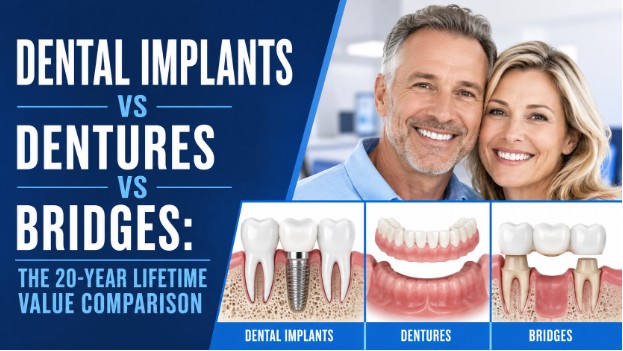
Dental implants cost more upfront but typically cost less over 20 years than dentures or bridges. A dental implant replaces the tooth root with a titanium post and a permanent porcelain crown; a dental bridge is a fixed prosthetic anchored to adjacent natural teeth; and a denture is a removable acrylic appliance that is replaced every 5–10 years as jawbone resorption alters fit.
At West Palm Beach Family Dental, Dr. Michael Berglass, DDS, places dental implants for $2,400 all-inclusive (2026 pricing) — which break even with denture replacement costs within 6–10 years for most patients.
Missing teeth cost more the longer you wait — jawbone loss increases treatment complexity and total expense every year. Schedule a free consultation with Dr. Berglass at West Palm Beach Family Dental to get a written 20-year cost comparison for your specific case.
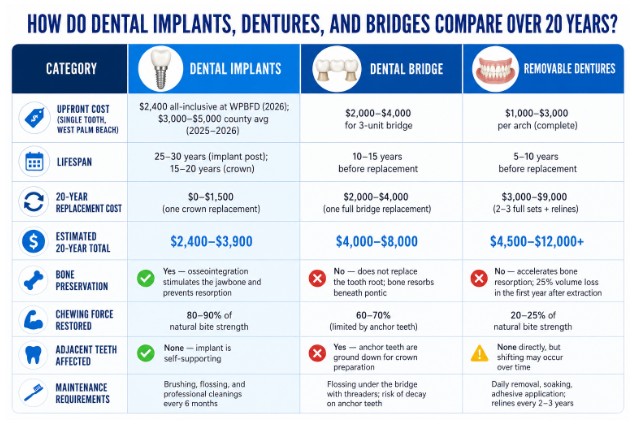
Dental implants cost $2,400 per tooth (2026 pricing) at West Palm Beach Family Dental, require no replacement cycle, and preserve jawbone density — making them the lowest 20-year total cost option for most patients.
Dentures start at a lower cost but can add $4,500–$12,000+ in relines, adhesives, and replacements over two decades.
Bridges fall in the middle of upfront cost but carry the risk of anchor-tooth failure that can expand a one-tooth problem into a three-tooth treatment.
The table below compares all three options across the eight categories that determine real lifetime value.
| Category | Dental Implants | Dental Bridge | Removable Dentures |
| Upfront cost (single tooth, West Palm Beach) | $2,400 all-inclusive at WPBFD (2026); $3,000–$5,000 county avg (2025–2026) | $2,000–$4,000 for 3-unit bridge | $1,000–$3,000 per arch (complete) |
| Lifespan | 25–30 years (implant post); 15–20 years (crown) | 10–15 years before replacement | 5–10 years before replacement |
| 20-year replacement cost | $0–$1,500 (one crown replacement) | $2,000–$4,000 (one full bridge replacement) | $3,000–$9,000 (2–3 full sets + relines) |
| Estimated 20-year total | $2,400–$3,900 | $4,000–$8,000 | $4,500–$12,000+ |
| Bone preservation | Yes — osseointegration stimulates the jawbone and prevents resorption | No — does not replace the tooth root; bone resorbs beneath the pontic | No — accelerates bone resorption; 25% volume loss in the first year after extraction |
| Chewing force restored | 80–90% of natural bite strength | 60–70% (limited by anchor teeth) | 20–25% of natural bite strength |
| Adjacent teeth affected | None — implant is self-supporting | Yes — anchor teeth are ground down for crown preparation | None directly, but shifting may occur over time |
| Maintenance requirements | Brushing, flossing, and professional cleanings every 6 months | Flossing under the bridge with threaders; risk of decay on anchor teeth | Daily removal, soaking, adhesive application; relines every 2–3 years |
The American College of Prosthodontists reports that 178 million Americans are missing at least one tooth, and 40 million are missing all teeth.
The replacement method chosen at the time of first tooth loss determines the cost trajectory for the next two decades.
Patients comparing quotes from multiple offices should use the practice’s guide to comparing dental implant quotes to verify what each line item includes and which costs appear later.
If you’re ready to get started, call us now!
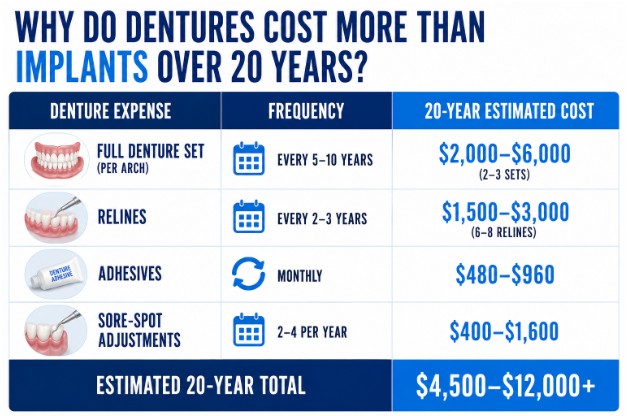
Dentures cost more over 20 years because jawbone resorption forces a cycle of relines, adjustments, and full replacements, accumulating $4,500–$12,000+ in expenses that did not exist at the time of purchase.
A systematic review published in Clinical Oral Implants Research found that the alveolar ridge loses approximately 25% of its width within the first year after tooth extraction, with continued resorption over subsequent years.
Jawbone resorption changes the shape of the gum tissue that supports a denture. The denture loosens. The patient adds adhesive. The dentist performs a reline ($300–$500 per reline).
The cycle repeats every 2–3 years until the denture requires full replacement, which costs $1,000–$3,000 per arch.
| Denture Expense | Frequency | 20-Year Estimated Cost |
| Full denture set (per arch) | Every 5–10 years | $2,000–$6,000 (2–3 sets) |
| Relines | Every 2–3 years | $1,500–$3,000 (6–8 relines) |
| Adhesives | Monthly | $480–$960 |
| Sore-spot adjustments | 2–4 per year | $400–$1,600 |
| Estimated 20-year total | $4,500–$12,000+ |
Dentures also restore only 20–25% of natural chewing force, which limits diet to softer foods and can affect nutritional intake — a particular concern for patients over 65.
Chewing difficulty is identified by the National Institute on Aging as a risk factor for malnutrition in older adults.
Dental implants eliminate the replacement cycle entirely because the titanium post fuses permanently with the jawbone through osseointegration.
Patients who already wear dentures and want to understand the transition process should read the practice’s guide on implants vs traditional options.
A dental bridge fails when one of its anchor teeth develops decay, fracture, or requires root canal treatment — turning a one-tooth problem into a three-tooth treatment that costs $4,000–$8,000+ to resolve.
Bridge preparation requires grinding down healthy adjacent teeth to create anchor points for the prosthetic. Those modified teeth become permanently compromised and more susceptible to decay at the crown margin over time.
The average lifespan of a bridge is 10–15 years, according to the American Dental Association, after which the prosthetic typically requires full replacement.
If an anchor tooth fails during that period, the patient faces the extraction of the anchor tooth plus a wider bridge or an implant to replace what was originally a single missing tooth.
Dental implants avoid this risk completely because they are self-supporting — no adjacent teeth are modified, ground down, or structurally compromised.
Dr. Berglass evaluates whether a bridge or an implant is the better long-term option during every free consultation, based on the patient’s CBCT 3D imaging, bone density, and the health of adjacent teeth.
Patients considering bridges should also review the practice’s overview of crowns and bridges in West Palm Beach to understand when a bridge is clinically appropriate and when a root-replacement option provides better durability.
Paying more now for a bridge that fails in 10 years costs more than paying once for an implant that lasts 25+ years. Schedule a free consultation with Dr. Berglass to see which option fits your bone health, budget, and long-term goals.
Bone preservation is the single clinical variable that separates implants from both dentures and bridges on long-term cost, because continued bone loss after tooth extraction increases the complexity and expense of any future treatment.
A dental implant is the only replacement option that maintains functional loading on the jawbone through osseointegration, the biological process in which titanium fuses directly with living bone tissue.
Dentures and bridges both leave the extraction site unstimulated. The American Academy of Implant Dentistry reports that the jawbone can lose up to 25% of its width in the first year after tooth loss and continues to resorb at a measurable rate for the remainder of the patient’s life.
Bone resorption after tooth loss has two financial consequences: it makes denture fit increasingly unstable (triggering the reline/replacement cycle described above), and it makes future implant placement more complex if the patient delays treatment.
Patients who wait 5+ years after tooth loss may require bone grafting ($500–$2,000 per site) before an implant can be placed — a procedure that would not have been necessary with earlier intervention.
Dr. Berglass uses in-house CBCT 3D imaging to assess current bone volume and determine whether grafting is needed or whether existing bone supports immediate implant placement.
For patients already experiencing visible facial changes from tooth loss, implants halt further resorption at the site of placement — a functional benefit that dentures and bridges cannot provide at any price.
Dental implants break even with dentures at approximately 6–10 years, and with bridges at approximately 10–12 years, when all replacement, reline, maintenance, and complication costs are included.
The break-even point shifts earlier for patients who smoke (accelerated bridge failure), have diabetes (slower denture healing and more frequent adjustments), or are under 60 (longer remaining lifespan amplifies cumulative replacement costs).
| Scenario | Implant Break-Even vs Dentures | Implant Break-Even vs Bridge |
| Non-smoker, healthy bone, age 50–65 | ~7 years | ~10 years |
| Diabetic patient (HbA1c < 7.5%) | ~6 years (more frequent denture adjustments) | ~9 years |
| Smoker with cessation protocol | ~8 years | ~8 years (accelerated bridge failure) |
| Patient over 70, moderate bone loss | ~9 years | ~12 years |
The practice offers CareCredit financing at 0% interest for 6–24 months, an In-Office Savings Plan at $375 per year (including 20% off all dental work), and in-house payment plans starting at $79 per month with no credit check.
CareCredit, the savings plan, and in-house financing allow patients to capture the 20-year value advantage of implants without absorbing the full upfront cost in a single payment.
Patients comparing same-day vs staged implant timelines should factor in temporary prosthetic costs during the staged healing period, which can add $500–$1,000 to the total if a temporary crown or flipper is needed during osseointegration.
If you’re ready to get started, call us now!
Denture wearers with sufficient remaining bone volume can transition to implants, though patients who have worn dentures for 5+ years typically require CBCT 3D imaging to assess remaining bone before determining candidacy.
Prolonged denture wear accelerates jawbone resorption because the prosthetic provides no root-level stimulation to the underlying bone.
Two common transition pathways exist. The first is implant-retained dentures, where 2–4 implants per arch are placed to snap-lock an existing or modified denture in place — this dramatically improves stability and chewing force while costing less than full individual implant placement.
The second is All-on-4 full-arch restoration, where four strategically angled implants support a fixed, non-removable bridge that permanently replaces all teeth in one arch.
Dr. Berglass evaluates transition candidacy using in-house CBCT imaging that identifies usable bone volume that a standard 2D X-ray cannot detect. Patients who have been told they are “not candidates” for implants based on a panoramic X-ray alone should request a free second opinion with 3D imaging before accepting continued denture wear as the only option.
For a detailed comparison of full-arch implant pathways, read the practice’s guide on full-arch implants in West Palm Beach.
Dental implants restore 80–90% of natural chewing strength, require no dietary restrictions after healing, and are maintained with normal brushing and flossing — the same routine as natural teeth.
Dentures restore only 20–25% of natural bite force, require daily removal and soaking, and commonly cause sore spots, slippage during speech, and food avoidance. Bridges restore 60–70% of chewing force but require specialized flossing with threaders and carry the ongoing risk of anchor-tooth decay.
The quality-of-life difference is most measurable in three areas: eating (implant patients eat steak, apples, and corn on the cob without restriction), speaking (denture slippage during conversation is eliminated), and confidence (implant crowns are visually indistinguishable from natural teeth).
The practice’s guide on how dental implants change everyday life covers these functional differences in detail.
Patients planning for recovery should read what to eat after dental implant surgery to set realistic expectations for the first 1–2 weeks of soft-diet healing before returning to unrestricted eating.
Your tooth replacement decision affects what you eat, how you speak, and what you spend for the next 20 years — not just what you pay today. Call (561) 968-6022 or schedule online to get a free, itemized 20-year cost comparison from Dr. Berglass at West Palm Beach Family Dental.
Are dental implants worth the higher upfront cost compared to dentures?
Dental implants at West Palm Beach Family Dental cost $2,400 all-inclusive per tooth, while dentures can cost $4,500–$12,000+ over 20 years due to relines, replacements, and adhesives. Implants break even against dentures within 6–10 years for most patients.
What lasts longer — dental implants, bridges, or dentures?
Dental implants last 25–30 years with proper maintenance, bridges last 10–15 years before replacement, and dentures last 5–10 years before the jawbone changes enough to require a new set. Implants are the only option that does not require a replacement cycle.
Do dental implants prevent bone loss in the jaw?
Dental implants prevent bone loss at the site of placement through osseointegration, the process by which titanium fuses directly with living jawbone tissue and supports functional loading. Dentures and bridges leave the extraction site unstimulated, allowing approximately 25% loss of bone width in the first year alone.
Can I get dental implants if I already wear dentures?
Denture wearers with sufficient remaining bone volume can transition to implants or implant-retained dentures after a CBCT 3D scan confirms adequate bone density. Patients told they lack bone based on a 2D X-ray should request a second opinion with 3D imaging at West Palm Beach Family Dental.
Does Medicare cover dental implants in Florida?
In most cases, Original Medicare does not cover routine dental services, including implants, dentures, or bridges. Some Medicare Advantage plans offer limited dental benefits, but coverage varies by carrier and plan tier. Medicare.gov explains current dental coverage limitations in detail.
What is the cheapest way to replace a missing tooth?
A removable partial denture is the lowest-upfront-cost option at $500–$1,500 per tooth, but it restores the least chewing function and requires the most frequent replacement. The lowest 20-year total cost option for most patients is a dental implant because it eliminates the need for replacement entirely.
Can I finance dental implants at West Palm Beach Family Dental?
West Palm Beach Family Dental offers CareCredit financing at 0% interest for 6–24 months, an In-Office Savings Plan at $375 per year with 20% off all dental work, and in-house payment plans starting at $79 per month with no credit check. Free consultations, including X-rays, are available before any financial commitment.
How do I know if I need an implant, a bridge, or dentures?
The right choice depends on how many teeth are missing, remaining bone density, the health of adjacent teeth, and the patient’s long-term budget. Dr. Michael Berglass determines the best option during a free consultation using in-house CBCT 3D imaging that reveals bone volume and nerve proximity, which a standard X-ray cannot capture.
What happens to my face if I choose dentures instead of implants?
Jawbone resorption from denture wear causes progressive loss of facial height and volume, resulting in a sunken or aged appearance around the mouth and chin. Dental implants halt bone loss at the site of placement and preserve facial structure. The practice’s guide on facial changes from tooth loss explains this process in detail.
Is a dental bridge a good option if I am missing one tooth?
A dental bridge can effectively replace a single missing tooth when the adjacent teeth are healthy, and the patient understands the 10–15-year replacement timeline. The trade-off is that both anchor teeth must be permanently ground down for crown preparation, which increases their long-term risk of fracture and decay compared to an implant that stands independently.

About Dr. Berglass
Dr. Michael Berglass, a dedicated dentist with over 25 years of experience, specializes in dental implants, cosmetic, and general dentistry in West Palm Beach, Florida. A proud alumnus of Stony Brook School of Dental Medicine (DDS, 1996), Dr. Berglass further honed his expertise with residencies in general practice and dental implants at North Shore-Long Island Jewish Hospital. His journey in dentistry has taken him from New York to North Carolina, and now to Florida, where he continues to offer top-notch dental care. Known for his wit and intellect, Dr. Berglass makes every patient's visit comfortable. Formerly a member of the American Dental Association and the Florida Dental Association, Dr. Berglass remains committed to staying informed about advancements in dentistry and providing exceptional care to his patients. He looks forward to welcoming you to his practice.
About Dr. Cedenos

Dr. Ivan Cedeno is originally from Cuba where he did his dental studies. Having graduated with a DDS diploma gave Ivan and his family great satisfaction, considering he comes from a family of dedicated dental care professionals. After years of practicing Dentistry in Cuba for a few years, Ivan decided to continue his growth journey as a professional in the United States. Early on, Ivan worked as a laboratory technician, which gave him some unique insights that dental school does not teach. Having graduated from the University of Puerto Rico as a DMD, Ivan is allowed to practice in the USA.


