What Is a Fellowship-Trained Implant Dentist? Inside Dr. Berglass’s 25-Year Restorative Journey
Originally published: July 2026 | Reviewed by Dr. Michael Berglass, DDS
A fellowship-trained implant dentist is a licensed dental professional who completed post-doctoral residency or fellowship education specifically in surgical implant placement and prosthetic restoration — training beyond the Doctor of Dental Surgery (D.D.S.) degree required for general licensure.
Dr. Michael Berglass, D.D.S., earned his D.D.S. from the Stony Brook School of Dental Medicine in 1996, then completed both a general practice residency and a dedicated dental implant fellowship at North Shore–Long Island Jewish Hospital in Manhasset, New York.
That post-doctoral credential separates fellowship-trained providers from general practitioners who place implants under standard licensure alone — a distinction the National Institute of Dental and Craniofacial Research identifies as clinically significant for patient safety outcomes in surgical prosthetics.
Your implant outcome depends on who holds the handpiece — Dr. Berglass brings fellowship-level precision to every case at West Palm Beach Family Dental.
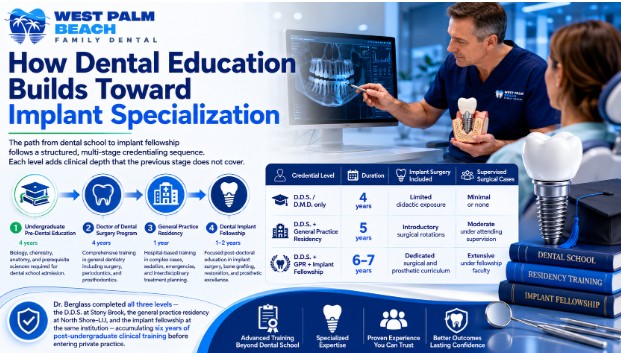
The path from dental school to implant fellowship follows a structured, multi-stage credentialing sequence. Each level adds clinical depth that the previous stage does not cover.
| Credential Level | Duration | Implant Surgery Included | Supervised Surgical Cases |
| D.D.S. / D.M.D. only | 4 years | Limited didactic exposure | Minimal or none |
| D.D.S. + General Practice Residency | 5 years | Introductory surgical rotations | Moderate under attending supervision |
| D.D.S. + GPR + Implant Fellowship | 6–7 years | Dedicated surgical and prosthetic curriculum | Extensive under fellowship faculty |
Dr. Berglass completed all three levels — the D.D.S. at Stony Brook, the general practice residency at North Shore–LIJ, and the implant fellowship at the same institution — accumulating six years of post-undergraduate clinical training before entering private practice.
If you’re ready to get started, call us now!
North Shore–Long Island Jewish Hospital — now part of Northwell Health — operates one of New York’s largest academic medical systems. The dental implant fellowship program at North Shore–LIJ trained residents in both the surgical and prosthetic phases of implant treatment, a dual-discipline curriculum that many fellowship programs split across separate tracks.
Dr. Berglass’s fellowship included direct training in:
That dual-phase training — surgical placement plus prosthetic restoration — means Dr. Berglass manages the entire implant process without referring patients to a separate surgeon or restorative specialist.
The diagnosing clinician and the treating surgeon remain the same person from consultation through final crown delivery.
Florida’s Department of Health maintains a public license verification portal where patients can confirm any dentist’s active licensure status, education, and disciplinary history.
The Florida Department of Health License Verification database lists the degree-granting institution and graduation year for every licensed provider in the state.
Beyond basic licensure, patients should verify three additional credential layers before scheduling implant surgery:
| Credential Check | Where to Verify | What to Confirm |
| Active Florida dental license | Florida Department of Health MQA portal | License status, school, graduation year |
| Post-doctoral residency/fellowship | Provider’s website or direct inquiry | Fellowship institution, program type, duration |
| Implant-specific training | Direct inquiry or professional affiliations | Surgical + prosthetic fellowship vs. general CE courses |
| Disciplinary history | Florida DOH public records | No active complaints or restrictions |
Patients should ask the provider directly whether the same clinician who performs the consultation also places the implant and delivers the final crown restoration. Practices that split the case across multiple providers lack the clinical continuity that fellowship-trained providers like Dr. Berglass deliver at every stage.
If you’re ready to get started, call us now!
Implant longevity depends on precise surgical variables that fellowship training addresses directly — angulation accuracy, depth calibration, torque application, and prosthetic load distribution. Each variable affects whether an implant integrates permanently or fails within the first five years.
Dr. Berglass applies 25 years of these fellowship-calibrated techniques to every implant placed at West Palm Beach Family Dental — a clinical foundation built at Stony Brook and North Shore–LIJ and refined across thousands of cases in private practice.
West Palm Beach Family Dental provides free consultations, including diagnostic X-rays, for every prospective implant patient. Dr. Berglass evaluates bone density, reviews medical history, and presents a complete treatment plan at the first visit — no referral required.
The practice charges $2,400 all-inclusive for a single-tooth implant, including the post, abutment, and crown. Financing starts at $79/month through in-house payment plans with no credit check, and the $375/year savings plan reduces the implant price to $1,920.
The office is located at 1840 Forest Hill Blvd., Suite 204, West Palm Beach, FL 33406. Hours are Sunday through Wednesday and Friday through Saturday, 8:30 AM–5:00 PM. Call (561) 968-6022 to schedule.
A weekend seminar does not equal a hospital fellowship — trust your implant to Dr. Berglass’s 25 years of fellowship-trained expertise.
What does fellowship-trained mean in dentistry?
Fellowship-trained means a dentist completed one to two years of post-doctoral education focused specifically on a clinical discipline like implant surgery and prosthetics. The training occurs at an accredited hospital or academic medical center under direct faculty supervision, adding specialized depth beyond the general dental school curriculum.
Where did Dr. Berglass complete his implant fellowship?
Dr. Berglass completed his dental implant fellowship at North Shore–Long Island Jewish Hospital in Manhasset, New York, now part of the Northwell Health system. He also completed a general practice residency at the same institution following his D.D.S. from Stony Brook.
Can any dentist in Florida place dental implants?
Any licensed general dentist in Florida can legally place dental implants without fellowship or residency training in implant surgery. Patients should verify whether their provider completed post-doctoral implant-specific education or holds only the standard licensure required for general practice across all procedures.
How many years of training does Dr. Berglass have?
Dr. Berglass completed four years of undergraduate education, four years of dental school at Stony Brook School of Dental Medicine, one year of general practice residency, and one year of implant fellowship at North Shore–LIJ — totaling ten years of formal clinical training.
What is the difference between a fellowship and a weekend implant course?
A fellowship involves 12 to 24 months of full-time supervised clinical training at an accredited institution, with structured case requirements and faculty evaluations. Weekend continuing education courses typically span two to four days and provide didactic instruction without the supervised surgical volume required by fellowship programs.
How does fellowship training affect implant success rates?
Fellowship training develops proficiency in surgical angulation, depth calibration, bone augmentation, and prosthetic design through hundreds of supervised clinical cases. Providers with this specialized training background manage complex anatomical variables and potential complications with greater precision than providers relying solely on general dental education.
Does Dr. Berglass do both the surgery and the crown?
Dr. Berglass performs every phase of implant treatment personally at West Palm Beach Family Dental — surgical placement of the titanium post, abutment connection after healing, and final crown fabrication and delivery. Patients see the same fellowship-trained provider from initial consultation through completed restoration.
How do I check a dentist’s credentials in Florida?
The Florida Department of Health maintains a public license verification portal that lists every licensed dentist’s degree-granting institution, graduation year, license status, and any disciplinary history. Patients can search the MQA database online and confirm active credentials before scheduling any dental procedure.
Is the consultation with Dr. Berglass really free?
West Palm Beach Family Dental provides free initial consultations for all prospective implant patients. The appointment includes a clinical examination, all necessary diagnostic X-rays, and a detailed treatment plan with the practice’s transparent all-inclusive pricing presented before any commitment.

About Dr. Berglass
Dr. Michael Berglass, a dedicated dentist with over 25 years of experience, specializes in dental implants, cosmetic, and general dentistry in West Palm Beach, Florida. A proud alumnus of Stony Brook School of Dental Medicine (DDS, 1996), Dr. Berglass further honed his expertise with residencies in general practice and dental implants at North Shore-Long Island Jewish Hospital. His journey in dentistry has taken him from New York to North Carolina, and now to Florida, where he continues to offer top-notch dental care. Known for his wit and intellect, Dr. Berglass makes every patient's visit comfortable. Formerly a member of the American Dental Association and the Florida Dental Association, Dr. Berglass remains committed to staying informed about advancements in dentistry and providing exceptional care to his patients. He looks forward to welcoming you to his practice.
About Dr. Cedenos

Dr. Ivan Cedeno is originally from Cuba where he did his dental studies. Having graduated with a DDS diploma gave Ivan and his family great satisfaction, considering he comes from a family of dedicated dental care professionals. After years of practicing Dentistry in Cuba for a few years, Ivan decided to continue his growth journey as a professional in the United States. Early on, Ivan worked as a laboratory technician, which gave him some unique insights that dental school does not teach. Having graduated from the University of Puerto Rico as a DMD, Ivan is allowed to practice in the USA.


