Private Practice vs. Corporate Dental Chains: Choosing a Personalized Implant Experience in Palm Beach County
Originally published: July 2026 | Reviewed by Dr. Michael Berglass, DDS

Every phase of a dental implant restoration — surgical placement, abutment connection, and crown fabrication — requires clinical continuity between the diagnosing provider and the treating surgeon.
Dr. Michael Berglass, D.D.S., a fellowship-trained implant dentist at West Palm Beach Family Dental, performs every stage personally, from the free consultation through final crown delivery, at a flat $2,400 all-inclusive fee.
Corporate dental chains rotate patients through different providers at each visit, fragmenting accountability across clinicians who never review the original treatment plan.
That fragmentation drives miscommunication between the surgeon who places the post and the dentist who designs the crown.
Revolving-door providers turn implant treatment into a gamble — Dr. Berglass keeps one expert on your case from consultation to crown.
A corporate dental chain — sometimes called a dental service organization (DSO) — is a multi-location practice owned by a corporate parent company rather than a practicing dentist.
The DSO handles billing, marketing, staffing, and financial targets while rotating associate dentists through clinic shifts based on scheduling availability rather than patient-provider relationships.
| Practice Model | Clinical Decision-Making | Provider Continuity | Pricing Structure |
| Corporate Chain / DSO | Corporate protocols and production targets guide treatment recommendations | Different provider at each visit; high associate turnover | Advertised “starting at” prices; components billed separately |
| Independent Private Practice | The treating dentist makes all clinical decisions based on the patient’s needs | Same provider from diagnosis through completion | Transparent bundled pricing set by the owner-dentist |
The distinction matters most during multi-phase procedures like dental implants, where treatment spans three to six months across surgical, healing, and restorative stages.
A patient who sees a different clinician at each stage loses the diagnostic thread that ensures proper implant angulation, abutment selection, and crown occlusion alignment.
Dr. Berglass operates West Palm Beach Family Dental as an owner-dentist practice — no corporate parent, no production quotas, and no revolving clinical staff making treatment decisions on cases they did not originate.
If you’re ready to get started, call us now!
Implant continuity means the same clinician who evaluates bone density, selects the implant system, determines surgical angulation, and places the titanium post, also designs the abutment connection and oversees final crown fabrication.
Each decision in the sequence constrains the next — a post placed at 15 degrees of angulation requires a differently milled abutment than one placed at zero degrees, and the crown contour must match the abutment’s emergence profile exactly.
When a corporate chain assigns the surgical phase to one associate and the restorative phase to another, the second provider inherits clinical decisions without the context that shaped them.
The National Institute of Dental and Craniofacial Research identifies communication gaps between treating providers as a contributing factor in prosthetic misfit and implant complications.
Dr. Berglass completed a dedicated dental implant fellowship at North Shore–Long Island Jewish Hospital in Manhasset, New York — post-doctoral training that covered both the surgical and prosthetic phases of implant treatment.
That dual-phase credential means one fellowship-trained provider handles the complete procedure rather than splitting responsibilities across two separately trained clinicians.
Corporate dental chains operate on daily production targets — revenue benchmarks each associate must meet per shift. The Federal Trade Commission has examined how production-based compensation in healthcare settings can create financial incentives that conflict with patient-centered treatment recommendations.
Associates working under production quotas face structural pressure to recommend higher-revenue procedures, upsell unnecessary add-ons, and compress appointment times to see more patients per shift.
In an implant context, that pressure manifests as unnecessary bone graft recommendations, premium implant system upsells without clinical justification, and abbreviated post-operative monitoring.
West Palm Beach Family Dental operates without commissions, quotas, or corporate revenue targets.
Dr. Berglass sets pricing based on actual material and clinical costs — $2,400 for a complete implant including the post, abutment, and crown — not on what a corporate spreadsheet determines each patient should generate.
Patients quoted $4,000–$6,000 elsewhere deserve a transparent second opinion from Dr. Berglass — a provider with no financial incentive to over-diagnose.
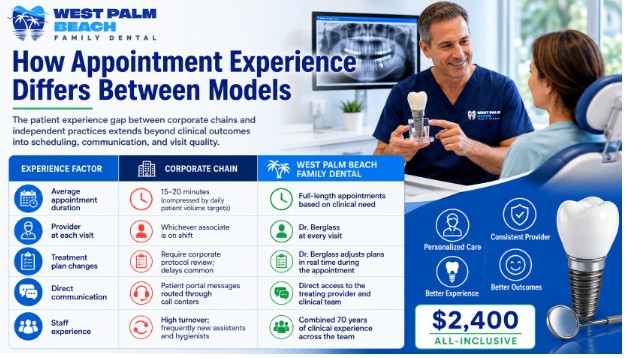
The patient experience gap between corporate chains and independent practices extends beyond clinical outcomes into scheduling, communication, and visit quality.
| Experience Factor | Corporate Chain | West Palm Beach Family Dental |
| Average appointment duration | 15–20 minutes (compressed by daily patient volume targets) | Full-length appointments based on clinical need |
| Provider at each visit | Whichever associate is on shift | Dr. Berglass at every visit |
| Treatment plan changes | Require corporate protocol review; delays are common | Dr. Berglass adjusts plans in real time during the appointment |
| Direct communication | Patient portal messages are routed through call centers | Direct access to the treating provider and clinical team |
| Staff experience | High turnover; frequently new assistants and hygienists | Combined 70 years of clinical experience across the team |
West Palm Beach Family Dental’s staff continuity means the same clinical team assists Dr. Berglass at every implant appointment. Patients become familiar with everyone in the treatment room rather than introducing themselves to unfamiliar assistants at each visit.
The practice offers a free consultation, including diagnostic X-rays, so prospective patients can evaluate the difference in experience firsthand before committing to treatment.
If you’re ready to get started, call us now!
Patients evaluating implant providers — whether corporate or independent — should ask five specific questions before scheduling surgery. The answers reveal whether the practice operates with genuine clinical continuity or rotates providers across treatment phases.
The first question asks whether the same dentist who performs the consultation also places the implant and delivers the final crown. Practices that answer “no” split the case across multiple providers, creating the continuity gaps that compromise outcomes.
The second question asks whether the quoted price includes the abutment and crown or covers only the implant post.
Most corporate offices quote the surgical component alone, then add $1,000–$2,000 in restorative fees after the post is already placed and the patient has no practical option to switch providers.
The third question asks whether the treating dentist completed postdoctoral implant training—a fellowship or residency focused specifically on implant surgery and prosthetics.
General dentists can legally place implants in Florida, but fellowship-trained specialists bring additional clinical depth that general licensure does not require.
The fourth question asks whether follow-up visits carry separate charges. Some offices bill $75–$150 per post-operative check, adding $300–$600 to the total cost over a typical healing period.
The fifth question asks whether the practice uses in-house or outsourced crown fabrication. Outsourced lab work adds cost and turnaround time while removing the treating dentist’s direct oversight of the final restoration.
Dr. Berglass built West Palm Beach Family Dental around a single-provider implant model — the same fellowship-trained clinician performs every clinical step from initial X-ray review through final crown cementation.
The practice charges $2,400 all-inclusive for a complete single-tooth implant restoration, including a titanium post, a custom abutment, and a porcelain or zirconia crown. Consultations, diagnostic imaging, and follow-up visits carry no additional charge.
Financing options include CareCredit at 0% interest for 6–24 months and in-house payment plans starting at $79/month with no credit check. The practice’s $375/year savings plan provides 20% off all procedures, reducing the implant price to $1,920 for enrolled members.
The practice is located at 1840 Forest Hill Blvd., Suite 204, West Palm Beach, FL 33406, and serves patients across Palm Beach, Lake Worth, Greenacres, and Riviera Beach.
Corporate chains treat patients like production numbers — Dr. Berglass treats every case as his own from start to finish at West Palm Beach Family Dental.
What is a dental service organization?
A dental service organization is a corporate entity that owns and manages multiple dental office locations. The DSO handles business operations, staffing, and financial targets while rotating associate dentists through shifts based on scheduling availability rather than established patient-provider relationships.
Does the same dentist do my implant from start to finish?
At West Palm Beach Family Dental, Dr. Berglass personally handles every phase of implant treatment — consultation, surgical placement, abutment connection, and final crown delivery. Corporate chains typically assign different providers to the surgical and restorative phases of the same case.
Why are dental implants cheaper at independent practices?
Independent practices like West Palm Beach Family Dental operate without franchise fees, corporate overhead, commission structures, or daily production quotas. Dr. Berglass sets pricing based on actual clinical and material costs, charging $2,400 all-inclusive, compared with $3,000–$6,000 at chain offices.
How do production quotas affect dental treatment recommendations? Production quotas require associate dentists to generate a specific revenue amount per shift. That financial structure can incentivize unnecessary add-on procedures, premium material upsells without clinical justification, and compressed appointment times that limit thorough patient evaluation and follow-up care.
Can I get a second opinion on a corporate chain’s implant quote?
West Palm Beach Family Dental offers free second-opinion consultations, including necessary diagnostic X-rays at no charge to the patient. Patients who received quotes of $4,000–$6,000 from corporate offices can compare itemized treatment plans and pricing with no obligation or consultation fee.
What credentials should my implant dentist have?
Patients should confirm that their implant provider has completed postdoctoral residency or fellowship training specifically in implant surgery and prosthetics. Dr. Berglass completed a dental implant fellowship at North Shore–Long Island Jewish Hospital — training beyond the general dental licensure required to practice in Florida.
Does West Palm Beach Family Dental accept insurance?
West Palm Beach Family Dental works with most dental insurance plans and files claims on each patient’s behalf. Patients without insurance can enroll in the in-office savings plan at $375 per year, which includes two cleanings and 20% off all dental work, including implants.
How do I know if a dental office is corporate-owned?
Corporate-owned offices typically operate under a branded national name, employ rotating associate dentists rather than a permanent owner-dentist, and advertise low starting prices that exclude the costs of abutments and crowns. Asking whether the treating dentist owns the practice directly reveals the ownership structure.
What is the advantage of one dentist doing the entire implant?
Single-provider continuity ensures the clinician who evaluated bone density and selected the implant system also controls abutment design and crown fabrication. Each decision in the sequence constrains the next, so splitting the case across multiple providers creates communication gaps that increase the risk of complications.
How long has Dr. Berglass been placing dental implants?
Dr. Berglass has over 25 years of clinical dental experience. He earned his Doctor of Dental Surgery from Stony Brook School of Dental Medicine in 1996 and completed a dental implant fellowship at North Shore–Long Island Jewish Hospital in Manhasset, New York.

About Dr. Berglass
Dr. Michael Berglass, a dedicated dentist with over 25 years of experience, specializes in dental implants, cosmetic, and general dentistry in West Palm Beach, Florida. A proud alumnus of Stony Brook School of Dental Medicine (DDS, 1996), Dr. Berglass further honed his expertise with residencies in general practice and dental implants at North Shore-Long Island Jewish Hospital. His journey in dentistry has taken him from New York to North Carolina, and now to Florida, where he continues to offer top-notch dental care. Known for his wit and intellect, Dr. Berglass makes every patient's visit comfortable. Formerly a member of the American Dental Association and the Florida Dental Association, Dr. Berglass remains committed to staying informed about advancements in dentistry and providing exceptional care to his patients. He looks forward to welcoming you to his practice.
About Dr. Cedenos

Dr. Ivan Cedeno is originally from Cuba where he did his dental studies. Having graduated with a DDS diploma gave Ivan and his family great satisfaction, considering he comes from a family of dedicated dental care professionals. After years of practicing Dentistry in Cuba for a few years, Ivan decided to continue his growth journey as a professional in the United States. Early on, Ivan worked as a laboratory technician, which gave him some unique insights that dental school does not teach. Having graduated from the University of Puerto Rico as a DMD, Ivan is allowed to practice in the USA.


