How Long Do Dental Implants Last? What West Palm Beach Patients Should Know
Originally published: May 2026 | Reviewed by Dr. Michael Berglass, DDS
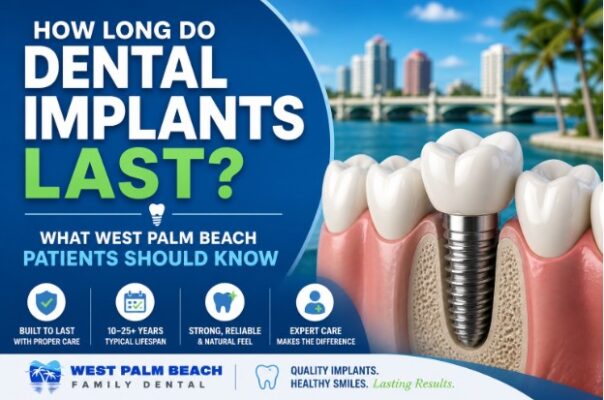
Dental implants placed by a Fellowship-trained implantologist last 20–25 years or longer in most patients, with the titanium post capable of lasting a lifetime and the porcelain crown typically requiring replacement after 10–15 years.
A 2024 meta-analysis published in the Journal of Clinical Medicine reported implant survival rates exceeding 92% across prospective studies covering 20 years.
At West Palm Beach Family Dental, Dr. Michael Berglass, DDS, has placed implants for over 29 years using systems with peer-reviewed long-term outcome data. Implant lifespan, what shortens it, and what West Palm Beach patients can do to protect their investment are each covered below.
Concerned about how long your implant will last? Schedule a free consultation with Dr. Berglass at West Palm Beach Family Dental — implant longevity assessment included at no charge.
Dental implants last 20–25 years or longer for most patients, with the titanium post designed to function for a lifetime when osseointegration is successful. The crown — the visible porcelain tooth — lasts 10–15 years before normal chewing wear requires replacement.
A landmark 40-year follow-up study tracking implants placed between 1982 and 2023 found all 18 monitored implants remained functional and stable with minimal bone loss over four decades.
The 2024 meta-analysis by Kupka et al. in the Journal of Clinical Medicine — the most comprehensive 20-year survival review to date — confirmed survival rates exceeding 92% in prospective studies, with the prevalence of dental implants in the United States projected to reach 23% by 2026.
Survival rates by timeframe, drawn from peer-reviewed data, show 95%+ at 10 years, approximately 94% at 15 years, and 92% at 20 years. The post itself drives these numbers — crown replacements account for most of the attrition, not implant post failures.
Dental Implant Lifespan by Component — 2026 Data
| Component | Expected Lifespan | Primary Failure Cause |
| Titanium implant post | 20–25 years to lifetime | Peri-implantitis, bone loss |
| Porcelain crown | 10–15 years | Normal wear, bruxism, diet |
| Abutment connector | 15–20 years | Loosening, mechanical stress |
If you’re ready to get started, call us now!
The implant post and the crown fail for entirely different reasons, on entirely different timelines — and confusing the two leads patients to overestimate or underestimate the procedure’s long-term cost.
The titanium post fuses directly with the jawbone through osseointegration, a biological process that takes 3–6 months to complete. Once integrated, the post functions like a natural tooth root — no decay is possible, and failure requires either peri-implantitis (bacterial bone loss) or excessive mechanical force.
Patients who maintain healthy gum tissue and avoid the risk factors covered below can expect the post to function for two decades or longer.
The porcelain crown sits above the gumline and faces everything a natural tooth does — chewing pressure, acidic foods, hot-and-cold cycling, and surface wear. Crown replacement after 10–15 years is maintenance, not failure.
Caring for dental implants correctly — including professional cleaning every six months and avoiding abrasive toothpaste — extends crown lifespan toward the upper end of that range.
West Palm Beach Family Dental assesses the condition of crowns at every routine exam. Early wear identification allows patients to plan crown replacement on their schedule rather than in response to an emergency.
Peri-implantitis is a bacterial inflammatory condition that destroys the bone surrounding a dental implant — the primary biological threat to long-term implant survival.
The 2025 AO/AAP systematic review published in the Journal of Periodontology found that more than half of implant patients experienced peri-implant disease over a 10-year follow-up period, with periodontitis history, smoking, diabetes, and alcohol consumption identified as the leading risk indicators.
Peri-implantitis progresses silently in its early stages. Patients report no pain as the bacteria erode the bone anchoring the implant post. By the time mobility or discomfort appears, significant bone loss has already occurred.
Prevention requires two actions: consistent home hygiene — brushing twice daily, using interdental brushes around the implant base, and an antimicrobial rinse when recommended — and professional monitoring every six months using X-rays to track marginal bone levels. West Palm Beach Family Dental uses digital radiography at each maintenance visit to detect bone changes before peri-implantitis advances to a stage requiring surgical intervention.
Smoking nearly doubles the risk of dental implant failure. A meta-analysis published in PMC covering more than 40,000 implants placed under risk conditions found a pooled relative risk of 1.92 (95% CI: 1.67–2.21) for implant failure in smokers — meaning smokers face approximately twice the failure rate of non-smokers at equivalent follow-up periods.
Nicotine reduces blood flow to gum tissue, delays wound healing after implant placement, and impairs osseointegration by creating local tissue hypoxia, as documented in Springer’s review of diabetes and smoking as peri-implant disease risk factors.
The same mechanism that slows healing after surgery continues to compromise tissue health around the implant post-placement.
West Palm Beach patients who smoke should discuss cessation protocols with Dr. Berglass before scheduling implant surgery.
The clinical literature recommends stopping smoking at least one week before and two months after implant placement to maximize osseointegration success.
Bruxism — involuntary teeth grinding, most commonly during sleep — is a significant mechanical threat to the longevity of dental implants.
A 2025 systematic review and meta-analysis published in PMC found an odds ratio of 4.68 for mechanical complications in implant-supported prostheses in patients with bruxism — meaning bruxers face nearly five times the risk of crown fracture, abutment screw loosening, and prosthetic failure compared to non-bruxers.
Unlike natural teeth, the titanium implant post has no periodontal ligament to absorb grinding forces. Force transmits directly into the surrounding bone, accelerating marginal bone loss when bruxism goes unmanaged.
A custom hard acrylic night guard distributes grinding forces evenly across the arch, protecting both the crown and the bone-implant interface.
West Palm Beach Family Dental evaluates every implant patient for bruxism during the consultation and recommends a night guard for those with a history of grinding. Patients who grind benefit from maintenance visits every 3–4 months, rather than the standard 6-month interval, to catch wear patterns early.
If you’re ready to get started, call us now!
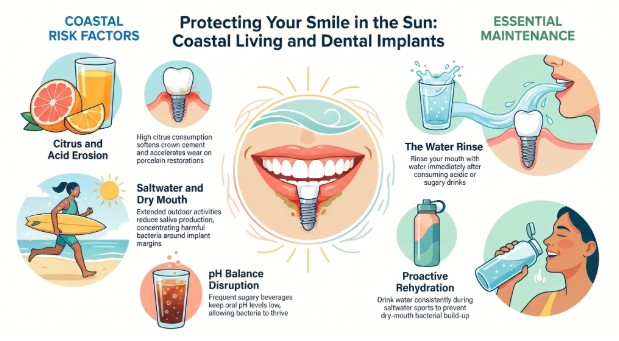
West Palm Beach patients face a specific combination of dietary and lifestyle factors that accelerate crown wear and elevate peri-implantitis risk when oral hygiene is inconsistent.
Citrus and acidic food consumption is higher in South Florida than in most U.S. regions due to year-round availability of fresh fruit, citrus-based cuisine, and acidic sports drinks popular in warm climates. Acid exposure softens the cement used in crown bonding and accelerates surface wear on porcelain crowns — not the post, but the visible restoration most likely to need replacement.
Saltwater sports and beach activities create a dry-mouth environment during extended outdoor activity. Reduced saliva production concentrates oral bacteria around implant margins, elevating the risk of peri-implantitis for patients who swim, kayak, or spend extended hours outdoors without consistently rehydrating.
Sugar in beverages — sweet tea, fruit juices, and flavored waters consumed throughout the day — keeps oral pH below the threshold at which bacteria thrive around implant margins.
West Palm Beach Family Dental recommends rinsing with water after consuming acidic or sugary beverages, particularly for patients engaged in outdoor activities. Patients can review the full maintenance protocol at the dental implants West Palm Beach page.
Preserving jawbone density is the single most controllable factor in long-term implant survival. The implant post relies on bone contact for stability — as bone recedes, the post loosens, and the implant fails.
Bone loss around implants accelerates from three sources: unmanaged peri-implantitis, excessive occlusal force from bruxism, and systemic conditions — particularly uncontrolled diabetes — that impair osteoblastic function.
The 2025 AAP/AO systematic review in the Journal of Periodontology identified diabetes mellitus as a significant risk indicator for peri-implantitis independent of hygiene practices.
Patients with Type 2 diabetes in West Palm Beach should discuss HbA1c targets with their physician before implant surgery. Studies consistently show that well-controlled diabetes does not disqualify patients from successful implant outcomes — uncontrolled diabetes does.
Dr. Berglass reviews each patient’s systemic health profile during the free consultation and identifies any bone preservation protocols required before and after placement.
Patients who have already lost bone prior to implant surgery can review affordable dental implants options that include bone graft assessment, so bone volume is addressed before placement rather than after.
Early identification of implant complications allows intervention before the post requires removal. Four warning signs warrant an immediate call to West Palm Beach Family Dental.
Mobility or movement in the implant crown or post — even minor — indicates either osseointegration failure in a recently placed implant or significant bone loss in a mature one. Neither is normal at any stage.
Persistent pain or pressure around the implant site beyond the standard 1–2 week post-surgical healing window indicates an inflammatory process, possible infection, or incorrect loading of the implant.
Visible gum recession around the implant base exposes the metal post margin and signals active bone loss beneath the gumline. Recession visible to the patient indicates that the process has already progressed beyond early-stage peri-implant mucositis.
Difficulty chewing or bite changes indicate either a crown issue — fracture or loosening — or implant-level instability. Both require clinical evaluation, but the treatments differ entirely.
Patients who notice any of these signs should contact West Palm Beach Family Dental immediately. Early intervention for peri-implantitis — professional debridement and antimicrobial therapy — avoids the surgical bone regeneration procedures required at advanced stages.
How long do dental implants last in West Palm Beach?
Dental implants in West Palm Beach last 20–25 years or longer for most patients, with the titanium post capable of lasting a lifetime when osseointegration is stable. The porcelain crown requires replacement every 10–15 years due to normal wear. A 2024 NIH meta-analysis reported implant survival rates above 92% at 20 years in prospective studies.
Does the implant post ever need to be replaced?
The implant post requires replacement only when peri-implantitis causes sufficient bone loss to destabilize it, or when unmanaged bruxism fractures the titanium fixture — a rare outcome. Most patients replace only the crown during the implant’s lifespan, not the post itself, because the post is not subject to decay or surface wear.
How does smoking affect dental implant lifespan?
Smoking nearly doubles implant failure risk, with a pooled relative risk of 1.92 across more than 40,000 implants in a published meta-analysis. Nicotine impairs osseointegration by reducing blood flow and creating tissue hypoxia at the implant site. West Palm Beach Family Dental recommends cessation at least one week before and two months after implant surgery.
What is peri-implantitis, and how is it prevented?
Peri-implantitis is bacterial inflammation that destroys the bone anchoring the implant post. Prevention requires brushing twice daily with a soft brush, using interdental brushes around the implant base, and attending professional cleanings every six months. The 2025 AAP/AO consensus identified periodontitis history, smoking, and uncontrolled diabetes as the leading peri-implantitis risk indicators.
Does teeth grinding shorten implant lifespan in West Palm Beach?
Bruxism carries an odds ratio of 4.68 for mechanical complications in implant-supported prostheses, according to a 2025 PMC meta-analysis. West Palm Beach Family Dental evaluates every implant patient for bruxism and provides a custom hard-acrylic night guard for patients with a grinding history to protect both the crown and bone-implant interface.
How often should implant crowns be replaced?
Implant crowns require replacement every 10–15 years on average due to normal chewing wear. West Palm Beach patients who consume acidic foods, citrus beverages, or engage in saltwater sports without consistent oral hygiene may experience wear at the lower end of this range. Dr. Berglass assesses crown condition at every maintenance visit.
Can diabetes affect how long dental implants last?
Uncontrolled diabetes impairs osteoblastic function and delays wound healing, increasing peri-implantitis risk and reducing long-term implant stability. Well-controlled diabetes does not disqualify patients from successful outcomes. West Palm Beach Family Dental reviews each patient’s HbA1c status during the consultation to identify any pre-surgical protocols required.
What should a West Palm Beach patient do if their implant feels loose?
Any movement in the implant crown or post warrants an immediate call to West Palm Beach Family Dental at (561) 968-6022. Mobility in a mature implant indicates active bone loss that worsens without intervention. Early debridement and antimicrobial therapy can preserve the implant post; delayed treatment typically requires surgical bone regeneration or full implant removal.
Ready to protect your implant investment? Review the full implant maintenance guide or schedule your free consultation with Dr. Berglass today.

About Dr. Berglass
Dr. Michael Berglass, a dedicated dentist with over 25 years of experience, specializes in dental implants, cosmetic, and general dentistry in West Palm Beach, Florida. A proud alumnus of Stony Brook School of Dental Medicine (DDS, 1996), Dr. Berglass further honed his expertise with residencies in general practice and dental implants at North Shore-Long Island Jewish Hospital. His journey in dentistry has taken him from New York to North Carolina, and now to Florida, where he continues to offer top-notch dental care. Known for his wit and intellect, Dr. Berglass makes every patient's visit comfortable. Formerly a member of the American Dental Association and the Florida Dental Association, Dr. Berglass remains committed to staying informed about advancements in dentistry and providing exceptional care to his patients. He looks forward to welcoming you to his practice.
About Dr. Cedenos

Dr. Ivan Cedeno is originally from Cuba where he did his dental studies. Having graduated with a DDS diploma gave Ivan and his family great satisfaction, considering he comes from a family of dedicated dental care professionals. After years of practicing Dentistry in Cuba for a few years, Ivan decided to continue his growth journey as a professional in the United States. Early on, Ivan worked as a laboratory technician, which gave him some unique insights that dental school does not teach. Having graduated from the University of Puerto Rico as a DMD, Ivan is allowed to practice in the USA.


