Can You Use Your X-Rays at a Different Dentist?
Originally published: May 2026 | Updated: August 2026 | Reviewed by Dr. Michael Berglass, DDS
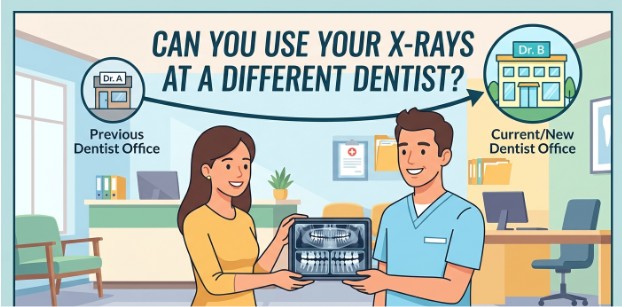
Yes — patients in Florida own their dental X-rays and can use them at any dental office they choose. A dentist cannot legally withhold X-rays, charge a fee to release them to another provider, or require a patient to retake imaging before agreeing to a consultation.
Under federal HIPAA regulations and Florida Statute 456.057, every Florida patient holds the legal right to request, receive, and transfer their dental records — including X-rays — to any provider at any time, for any reason.
Dental X-rays are not the property of the dental practice that took them. The equipment, the technician, and the facility belong to the practice — but the images produced of your teeth, jaw, and bone structure belong to you.
This distinction matters in practice because it determines who controls access to your diagnostic history.
Patients who bring existing X-rays to a dental second-opinion consultation gain three direct advantages over those who arrive without them.
First, existing X-rays give the second dentist a clinical baseline. A dentist reviewing your periapical X-rays, panoramic film, or CBCT scan can assess bone density, root structure, decay progression, and existing restorations from the same imaging your first dentist used — which means the second opinion evaluates identical evidence rather than a new snapshot taken under different conditions.
Second, bringing existing X-rays eliminates duplicate radiation exposure. The American Dental Association recommends that dental X-rays be taken only when clinically necessary and that existing films be used whenever they are current and adequate for the diagnostic task.
For patients preparing for dental implant consultations, panoramic X-rays and CBCT scans involve meaningful radiation doses — avoiding unnecessary retakes is a genuine clinical benefit, not a technicality.
Third, bringing existing X-rays reduces the cost of the second consultation. Practices that offer free second opinion consultations — including Boynton Implant & Cosmetic Dentistry — can complete the review using your existing films, which means the consultation remains free.
Practices that charge for second opinions often base that fee on new imaging — bringing your own eliminates or reduces that cost entirely.
If you’re ready to get started, call us now!
The Health Insurance Portability and Accountability Act establishes that patients have the right to access their protected health information, including dental X-rays, treatment records, clinical notes, and any other documentation created in the course of their dental care.
HIPAA applies to every dental practice in the United States that transmits health information electronically, which includes virtually every modern dental office.
Under HIPAA, a covered dental practice must provide access to patient records within 30 days of a written request. In practice, most Florida dental offices process record requests within two to five business days. A practice may charge a reasonable cost-based fee for copying physical records, but it cannot charge a fee simply for releasing digital X-rays that already exist in an electronic format.
Florida Statute 456.057 governs patient access to medical and dental records specifically within Florida and reinforces HIPAA protections at the state level.
Under this statute, licensed Florida dental practitioners must provide patients or their authorized representatives with copies of examination records, X-rays, and treatment documentation upon written request.
A dental office that refuses, delays without justification, or conditions the release of records on the payment of outstanding balances is in violation of Florida law. Patients whose records are wrongfully withheld may file a complaint with the Florida Department of Health.
The majority of dental practices in Boynton Beach and across Palm Beach County now use digital radiography. Digital X-rays are stored as image files in the practice’s dental software — typically in DICOM format — and can be transferred to a patient or a second dental provider via secure email, patient portal download, or USB drive.
Digital transfer is typically instant, costs nothing, and causes no loss of image quality.
When requesting digital X-rays, ask specifically for the full-resolution original files rather than a printed or scanned copy.
A printed copy of a digital X-ray loses diagnostic resolution — the second dentist needs the original digital file to assess bone density, root length, and decay depth with clinical accuracy.
The American Academy of Oral and Maxillofacial Radiology establishes that diagnostic-quality digital radiographs must be transferred in their original format to preserve clinical utility.
Older dental practices may still use conventional film radiography. Physical film X-rays cannot be emailed — they must be physically duplicated or loaned to the patient for transfer. Most practices retain the original films and provide duplicates, which may carry a duplication fee of $10–$30, depending on the number of films.
Patients who receive duplicate films should transport them in the protective sleeve or envelope provided and, if requested, return the originals to the first practice after the second-opinion consultation.
Cone beam computed tomography scans — the three-dimensional imaging standard for dental implant candidacy assessment — are stored as large DICOM datasets and are typically provided on a USB drive or CD rather than via email due to file size.
CBCT scans taken within the past 12 months are generally adequate for implant planning and should be requested alongside standard X-rays when implant treatment is under review.
Patients who have undergone a bone grafting procedure should also request any pre- and post-graft imaging to give the second dentist a complete picture of the current bone volume.
Bring your existing X-rays and records — Dr. Berglass reviews them at no charge. Boynton Implant & Cosmetic Dentistry provides free second-opinion consultations, including an independent review of records and any necessary updated imaging. Schedule your appointment today.
If you’re ready to get started, call us now!
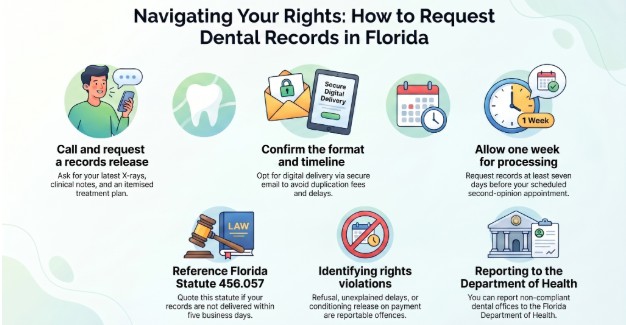
Call your current dental office and state that you are requesting a records release under HIPAA and Florida Statute 456.057. Ask specifically for: your most recent full-mouth or periapical X-rays in original digital format, any panoramic X-rays or CBCT scans taken within the past two years, your written treatment plan with itemized CDT procedure codes, and clinical notes from your most recent examination. You do not need to explain why you want them or name the second provider.
Request digital delivery via secure email or patient portal, where available — this is the fastest, free option and produces no image-quality loss. If your practice uses physical film, request duplicate copies and ask about any duplication fees upfront.
Confirm the expected turnaround time and ask for a specific delivery date rather than a vague estimate.
When the records arrive, confirm that the X-ray files open correctly and display at full diagnostic resolution before your second-opinion appointment.
Digital files that arrive as low-resolution JPEGs or printed scans are not clinically adequate — contact the practice and request the original DICOM files if quality is insufficient.
Review the complete preparation checklist in the guide on what to bring to a dental second-opinion appointment to confirm you have everything needed before your consultation.
Carry digital files on a USB drive, or confirm that the second practice accepts secure email transfers before your appointment. For physical films, use the provided protective sleeve and handle them by the edges to avoid damaging the diagnostic surface.
Arrive five to ten minutes early to allow time for intake paperwork before the clinical review begins.
Dr. Michael Berglass evaluates existing imaging at the start of every second opinion consultation and recommends updated imaging only when clinically necessary — never as a default. Contact Boynton Implant & Cosmetic Dentistry to schedule your free consultation today.
X-rays taken more than 12–18 months ago may not adequately reflect your current bone density, decay progression, or gum health — particularly for patients being evaluated for dental implants, root canals, or tooth extractions.
The American Dental Association’s radiograph guidelines recommend that new-patient imaging intervals be determined by clinical judgment based on the patient’s individual risk factors, rather than applied as a blanket rule.
A second dentist who determines that existing X-rays are insufficient for a complete assessment will recommend updated imaging.
At Boynton Implant & Cosmetic Dentistry, necessary X-rays taken during a second opinion consultation are included at no charge.
Patients whose cases require a CBCT scan for implant planning receive this imaging as part of the free consultation rather than as a separately billed procedure.
Patients who have experienced dental anxiety and avoided routine dental care for extended periods should expect that updated imaging will likely be needed — existing films from two or more years ago rarely reflect sufficient clinical detail for major restorative treatment planning.
Can a dentist legally refuse to give me my X-rays in Florida?
No Florida dentist can legally refuse to release patient X-rays. Florida Statute 456.057 and federal HIPAA regulations require dental offices to provide records on patient request. A practice that refuses or conditions release on payment violates state and federal patient rights laws and is reportable to the Florida Department of Health.
Can my dentist charge me for my own X-rays?
A dental office may charge a reasonable cost-based fee for duplicating physical film X-rays — typically $10–$30. Digital X-rays that already exist in electronic format cannot be subject to release fees under HIPAA. A practice charging for digital records release does not comply with federal law.
Do I need to take new X-rays at a second opinion appointment?
Not necessarily. X-rays taken within the past 12 months are generally adequate for most second-opinion reviews. Updated imaging may be recommended when existing films are outdated, low resolution, or insufficient for the specific procedure being evaluated — such as a CBCT scan for implant candidacy.
What format should I request my digital X-rays in?
Request the original DICOM-format files — the clinical standard for dental radiography. Avoid printed copies or scanned versions of digital X-rays, which lose diagnostic resolution. DICOM files can be delivered via secure email, patient portal, or USB drive, depending on the practice’s system.
How long does it take to get my X-rays from my dentist?
Most Florida dental offices process record requests within two to five business days. Request records at least 1 week before your second-opinion appointment to allow adequate processing time and a buffer for any delays.
Can I keep my X-rays permanently?
Yes. As the patient, you own your dental records, including X-rays. You may retain copies indefinitely. Your dental practice retains its own copy as part of your clinical record — releasing a copy to you does not remove their records.
What if I need a CBCT scan for an implant second opinion?
If your existing X-rays do not include a CBCT scan, or if your existing scan is more than 12 months old, the second dentist may recommend updated three-dimensional imaging. At Boynton Implant & Cosmetic Dentistry, CBCT scans for a second-opinion implant assessment are included in the free consultation.
Where can I find the complete list of items to bring to my second-opinion appointment?
The full preparation checklist — including X-rays, treatment plan, medication list, and questions to ask — is in the dedicated guide on what to bring to a dental second-opinion appointment.

About Dr. Berglass
Dr. Michael Berglass, a dedicated dentist with over 25 years of experience, specializes in dental implants, cosmetic, and general dentistry in West Palm Beach, Florida. A proud alumnus of Stony Brook School of Dental Medicine (DDS, 1996), Dr. Berglass further honed his expertise with residencies in general practice and dental implants at North Shore-Long Island Jewish Hospital. His journey in dentistry has taken him from New York to North Carolina, and now to Florida, where he continues to offer top-notch dental care. Known for his wit and intellect, Dr. Berglass makes every patient's visit comfortable. Formerly a member of the American Dental Association and the Florida Dental Association, Dr. Berglass remains committed to staying informed about advancements in dentistry and providing exceptional care to his patients. He looks forward to welcoming you to his practice.
About Dr. Cedenos

Dr. Ivan Cedeno is originally from Cuba where he did his dental studies. Having graduated with a DDS diploma gave Ivan and his family great satisfaction, considering he comes from a family of dedicated dental care professionals. After years of practicing Dentistry in Cuba for a few years, Ivan decided to continue his growth journey as a professional in the United States. Early on, Ivan worked as a laboratory technician, which gave him some unique insights that dental school does not teach. Having graduated from the University of Puerto Rico as a DMD, Ivan is allowed to practice in the USA.


