West Palm Beach Family Dental offers Invisalign clear aligners to straighten teeth with a low-visibility orthodontic option.
A consultation confirms candidacy, estimated timeline, and retainer planning, so alignment results stay stable long term.

Dr. Michael Berglass, DDS, provides dental care backed by 25+ years of clinical experience.
West Palm Beach Family Dental evaluates tooth alignment, bite relationship, and oral health before Invisalign begins, ensuring the treatment plan aligns with the clinical goal.
Invisalign is a clear aligner system that moves teeth using a sequence of custom-fit trays. Each aligner applies controlled pressure to specific teeth, allowing tooth movement to occur in planned stages.
Invisalign guidance typically recommends 20 to 22 hours of wear per dayfor best results.
Patients usually want a specific outcome, not a generic “perfect smile.”
Patients who want an alignment-first start can use Straighten Your Smile to map the best next step.
Invisalign aligners are removable for meals and brushing, so many patients experience fewer day-to-day restrictions than fixed braces.
Invisalign aligners are also low-visibility, so many adults and teens feel more comfortable during work, school, and social settings.
Invisalign success depends on wear time and tracking, so consistent use matters more than shortcuts.
Most patients qualify when their teeth and gums are healthy, and the orthodontic goal aligns with the aligner movement.
When gum inflammation needs treatment before aligners, planning can begin with gum disease treatment, so Invisalign starts on a healthier foundation.
Invisalign works best when expectations match clinical reality.
If crowding makes flossing difficult or gaps trap food, call today to see whether Invisalign can improve alignment and cleanability.
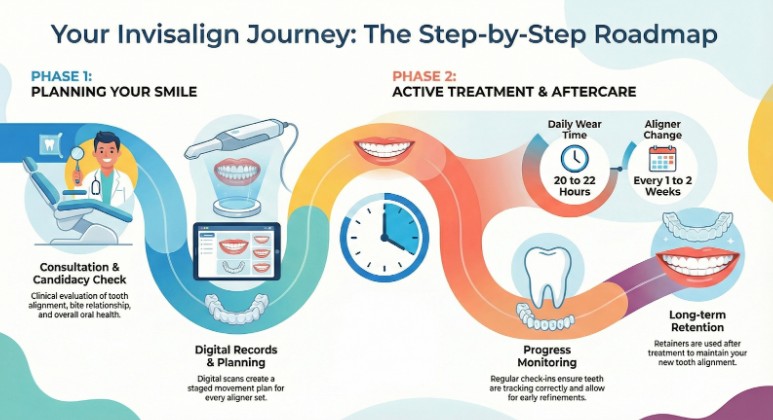
Invisalign timelines vary by case complexity and patient wear time. Invisalign notes that treatment time depends on product type, wear time, and case complexity.
Many patients wear each aligner set for about 1 to 2 weeks, depending on the prescribed plan and tracking.
Many Invisalign patients come in for progress checkups every 6 to 8 weeks, depending on the case and tracking.
A treatment plan confirms the follow-up interval based on movement goals and aligner fit.
Patients can request an evaluation through our contact form and phone line so the team can confirm next steps.
Invisalign cost depends on the treatment scope rather than a single flat fee.
A consultation includes a written plan, so pricing aligns with the clinical scope.
Teeth can shift after orthodontic treatment, and retainers help maintain alignment. The American Association of Orthodontists explains why retainers matter in its guidance on retainer wear.
If you want straighter teeth without brackets, request an Invisalign evaluation now and leave with a retainer plan designed to protect your results.
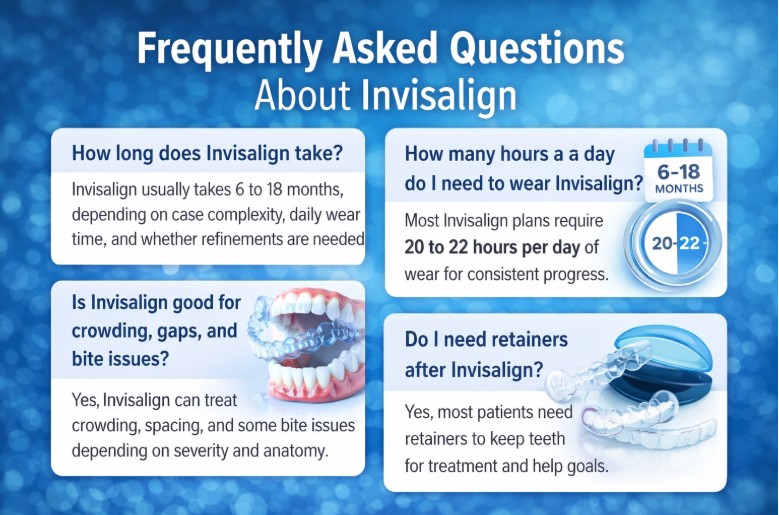
How long does Invisalign take?
Invisalign usually takes 6 to 18 months, depending on case complexity, daily wear time, and whether refinements are needed. Mild crowding often finishes faster than complex bite correction. A consultation and treatment plan provides the most accurate timeline for your teeth.
How many hours a day do I need to wear Invisalign?
Most Invisalign plans require 20 to 22 hours of wear per dayfor consistent progress. Removing aligners too often can slow movement and cause poor tracking. Your dentist may adjust wear guidance based on your case and how your teeth respond.
How often do I change Invisalign trays?
Most patients change their Invisalign trays every 1 to 2 weeks, according to the prescribed schedule and tracking. Switching too early or too late can reduce predictability. Your dentist will confirm the exact change interval when your aligners are delivered.
Is Invisalign good for crowding, gaps, and bite issues?
Invisalign can treat crowding and spacing, and some bite issues may be treatable depending on severity and anatomy. The best candidates have mild to moderate alignment needs. A consultation confirms whether aligners can correct your bite goal or if another approach is needed.
Will Invisalign affect eating and brushing?
Invisalign usually does not disrupt eating or hygiene because aligners are removable for meals and for brushing and flossing. Removability can make cleaning easier than fixed appliances. Consistently wearing aligners after meals keeps treatment on schedule.
Does Invisalign hurt?
Invisalign can cause mild pressure or soreness, especially when starting a new tray, because aligners apply force to move teeth. Discomfort often improves within a few days as the mouth adapts. Sharp pain, swelling, or persistent problems should be evaluated by your dentist.
How much does Invisalign cost in West Palm Beach?
Invisalign costs depend on case complexity, treatment length, the number of aligners, refinements, and the retention plan. Insurance coverage and payment options also affect out-of-pocket costs. A consultation provides a written plan with scope and pricing drivers.
Can teens use Invisalign?
Some teens qualify for Invisalign if their permanent teeth have erupted and they can wear aligners consistently. Invisalign aligners can fit into school, sports, and social routines because they are removable. A consultation confirms whether Invisalign matches the teen’s orthodontic needs and compliance level.
Do I need retainers after Invisalign?
Yes. Most patients need retainers because teeth can shift after aligner treatment. Retainers help maintain alignment, especially during the first months after finishing. Your dentist recommends a retainer schedule based on your bite, crowding history, and relapse risk.
What happens if I do not wear Invisalign enough?
Low wear time can cause poor tracking, slower progress, and the need for refinements or a longer timeline. Gaps between planned and actual movements can cause trays to fit poorly. Consistent daily wear is the main driver of predictable Invisalign results.
About Dr. Berglass

Dr. Michael Berglass, a dedicated dentist with over 25 years of experience, specializes in dental implants, cosmetic, and general dentistry in Boynton Beach, Florida. A proud alumnus of Stony Brook School of Dental Medicine (DDS, 1996), Dr. Berglass further honed his expertise with residencies in general practice and dental implants at North Shore-Long Island Jewish Hospital. His journey in dentistry has taken him from New York to North Carolina, and now to Florida, where he continues to offer top-notch dental care. Known for his wit and intellect, Dr. Berglass makes every patient's visit comfortable. A member of the American Dental Association and Florida Dentists' Association, he stays at the forefront of dental advancements. Dr. Berglass is committed to providing exceptional care and looks forward to welcoming you to his practice.
About Dr. Cedenos

is originally from Cuba where he did his dental studies. Having graduated with a DDS diploma gave Ivan and his family great satisfaction, considering he comes from a family of dedicated dental care professionals. After years of practicing Dentistry in Cuba for a few years, Ivan decided to continue his growth journey as a professional in the United States. Early on, Ivan worked as a laboratory technician, which gave him some unique insights that dental school does not teach. Having graduated from the University of Puerto Rico as a DMD, Ivan is allowed to practice in the USA.


