Dental Implants for Seniors: Overcoming Bone Loss and Age Concerns Safely
Originally published: July 2026 | Reviewed by Dr. Michael Berglass, DDS

Dental implants are safe for most seniors over 60, including those with measurable bone loss — age alone is not a disqualifying factor.
Dr. Michael Berglass, D.D.S., a fellowship-trained implant dentist at West Palm Beach Family Dental, evaluates bone density, medical history, and systemic health during a free diagnostic consultation to determine whether implants, bone augmentation, or alternative structural placements offer the safest and most predictable outcome for each senior patient.
The clinical picture for seniors is more nuanced than a simple yes or no — bone volume, systemic conditions, and medication history all shape the treatment approach, and most concerns have workable clinical solutions.
Seniors with bone loss deserve answers, not assumptions — Dr. Berglass evaluates every patient individually and builds a clinical path forward at West Palm Beach Family Dental.
Jawbone atrophy — the gradual reduction in bone height and width after tooth loss — is a predictable biological consequence of edentulism. The jawbone remodels constantly in response to functional load. When a natural tooth root is removed and no implant or prosthetic root replaces it, the bone in that region loses its stimulation signal and begins to resorb.
Understanding where bone has been lost — and how much remains — requires diagnostic imaging rather than clinical examination alone.
Dr. Berglass uses CBCT diagnostic imaging during the free consultation to map three-dimensional bone architecture before recommending any surgical approach.
Traditional two-dimensional X-rays show bone height but cannot measure bone width or reveal the precise location of critical anatomical structures — the inferior alveolar nerve in the lower jaw and the maxillary sinus floor in the upper jaw.
Placing an implant without three-dimensional imaging in a senior patient with bone atrophy introduces unnecessary risk.
Cone beam computed tomography (CBCT) produces a three-dimensional model of the jawbone that Dr. Berglass uses to evaluate:
| Imaging Type | Bone Height | Bone Width | Nerve Location | 3D Angulation Planning |
| Periapical X-ray | Yes | No | Approximate | No |
| Panoramic X-ray | Yes | No | Approximate | No |
| CBCT (3D) | Yes | Yes | Precise (±0.5mm) | Yes |
The CBCT scan is included in West Palm Beach Family Dental’s free consultation for senior patients who present with documented bone loss or prior denture wear. Dr. Berglass reviews the three-dimensional model with the patient during the same appointment, explaining available bone volume in plain language before presenting any treatment recommendation.
If you’re ready to get started, call us now!
Many seniors with reduced bone volume avoid extensive bone grafting entirely through alternative implant placement strategies. During the consultation, Dr. Berglass evaluates three structural alternatives that use existing bone architecture more efficiently than conventional vertical placement.
Angling the implant 15–45 degrees from vertical allows the post to engage denser cortical bone at the anterior of the jaw while extending the implant’s effective length beyond the posterior bone deficiency.
The All-on-4 protocol — four implants supporting a full-arch restoration — uses two tilted posterior implants specifically to avoid the sinus floor and nerve canal in patients with significant posterior bone loss.
Standard implant lengths range from 10–16 mm. Short implants (6–8 mm) and extra-short implants (4–5 mm) were developed specifically for patients with limited bone height above the nerve canal or below the sinus floor.
Published data in the Journal of Oral Implantology show that short implants achieve survival rates comparable to those of standard-length implants in patients with D1–D3 bone density when proper diameter selection compensates for reduced length.
When bone width falls below the minimum threshold for standard implant diameter, but bone height remains adequate, Dr. Berglass evaluates ridge expansion — a procedure that splits and laterally displaces the buccal bone plate to widen the ridge without removing bone tissue.
Ridge expansion preserves the existing bone volume while creating the necessary width for implant placement, often allowing immediate implant insertion during the same appointment.
Most seniors presenting with moderate bone loss qualify for at least one of these three approaches without requiring the extended grafting timelines that concerned patients often anticipate.
Dr. Berglass identifies the strategy that best matches each patient’s bone architecture during the free consultation at West Palm Beach Family Dental.
Several systemic conditions common in patients over 60 require medical coordination before implant placement, but do not categorically eliminate candidacy. Dr. Berglass reviews each patient’s full medical history and current medication list at the consultation and coordinates with the patient’s physician when necessary.
Controlled Diabetes
Uncontrolled diabetes impairs wound healing and increases infection risk at the surgical site. However, the American Diabetes Association reports that well-controlled diabetic patients — defined as HbA1c below 7.5% — demonstrate implant survival rates comparable to those of non-diabetic patients in published clinical studies.
Dr. Berglass requests recent HbA1c documentation and coordinates treatment timing with the patient’s endocrinologist when values approach or exceed the controlled threshold.
Bisphosphonates — including alendronate (Fosamax), risedronate (Actonel), and zoledronic acid (Reclast) — reduce bone resorption but also impair bone remodeling, which can affect osseointegration and carry a small risk of medication-related osteonecrosis of the jaw (MRONJ) following oral surgery.
Dr. Berglass evaluates the duration of bisphosphonate therapy, dosage and route (oral vs. intravenous), and the length of therapy before determining surgical timing.
Most oral bisphosphonate patients with under five years of therapy proceed to implant placement with appropriate precautions.
Anticoagulant therapy — including warfarin, aspirin, and direct oral anticoagulants — requires coordination with the prescribing physician to manage bleeding risk during implant surgery.
Dr. Berglass does not unilaterally advise patients to discontinue cardiac medications. A physician-coordinated protocol determines whether temporary dose adjustment is safe before the surgical appointment.
| Condition | Impact on Implants | Management Approach |
| Controlled diabetes (HbA1c <7.5%) | Minimal — comparable survival rates | Confirm HbA1c before scheduling surgery |
| Uncontrolled diabetes (HbA1c ≥7.5%) | Impaired healing, infection risk | Defer until glycemic control is achieved |
| Oral bisphosphonates (<5 years) | Low MRONJ risk | Proceed with precautions after physician review |
| IV bisphosphonates | Higher MRONJ risk | Specialist consultation required |
| Anticoagulant therapy | Surgical bleeding risk | Physician-coordinated protocol before surgery |
| Osteoporosis (no bisphosphonates) | Reduced bone density (D3–D4) | Short implants or tilted placement strategies |
If you’re ready to get started, call us now!
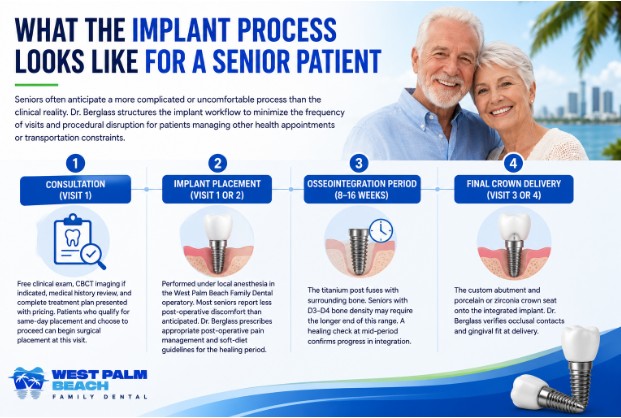
Seniors often anticipate a more complicated or uncomfortable process than the clinical reality. Dr. Berglass structures the implant workflow to minimize the frequency of visits and procedural disruption for patients managing other health appointments or transportation constraints.
The complete process requires two to four office visits for most senior patients. The practice is located at 1840 Forest Hill Blvd., Suite 204, West Palm Beach, FL 33406. Office hours run Sunday through Wednesday and Friday through Saturday, 8:30 AM–5:00 PM. Call (561) 968-6022 to schedule.
Bone loss does not close the door on implants — Dr. Berglass opens a clinical path forward for seniors at West Palm Beach Family Dental.
Yes — dental implants are safe for most seniors over 60 with bone loss in West Palm Beach, and age alone is not a disqualifying condition. Dr. Berglass evaluates each patient using three-dimensional CBCT imaging to precisely map the remaining bone volume before recommending treatment. Seniors with reduced bone density have multiple clinical options available — including tilted implant placement, short implant systems, and ridge expansion — that avoid or minimize the need for bone grafting while achieving stable, long-term implant integration.
What age is too old for dental implants?
No established upper age limit exists for dental implant candidacy. Clinical research published in the International Journal of Oral and Maxillofacial Implants confirms that implant survival rates in patients over 70 are comparable to those in younger adult cohorts when systemic health is managed appropriately and bone volume is evaluated with diagnostic imaging before any surgical planning begins.
How much bone do you need for a dental implant if you are a senior?
Standard implants require approximately 10 mm of bone height and 5–6 mm of bone width at the planned placement site. Seniors below these thresholds have options including short implant systems, extra-short implants, tilted placement strategies, or ridge expansion procedures that use available bone more efficiently than conventional vertical placement alone.
Can dental implants fail in seniors due to age-related bone loss?
Age-related bone loss reduces density but does not prevent osseointegration when appropriate implant systems and placement strategies match the available bone architecture. Failure risk increases when implants are placed in bone below minimum density thresholds without accommodation — a risk that proper CBCT-guided planning and implant system selection mitigate before surgery begins.
Does osteoporosis prevent seniors from getting dental implants?
Osteoporosis alone does not prevent implant placement. Seniors without bisphosphonate medications proceed with standard precautions, while those on oral bisphosphonates for under five years proceed with physician coordination. Intravenous bisphosphonate therapy requires specialist consultation before any oral surgical procedure is scheduled or performed.
How long do dental implants last for seniors?
Dental implants placed in seniors with adequate bone volume and well-managed systemic health demonstrate 20+ year survival rates consistent with implants placed in younger patients. The titanium post itself does not age or decay. The porcelain or zirconia crown typically lasts 10–20 years before requiring replacement, while the underlying implant remains functional indefinitely with proper oral hygiene.
Is the dental implant procedure painful for older patients?
Implant placement is performed under local anesthesia, and most seniors report post-operative discomfort comparable to or less than a routine tooth extraction. Dr. Berglass prescribes appropriate post-surgical pain management. Seniors with well-managed health conditions generally tolerate the procedure without complications under local anesthesia alone in the office operatory.
How many visits does a senior need for dental implants?
Most senior implant cases require two to four office visits over three to six months — the initial free consultation, the implant placement appointment, a mid-healing evaluation, and the final crown delivery visit. Seniors with slower osseointegration due to reduced bone density may extend the healing phase by 4 to 6 weeks beyond the standard 8-week timeline.
What is the cost of dental implants for seniors in West Palm Beach?
West Palm Beach Family Dental charges $2,400 all-inclusive for a complete single-tooth implant — titanium post, custom abutment, and porcelain or zirconia crown — with no hidden fees. In-house financing starts at seventy-nine dollars per month with no credit check. The annual savings plan at $375 provides 20% off all procedures, reducing the implant price to $19,200.
Can a senior get dental implants if they have been wearing dentures for years? Seniors who have worn removable dentures for years typically present with significant alveolar bone resorption due to ridge compression. Dr. Berglass evaluates residual bone volume using CBCT imaging and determines whether implant-supported overdentures, tilted-implant protocols, or standard single-tooth placements are appropriate based on the three-dimensional bone map rather than on the duration of denture wear alone.
Does Medicare cover dental implants for seniors in Florida?
Traditional Medicare does not cover dental implants or most routine dental procedures. Some Medicare Advantage plans include dental benefits that may apply partial coverage to implant-related procedures. Seniors without dental coverage benefit most from West Palm Beach Family Dental’s in-office savings plan at $375 per year, which provides 20% off implants and 2 included cleanings, with no insurance enrollment required.

About Dr. Berglass
Dr. Michael Berglass, a dedicated dentist with over 25 years of experience, specializes in dental implants, cosmetic, and general dentistry in West Palm Beach, Florida. A proud alumnus of Stony Brook School of Dental Medicine (DDS, 1996), Dr. Berglass further honed his expertise with residencies in general practice and dental implants at North Shore-Long Island Jewish Hospital. His journey in dentistry has taken him from New York to North Carolina, and now to Florida, where he continues to offer top-notch dental care. Known for his wit and intellect, Dr. Berglass makes every patient's visit comfortable. Formerly a member of the American Dental Association and the Florida Dental Association, Dr. Berglass remains committed to staying informed about advancements in dentistry and providing exceptional care to his patients. He looks forward to welcoming you to his practice.
About Dr. Cedenos

Dr. Ivan Cedeno is originally from Cuba where he did his dental studies. Having graduated with a DDS diploma gave Ivan and his family great satisfaction, considering he comes from a family of dedicated dental care professionals. After years of practicing Dentistry in Cuba for a few years, Ivan decided to continue his growth journey as a professional in the United States. Early on, Ivan worked as a laboratory technician, which gave him some unique insights that dental school does not teach. Having graduated from the University of Puerto Rico as a DMD, Ivan is allowed to practice in the USA.


