Dental Bridge vs. Dental Implant: Longevity, Real Costs, and Health Impacts for Missing Teeth
Originally published: July 2026 | Updated: August 2026 | Reviewed by Dr. Michael Berglass, DDS

A dental implant replaces a missing molar without altering adjacent healthy teeth and prevents the jawbone resorption that begins immediately after tooth loss.
Dr. Michael Berglass, D.D.S., a fellowship-trained implant dentist at West Palm Beach Family Dental, places complete single-tooth implants at $2,400 all-inclusive, while a three-unit bridge costs $2,000–$5,000 and requires irreversible enamel removal from two healthy teeth.
Over a 20-year timeline, a bridge typically requires one to two replacements at a cumulative cost that exceeds the one-time implant investment.
Grinding down two healthy teeth to replace one missing tooth is not conservative dentistry — Dr. Berglass preserves your natural teeth with a standalone $2,400 implant at West Palm Beach Family Dental.
A dental bridge is a fixed prosthetic that spans the gap left by a missing tooth, with a pontic (artificial tooth) supported by crowns bonded to the two adjacent natural teeth. The adjacent teeth — called abutment teeth — must be reduced by removing 1–2 mm of enamel circumferentially so the anchor crowns can fit over them.
The National Institute of Dental and Craniofacial Research’s Dental Implants clinical resource confirms that this preparation permanently alters healthy tooth structure that cannot regenerate.
A dental implant replaces the missing tooth independently. A titanium post is inserted surgically into the jawbone, where it fuses through osseointegration; a custom abutment threads onto the post, and a porcelain or zirconia crown is cemented onto the abutment.
No adjacent teeth are touched, drilled, or modified at any point in the process.
| Feature | Dental Bridge | Dental Implant |
| Adjacent teeth affected | Two healthy teeth permanently reduced | Zero — standalone replacement |
| Jawbone stimulation | None — pontic sits above the bone surface | Yes — a titanium post transmits occlusal forces to bone |
| Average lifespan | 7–15 years before replacement | 20+ years (post); 10–20 years (crown) |
| Reversibility | Irreversible — abutment teeth permanently altered | Reversible crown; post remains integrated indefinitely |
| Replacement process | The entire three-unit bridge was replaced | Crown only — post remains in place |
If you’re ready to get started, call us now!
The most significant long-term consequence of a dental bridge is the irreversible damage to the two abutment teeth. Enamel removal for crown preparation weakens the structural integrity of otherwise healthy teeth, increasing their susceptibility to decay beneath the crown margins, fracture under occlusal load, and eventual pulp death, requiring root canal treatment.
A retrospective analysis published in the Journal of Prosthetic Dentistry estimates that approximately 15–20% of abutment teeth beneath dental bridges require root canal therapy within 10 years of bridge placement due to pulp inflammation triggered by crown preparation.
A tooth that needed no treatment before the bridge now requires endodontic intervention — and if the root canal fails, the abutment tooth is extracted, the bridge fails, and the patient faces a larger prosthetic problem than the single missing molar that started the process.
The second anatomical cost is bone resorption beneath the bridge pontic. A bridge pontic rests on the gum tissue above the ridge — the pontic does not contact or stimulate the underlying jawbone.
Without root-like stimulation, the alveolar bone beneath the pontic resorbs at the same rate as an untreated extraction site.
The American Academy of Periodontology’s Dental Implants patient resource confirms that only implant-based replacements maintain alveolar bone volume by transmitting functional forces directly into the jaw.
Patients who eventually convert from a failed bridge to an implant may discover that years of bone resorption beneath the pontic have dropped bone volume below the threshold for direct implant placement — requiring bone grafting that adds $400–$1,500 and 4–6 months to the treatment timeline.
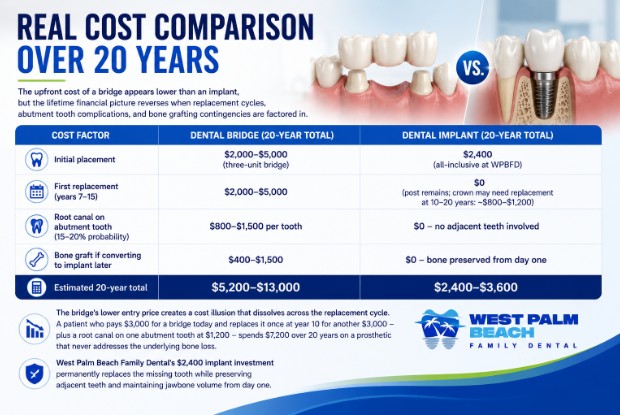
The upfront cost of a bridge appears lower than that of an implant, but the lifetime financial picture reverses when replacement cycles, abutment tooth complications, and bone grafting contingencies are factored in.
| Cost Factor | Dental Bridge (20-Year Total) | Dental Implant (20-Year Total) |
| Initial placement | $2,000–$5,000 (three-unit bridge) | $2,400 (all-inclusive at WPBFD) |
| First replacement (years 7–15) | $2,000–$5,000 | $0 (post remains; crown may need replacement at 10–20 years: ~$800–$1,200) |
| Root canal on abutment tooth (15–20% probability) | $800–$1,500 per tooth | $0 — no adjacent teeth involved |
| Bone graft if converting to implant later | $400–$1,500 | $0 — bone preserved from day one |
| Estimated 20-year total | $5,200–$13,000 | $2,400–$3,600 |
The bridge’s lower entry price creates a cost illusion that dissolves across the replacement cycle.
A patient who pays $3,000 for a bridge today and replaces it once at year 10 for another $3,000 — plus a root canal on one abutment tooth at $1,200 — spends $7,200 over 20 years on a prosthetic that never addresses the underlying bone loss.
West Palm Beach Family Dental’s $2,400 implant investment permanently replaces the missing tooth while preserving adjacent teeth and maintaining jawbone volume from day one.
Financing at $79/month with no credit check makes the one-time implant cost immediately accessible, rather than deferring to a bridge that costs more over its lifetime.
A bridge saves money today and costs more over a lifetime — Dr. Berglass shows you the 20-year math at West Palm Beach Family Dental.
Not every clinical scenario favors an implant over a bridge. Dr. Berglass evaluates each patient’s bone density, systemic health, and the condition of adjacent teeth during the free consultation and presents the option that best serves the patient’s long-term clinical outcome — including a bridge when it is the more appropriate choice.
Patients whose abutment teeth already have large existing restorations — crowns, onlays, or extensive composite fillings — lose less additional tooth structure from bridge preparation than patients with fully intact enamel.
A bridge anchored to teeth that already carry crowns sacrifices no additional healthy enamel, since the preparation for the prior restoration was already completed.
Patients with medical contraindications that prevent implant surgery — uncontrolled diabetes with HbA1c above 7.5%, active intravenous bisphosphonate therapy, or recent radiation to the jaw — may benefit from a bridge as an interim or permanent solution when implant placement carries unacceptable surgical risk.
The American Diabetes Association identifies glycemic control as a primary determinant of surgical healing outcomes in diabetic dental patients.
Patients who require immediate tooth replacement for professional or social reasons and do not qualify for same-day implant placement may choose a bridge as a faster restoration — a three-unit bridge can be fabricated and placed within two to three weeks, while conventional implant timelines span three to six months.
If you’re ready to get started, call us now!
Molars bear the highest occlusal forces in the dental arch — up to 200 pounds per square inch during forceful chewing, according to the U.S. National Library of Medicine biomechanics reference.
Replacing a missing molar with a prosthetic that transmits those forces directly into the jawbone through a titanium post maintains the bone density and structural integrity that a bridge pontic sitting above the bone surface cannot replicate.
The implant post also prevents the adjacent teeth from shifting into the gap — a process called mesial drift that begins within months of molar extraction and accelerates over years.
A bridge physically blocks the drift by spanning the gap, but it does so by loading the abutment teeth with the occlusal forces that the missing molar would have absorbed. An implant absorbs those forces independently through the titanium post, distributing the load into the jawbone rather than onto neighboring teeth.
Dr. Berglass evaluates candidacy for molar replacement using CBCT imaging during the free consultation, measuring the available bone height above the inferior alveolar nerve and the bone width at the molar site.
Posterior molar sites require careful dimensional evaluation because proximity to the nerve canal and sinus floor constrains implant length and angulation more than in anterior positions.
Patients comparing the two options should evaluate five clinical and financial questions that Dr. Berglass reviews during the free consultation, with transparent data for each.
Healthy adjacent teeth with no existing restorations lose the most from bridge preparation. An implant preserves them completely. Patients whose adjacent teeth already have crowns experience less incremental structural sacrifice with a bridge.
An implant is the only tooth replacement that maintains alveolar bone volume through direct stimulation. Patients concerned about long-term facial structure changes, future implant candidacy, or progressive bone loss should prioritize the implant option.
Patients should compare the bridge’s initial cost, plus one to two replacement cycles, plus potential complications involving the abutment tooth, against the implant’s one-time $2,400 investment, plus a possible crown replacement at 10–20 years.
Uncontrolled diabetes, active IV bisphosphonate therapy, and recent jaw radiation are the primary medical contraindications. Dr. Berglass coordinates with each patient’s physician to determine surgical clearance when systemic conditions are present.
Bridges are fabricated in two to three weeks. Conventional implants require three to six months. Patients who qualify for same-day placement close that gap significantly — Dr. Berglass evaluates eligibility for immediate placement at the consultation.
The practice is located at 1840 Forest Hill Blvd., Suite 204, West Palm Beach, FL 33406. Call (561) 968-6022 to schedule a free consultation to compare both options, with transparent pricing and diagnostic imaging.
Replacing one tooth should not mean damaging two more — Dr. Berglass presents every option with real numbers at West Palm Beach Family Dental.
A permanent dental implant is the clinically superior option for most patients replacing a missing molar because the titanium post preserves jawbone volume, absorbs occlusal forces independently, and requires no alteration of adjacent healthy teeth. Dr. Berglass evaluates both options during the free consultation, using diagnostic imaging, and presents transparent pricing — $2,400 all-inclusive for the implant — so patients can decide with complete clinical and financial information.
How long does a dental bridge last compared to an implant?
A dental bridge lasts seven to fifteen years on average before requiring complete replacement of the three-unit prosthetic. A dental implant post lasts 20 or more years with proper maintenance, while the crown portion typically requires replacement after 10 to 20 years — making the implant the longer-lasting restoration overall.
Does a dental bridge stop bone loss at the missing tooth site?
A dental bridge does not stop bone loss because the pontic sits above the gum surface without contacting or stimulating the underlying jawbone. Alveolar bone beneath the pontic resorbs at the same rate as an untreated extraction site. Only an implant-based replacement transmits functional forces into the jaw to maintain bone volume.
How much does a dental bridge cost compared to an implant?
A three-unit bridge typically costs $2,000–$5,000 for initial placement. West Palm Beach Family Dental charges $2,400 for a single-tooth implant, all-inclusive. Over twenty years, bridge replacement cycles and abutment tooth complications push total costs to $5,200–$13,000 versus $2,400–$3,600 for the implant.
Do healthy teeth get damaged during bridge placement?
Bridge placement requires removing one to two millimeters of enamel from both adjacent teeth to create space for anchor crowns — permanently altering healthy structure. Approximately fifteen to twenty percent of bridge abutment teeth require root canal therapy within ten years due to inflammation from crown preparation.
Can I switch from a bridge to an implant later?
Patients can replace a failed bridge with a dental implant, but years of bone resorption beneath the bridge pontic may require bone grafting before implant placement. Grafting adds $400 to $1,500 and 4 to 6 months of healing. Patients who choose an implant initially avoid this complication entirely.
Is a dental implant worth the higher upfront cost?
The implant’s $2,400 cost at West Palm Beach Family Dental is comparable to many bridge quotes when the bridge includes all three units and preparation fees. Over time, the implant costs less because the post remains permanently integrated, whereas bridges require complete replacement every seven to fifteen years.
What happens to adjacent teeth if I choose an implant instead of a bridge?
Adjacent teeth remain completely untouched during implant placement because the titanium post inserts directly into the jawbone at the missing tooth site. No enamel removal, no crown preparation, and no structural alteration occur on any neighboring teeth. The implant functions as a fully independent standalone replacement.
Does insurance cover bridges and implants differently?
Most dental insurance plans cover bridges and implants under major restorative benefits at approximately fifty percent of the allowed amount after the annual deductible. Annual maximums typically cap at between $1,000 and $2,000, regardless of procedure type. West Palm Beach Family Dental files claims for both options on each patient’s behalf.
How do I know if I qualify for an implant instead of a bridge?
Dr. Berglass evaluates implant candidacy during the free consultation, using CBCT imaging to measure bone height, width, and density at the site of the missing tooth. Patients with adequate bone dimensions and manageable systemic health conditions qualify for implant placement. The consultation includes transparent pricing and a side-by-side comparison of both treatment options.
Can a dental implant be placed the same day as an extraction?
Patients who meet bone density and socket integrity thresholds can receive an implant the same day as tooth extraction through the immediate-placement protocol. Dr. Berglass measures insertion torque during the procedure to confirm the implant achieves sufficient primary stability for same-day provisional crown attachment when clinically appropriate.

About Dr. Berglass
Dr. Michael Berglass, a dedicated dentist with over 25 years of experience, specializes in dental implants, cosmetic, and general dentistry in West Palm Beach, Florida. A proud alumnus of Stony Brook School of Dental Medicine (DDS, 1996), Dr. Berglass further honed his expertise with residencies in general practice and dental implants at North Shore-Long Island Jewish Hospital. His journey in dentistry has taken him from New York to North Carolina, and now to Florida, where he continues to offer top-notch dental care. Known for his wit and intellect, Dr. Berglass makes every patient's visit comfortable. Formerly a member of the American Dental Association and the Florida Dental Association, Dr. Berglass remains committed to staying informed about advancements in dentistry and providing exceptional care to his patients. He looks forward to welcoming you to his practice.
About Dr. Cedenos

Dr. Ivan Cedeno is originally from Cuba where he did his dental studies. Having graduated with a DDS diploma gave Ivan and his family great satisfaction, considering he comes from a family of dedicated dental care professionals. After years of practicing Dentistry in Cuba for a few years, Ivan decided to continue his growth journey as a professional in the United States. Early on, Ivan worked as a laboratory technician, which gave him some unique insights that dental school does not teach. Having graduated from the University of Puerto Rico as a DMD, Ivan is allowed to practice in the USA.


