What to Bring to a Dental Second Opinion Appointment
Originally published: May 2026 | Updated: August 2026 | Reviewed by Dr. Michael Berglass, DDS
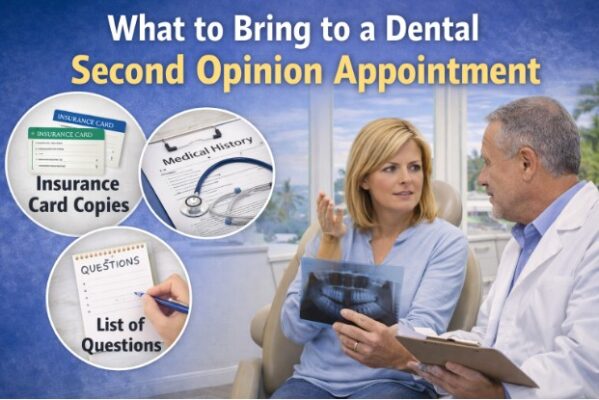
Patients attending a dental second opinion appointment in Boynton Beach, Florida should bring nine items: recent dental X-rays, an itemized written treatment plan with CDT procedure codes, clinical notes from the most recent exam, a dental insurance card and benefits summary, a current medications list, a relevant medical history summary, a written questions list, the first dentist’s contact information, and a government-issued photo ID.
Florida patients own their dental records under HIPAA and Florida Statute 456.057 — any dental office must release X-rays and treatment plan documentation on request.
Arriving with complete documentation transforms a dental second-opinion consultation from a general conversation into a precise, line-by-line clinical review of every proposed procedure.
Key Takeaways
| Item | What to Request | Why It Matters |
| Dental X-rays | Most recent full-mouth series or periapical X-rays — digital preferred | Eliminates duplicate radiation; gives the second dentist baseline imaging for independent review |
| Written treatment plan | Itemized document with procedure names, CDT codes, and costs per item | Allows line-by-line clinical and cost review — a verbal quote is not sufficient |
| Clinical notes | Chart notes from your most recent examination | Provides the second dentist with the clinical observations that informed the original diagnosis |
| Insurance card and benefits summary | Current dental insurance card plus any explanation of benefits documents | Determines what the second consultation and any recommended treatment will cost out of pocket |
| Medications list | Current prescription and over-the-counter medications with dosages | Affects anesthesia options, osseointegration for dental implants, healing timelines, and candidacy for certain procedures |
| Medical history summary | Systemic conditions relevant to dental care — diabetes, heart conditions, blood thinners | Directly affects treatment planning for implants, gum disease, and oral surgery |
| Written questions list | Your own prepared list of concerns before the appointment | Ensures every concern gets addressed — not just the ones recalled under clinical pressure |
| First dentist contact info | Name, phone, and address of your current dental office | Allows the second dentist to request additional records or imaging directly if needed |
| Photo ID | Government-issued ID | Required for new patient intake at most practices |
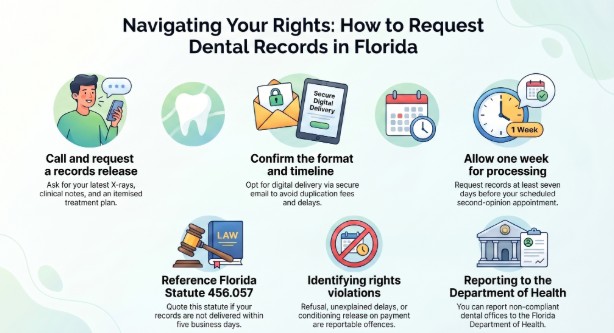
Florida patients hold the legal right to their own dental records under both federal HIPAA regulations and Florida Statute 456.057, which governs patient access to medical and dental records statewide. Requesting records requires one phone call to your current dental office.
Call your current dental office and tell the front desk that you need a records release for a second-opinion consultation. Use this phrasing: “I’d like copies of my most recent X-rays, my treatment plan with itemized procedure codes and costs, and the clinical notes from my last exam.” You do not need to justify the request, name the second dentist, or explain your reasons.
Ask whether digital X-rays are available via secure email or patient portal — the fastest delivery method and typically free of charge. Physical film copies may carry a modest duplication fee. Most Florida dental offices process records within two to five business days.
Request records at least 1 week before your second-opinion appointment to allow adequate processing time.
If records are not delivered within five business days, call again and reference your rights under Florida Statute 456.057.
A dental office that refuses to release records, delays without explanation, or conditions release on a financial commitment is violating patient rights, reportable to the Florida Department of Health.
Dr. Michael Berglass reviews all documentation independently before conducting his own clinical examination — so you arrive prepared and leave with a clear answer. Schedule your free second opinion consultation today.
If you’re ready to get started, call us now!
Most patients arrive at second opinion appointments with a verbal memory of what their first dentist said — “you need three crowns and a root canal” — rather than the actual written treatment plan. A verbal summary is not sufficient for a thorough second opinion review.
The written treatment plan contains CDT procedure codes — standardized five-digit identifiers that specify exactly what each proposed treatment involves.
When a treatment plan states “D2740 — crown, porcelain/ceramic substrate” for three separate teeth, the second dentist reviews that code directly against the clinical evidence. “My dentist said I need three crowns” conveys none of that specificity and leads to a general conversation rather than an independent clinical assessment.
An itemized written plan also enables direct cost comparison. Implant pricing in Palm Beach County varies by 20–40% between providers for the same procedure code.
Without the itemized original plan, the second dentist cannot determine whether the first quote was reasonable, inflated, or missing components your case requires.
Patients considering single tooth implants, All-on-4 reconstruction, or full-mouth dental implants should know that cost differences between providers for identical procedure codes can exceed $3,000 per arch — a gap that a written plan comparison surfaces immediately.
Patients who arrive with a written list of questions leave second-opinion appointments better informed than those who rely on memory.
Under the mild social pressure of a clinical consultation, most people forget half of what they planned to ask. Write your questions before the appointment — and bring the list on paper or your phone.
| Question to Ask | Why It Produces Useful Information |
| Do you agree with this diagnosis based on these X-rays? | Establishes whether the second dentist independently confirms or disputes the original clinical finding |
| Is the proposed treatment the least invasive option? | Surfaces whether less aggressive alternatives exist that the first dentist did not present |
| Are all procedures immediately necessary, or can any be staged? | Identifies which items on the plan are urgent versus precautionary — so you can prioritize and budget accordingly |
| What happens if I monitor this instead of treating it now? | Quantifies the actual clinical risk of delaying, which separates genuine urgency from sales pressure |
| Can you provide an itemized estimate with procedure codes? | Enables direct, code-level cost comparison with the original quote |
| What does my insurance cover for each proposed procedure? | Clarifies the true out-of-pocket cost before any commitment |
| What is your specific experience with this procedure? | Establishes clinical credibility for the second opinion itself |
Patients preparing for an implant-specific second opinion should also review the full list of questions to ask your dentist before getting dental implants — a dedicated resource covering implant candidacy, bone grafting, and treatment timeline questions in full detail.
If you’re ready to get started, call us now!
Organize all documentation into a single folder — physical copies or a device with digital files both work. Arrive five to ten minutes early to complete new-patient intake paperwork without compromising the clinical consultation time.
Confirm your appointment includes a records review, not just a general exam — at Boynton Implant & Cosmetic Dentistry, second opinion consultations always begin with an independent documentation review before any examination begins.
Dr. Michael Berglass, D.D.S. — a dental implant specialist with 25 years of experience and advanced residency training at North Shore–Long Island Jewish Hospital — reviews your existing X-rays and written treatment plan independently before conducting his own clinical examination. Updated imaging is recommended only when existing films are insufficient for a complete assessment. At this practice, necessary X-rays are included in the free second opinion consultation at no additional charge.
The full consultation takes 30 to 60 minutes and concludes with a plain-language explanation of findings — including whether the original plan is clinically appropriate and what alternatives exist.
Patients who receive a confirmed diagnosis and proceed with treatment at Boynton Implant & Cosmetic Dentistry can review the in-office savings plan for cost reduction options and the general dentistry services available alongside implant and restorative treatment.
Verified patient outcomes are documented in the before-and-after gallery.
Dr. Berglass reviews your existing treatment plan and X-rays independently — then tells you exactly what the clinical evidence shows, including whether the original plan is appropriate or whether better options exist for your specific case. Book your free consultation at Boynton Implant & Cosmetic Dentistry today.
Can I use my existing X-rays for a second-opinion appointment?
Yes — Florida patients own their dental X-rays under HIPAA and Florida Statute 456.057, and bringing existing films eliminates duplicate radiation exposure and reduces consultation costs. The full process is covered in the dedicated guide on using your X-rays at a different dentist.
What if my dentist will not give me my X-rays?
No Florida dental office can legally withhold patient X-rays. Florida Statute 456.057 and federal HIPAA regulations require the release of records upon patient request. A practice that refuses is violating patient rights, reportable to the Florida Department of Health.
Do I need my insurance card for a second opinion appointment?
Yes — your insurance card allows the second practice to verify benefits, confirm in-network status, and determine whether the second consultation itself is covered under your plan. PPO dental plans typically cover second opinion consultations — call your carrier before the appointment to confirm coverage.
What if I only have a verbal quote and no written treatment plan?
Call your current dental office and request a written treatment plan with itemized CDT procedure codes before your second opinion appointment. Every dental office must provide written treatment documentation on request — a verbal quote is not a substitute for a formal treatment plan.
How far in advance should I request my records?
Request records at least 1 week before your second-opinion appointment. Florida dental offices typically process records within two to five business days — building in buffer time ensures you arrive with complete documentation rather than having to reschedule.
Should I tell the second dentist what my first dentist recommended?
Telling the second dentist what was recommended is optional — the written treatment plan communicates the clinical specifics more accurately than any verbal account. Bring the documentation and let the second dentist review it independently before adding your own context.
What is the single most important item to bring?
The itemized written treatment plan, including CDT procedure codes, is the most important document. CDT codes give the second dentist a precise, standardized picture of what was proposed, which is what makes an independent clinical review meaningful rather than a general conversation about your dental history.

About Dr. Berglass
Dr. Michael Berglass, a dedicated dentist with over 25 years of experience, specializes in dental implants, cosmetic, and general dentistry in West Palm Beach, Florida. A proud alumnus of Stony Brook School of Dental Medicine (DDS, 1996), Dr. Berglass further honed his expertise with residencies in general practice and dental implants at North Shore-Long Island Jewish Hospital. His journey in dentistry has taken him from New York to North Carolina, and now to Florida, where he continues to offer top-notch dental care. Known for his wit and intellect, Dr. Berglass makes every patient's visit comfortable. Formerly a member of the American Dental Association and the Florida Dental Association, Dr. Berglass remains committed to staying informed about advancements in dentistry and providing exceptional care to his patients. He looks forward to welcoming you to his practice.
About Dr. Cedenos

Dr. Ivan Cedeno is originally from Cuba where he did his dental studies. Having graduated with a DDS diploma gave Ivan and his family great satisfaction, considering he comes from a family of dedicated dental care professionals. After years of practicing Dentistry in Cuba for a few years, Ivan decided to continue his growth journey as a professional in the United States. Early on, Ivan worked as a laboratory technician, which gave him some unique insights that dental school does not teach. Having graduated from the University of Puerto Rico as a DMD, Ivan is allowed to practice in the USA.


